Exploring Top BBA Career Options: Your Gateway to Success

Exploring Top BBA Career Options: Your Gateway to Success

In the fast-paced business world, a Bachelor of Business Administration (BBA) degree stands out as a powerful credential that opens doors to many career opportunities. Whether you aim to climb the corporate ladder, start your venture, or specialise in finance, marketing, or human resources, a BBA provides the essential knowledge and skills to thrive. In this blog, we will discuss the best BBA career options, salary, and the best companies to apply to. Let’s explore!

Introduction to BBA Career Options

BBA is a general, flexible undergraduate degree program with essential business knowledge. It is a field that encompasses elements like management, marketing, finances, human resources, and operations. This is true as the BBA embraces a generalised learning process that prepares graduates for any job market.

If your goal is to be employed with an MNC, want to have your own business, or be part of a government organisation, then BBA can be the perfect stepping stone for you. Now, let us explore some promising job profiles that successful candidates in BBA are likely to enter.

Top 8 BBA Career Options

Top 8 BBA Career Options​

Here is a table summarising the career options, their average salaries in India, and the top companies that hire for these roles: 

Career Option

Salary (India)

Top Companies

Data Scientist

10 lakhs per annum

TCS, Infosys, IBM, Accenture

Digital Marketer

7 lakhs per annum

Google, Facebook, Amazon, Flipkart

Business Analyst

8 lakhs per annum

Deloitte, McKinsey, Accenture, Infosys

Product Manager

10 lakhs per annum

Google, Microsoft, Amazon, Apple

HR Manager

10 lakhs per annum

Tata Consultancy Services, Accenture, Deloitte, Wipro

Advertising Manager

12 lakhs per annum

Ogilvy & Mather, JWT India, McCann Worldgroup, DDB Mudra

Financial Expert

12 lakhs per annum

HDFC Bank, ICICI Bank, SBI, Axis Bank


Note – Average salaries are subject to change based on market conditions and individual qualifications.


1. Data Scientist


In today’s world, data is everywhere. It seems impossible to avoid it, yet it is impossible not to embrace it. The insights derived from such analyses help firms formulate business strategies that enhance the appeal of their offers and satisfy consumers’ needs.

This is where data scientists come into play. Data science is a professional field in which a data scientist collects data and analyses it to make policies, decisions, or strategies.

After getting your BBA degree, you can choose to be a data scientist by learning more about data analysis, with data programming and improving your IT skills in statistics. As the business landscape evolves, BBA career options expand, offering graduates more opportunities to excel.

2. Digital Marketer


The digital marketing industry is evolving very fast. It is a marketing technique that includes selling products and services through technological themes like social media, search engines, and emails.

Marketing is one of the basic areas of a Business Management degree and also a field that offers knowledge regarding marketing strategies, customer psychology, and marketing analysis. This is one of the BBA career options for the future generation.

3. Business Analyst


Business analysts are crucial in helping organisations improve their processes, products, and services. They analyse business needs, identify areas for improvement, and recommend solutions to enhance efficiency and profitability.

When you complete your BBA, you’re ready to understand the business environments you intend to serve, mechanical and organic analysis, and business strategy.

To transition into the business analyst position, some extra education in data analysis, project management, and business intelligence may be necessary. This career opportunity is an excellent opportunity to be involved in different processes and contribute to the organisation’s performance. Business Analyst is the best-known BBA career option nowadays. 

4. Product Manager


Product managers create products and are held accountable for their success/independence. This team collaborates and engages with other functional teams, such as engineering, marketing, and sales departments, to guarantee that products comply with customers’ needs and business objectives. Product managers can also be the best BBA career options for the future generation. 

5. HR Manager


Human resource managers manage human capital, commonly referred to as HR, in carrying out organisational affairs. These include issues of staffing, training employees, maintaining good employee relations, and compensation and benefits.

The larger roles of HR managers comprise making sure that the work environment is congenial and that employees do not experience dissatisfaction.

To obtain this position, one requires knowledge and skills that may be obtained by pursuing a BBA degree with a major in human resources. Further, it is possible to acquire experience by working as an intern or as a holder of an initial position in the field of HR to achieve great performance as a human resources manager.

Human Resources (HR) offers compelling BBA career options, with job profiles such as HR manager and recruitment specialist, focusing on talent management and employee relations

Read More: One-Year Online MBA Program: Eligibility, Fees, and more

6. Advertising Manager


They supervise advertising campaigns for products or services, ensuring customer awareness and demand. They collaborate with creative groups, media planners, and the client to ensure that advertisement campaigns and indexes reach the targeted people.

With a focus on creative and analytical skills, BBA career options like advertising manager and data analyst offer graduates diverse opportunities to thrive in various industries.

Therefore, having a BBA degree emphasising marketing or advertising will enable one to be fit for this position. It’s about consumers’ consumption and utilisation patterns, along with marketing and communication tools.

7. Financial Expert


Financial experts or Advisors are people with expertise in finance who assist people and firms in making sound financial decisions. They interpret business data, evaluate the prospects of an investment, and advise on how to acquire funding to fulfil certain objectives.

With this BBA degree focused on finance, you will develop a solid understanding of financial concepts, financial accounting, and investment analysis. You can pursue further academic credentials, such as CFA or CFP programs.

8. International Business Specialist


In a world experiencing higher degrees of globalisation, it is imperative to have international business specialists to help operating companies expand into other countries.

International business roles are prominent among BBA career options, providing job profiles like international trade specialist and global supply chain manager for those interested in global commerce.

They grasp elements of international business, the import/export of goods and services, and cultural variations, which assist organisation in managing business operations in international markets.

To perform this role, an individual must possess specific fundamental skills and knowledge, which can be obtained from a BBA degree and a focus on international business.

You may also add other skills, such as learning new languages to communicate well with independent or developing countries, experience in international business or trade, or knowledge of global economic trends, that may help as well.

Government Jobs After BBA

In addition to the diverse career options in the private sector, BBA graduates can also explore opportunities in the public sector. Government jobs offer stability, competitive salaries, and various benefits. Here are some government job options for BBA graduates.

Sector

Roles

Salary (Annual)

Banking Sector

Probationary Officer (PO), Clerk

8 Lakhs

Civil Services

IAS, IPS, IRS

10 Lakhs

Public Sector Undertakings (PSUs)

Management Trainee, Assistant Manager

8 Lakhs 

Railways

Station Master, Commercial Apprentice

8 Lakhs 

Defence Services

Officer in the Indian Army, Navy, and Air Force

15 Lakhs 

State Government Jobs

Municipal Officer, State Public Service Commission roles

8 Lakhs 


Note: Average salaries are subject to change based on market conditions and individual qualifications.

Civil Services


In India, the civil services examination, conducted by the Union Public Service Commission (UPSC), is one of the most recognised examinations in the country. Any BBA graduate can take this examination and opt for a brilliant Administrative Service like IAS, IPS, or IFS.

These roles are patriotic, and the candidate must be ready to play a vital role in transforming society. 

Banking Sector


Candidates with a BBA degree can opt for various posts in Indian public sector banks, such as Probationary Officer (PO), Clerk, and Specialist Officer. These jobs require candidates to undertake tests conducted by the Institute of Banking Personnel Selection (IBPS). 

Banking is a good profession because of the numerous employment and training prospects, security, and outstanding benefits.

Public Sector Undertakings (PSUs)


Public Sector Undertakings, otherwise known as PSUs, are government enterprises that offer job openings in different streams for BBA graduates. 

The Bachelor of Business Administration (BBA) holder is, therefore, very marketable and may find opportunities in firms such as Bharat Heavy Electricals Limited (BHEL), Oil and Natural Gas Corporation (ONGC), and Steel Authority of India Limited (SAIL).

Combine your passion for public service with your business knowledge acquired from a BBA degree by exploring the diverse career paths in civil services, one of the many rewarding BBA career options.

The versatility of BBA career options is evident in government roles like tax examiner and customs officer, where graduates can play a crucial role in revenue collection and regulation.

State Government Jobs


They also have the option to work in state government departments for employment after they complete their BBA degree. For any administrative, finance or manager post, there are examinations that each of the States sets for their people. These jobs are many, well-paid, rooted in the community and serve many people.

Read More:- What is the entrance exam for MBA?

Options for Further Study After BBA

Options for Further Study After BBA​
  1. Master of Business Administration (MBA): Offers advanced knowledge in business administration and management, with specializations available in areas like finance, marketing, entrepreneurship, and international business.
  2. Master of Science (MSc) in Business Analytics: Focuses on advanced statistical and analytical techniques for interpreting complex data sets, making graduates highly desirable for data-driven decision-making roles.
  3. Master of Science (MSc) in Marketing: Provides advanced coursework in marketing strategies, digital marketing, market analysis, and consumer psychology, preparing graduates for leadership roles in marketing management and market research.
  4. Master of Human Resource Management (MHRM): Specializes in talent acquisition, employee relations, compensation management, and  organisational development, opening up opportunities for leadership roles in HR departments.
  5. Chartered Financial Analyst (CFA) Program: Ideal for those interested in finance and investment management, covering topics such as investment analysis, portfolio management, and ethics in finance, leading to careers in investment banking, asset management, or financial consulting.

Note – If you’re feeling uncertain about which path to take for further studies after your BBA, check out Hike Education’s website for personalised career guidance. We’re here to assist you every step of the way!

Conclusion

Acquiring a BBA degree is one way of being assured of getting into a fulfilling and successfully positioned employment field. This shows that the possibilities are incredibly diverse regardless of whether you decide to work for a private company, to do government service, or to further your education.

One of the most appealing aspects of a BBA degree is the diverse BBA career options it offers aspiring business professionals.

Moreover, gear yourself with the time to manage your spare time by engaging in activities that you are interested in developing skills in or finding the career you really want.

The key is to stay curious, keep learning, and seize the opportunities that come your way. With a BBA degree, the sky’s the limit!

BBA Career Options : FAQs

Q1. What are the best BBA career options?

The BBA degree, upon completion, opens up a number of vocational prospects in different sectors of the economy, including managerial positions, marketing, financial services, and human resources. Some of the employment opportunities for graduates are in private organisation or sectors, going into business on their own, or seeking a government position.

Q2. Can I pursue higher studies after BBA?

Many BBA graduates further their education to advanced levels, such as Master of Business Administration (MBA), Chartered Accountancy (CA), or other specialised master’s programs.

Q3. What skills are essential for a successful career after BBA?

It is  essential to develop practical communication skills, leadership, problem-solving, analytical thinking, and adaptation abilities to be successful after receiving the BBA degree. It is also possible to gain specialised knowledge in particular fields, including data analysis, online marketing, or projecting financial results.

Q4. Are internships important for BBA graduates?

Internships are a necessity for BBA students because they help them gain hands-on experience and a view of what awaits them in the field by applying the theory learned at school. Internships can also be beneficial in building your resume increasing your chances of getting a job.

Q5. Can I get 1 lakh salary after BBA?

Pay disparities exist in India for individuals who complete a BBA degree. The typical yearly compensation for graduates of business administration programs ranges from INR 1.5 Lakhs to INR 10 Lakhs, contingent on industry, region, experience, and employer standing.

More Information:-

The Ultimate Guide to MBA After 12th: Eligibility, Job Profiles, Exams and Career

MBA Dual Specialization: A Complete Roadmap


    Enter Your Details To Get Counselling From Our Experts

    I consent to be contacted by Hike Education via Call, SMS, Email, or WhatsApp, even if I'm registered on DND/NDNC.


    Business Finance: Definition, Importance, Types and More

    Business Finance: Definition, Importance, Types and More

    Hey there! Have you ever wondered how businesses manage all the money stuff? It’s like being the boss of your piggy bank but on a much bigger scale. Welcome to the world of business finance! Don’t worry if you still need to become a money whiz; we’re here to break it down for you in the easiest way possible. It is all about handling the dough (not the pizza kind, though that’s important, too).

    Business finance is the secret sauce behind every successful company, from starting a business to running smoothly and making it grow big and strong.

    So, grab a comfy seat and get ready to dive into the exciting business world. We promise it’s going to be a journey worth taking!

    What is Business Finance?

    It is the practice of financing a business. Like any other person, organisations also require managing money, though it could be on a large or small scale, depending on the type of business involved.

    It is the management of funds for businesses, including how to raise funds and the proper utilisation, allocation, and control of such funds.

    Business finance refers to the management and regulation of financial resources in a business to ensure the proper functioning of its business processes, the determination of funds required for specific activities, the accumulation of funds, and their allocation.

    Importance of Business Finance

    While you have an idea of what business financing is, let’s get to know more about its importance:

    Category

    Description

    Starting a Business

    Startup funds are essential for buying equipment, leasing a location, and compensating employees at the initial stage of launching a business.

    Running Day-to-Day Operations

    Businessmen and businesswomen require capital to operate their businesses. This includes paying bills, purchasing business-related items, and paying employees’ wages.

    Growth and Expansion

    Growing businesses require more money to expand, open outlets, purchase machinery, or employ staff. Funds are crucial for a business’s financial needs.

    Unexpected Expenses

    Extra cash may be needed for equipment failure or business losses. Sufficient funds are a buffer against unexpected expenses, ensuring the business is hardly affected by surprises.

    Long-Term Success

    Organising the funding process is crucial for sustainable success. This includes developing long-term business strategies, securing its wealth, and averting future dangers.

    Types of Business Finance

    Types of Business Finance

    It is worth noting that various finances exist for business organisations. Being familiar with these types assists a business in choosing which type suits its needs.

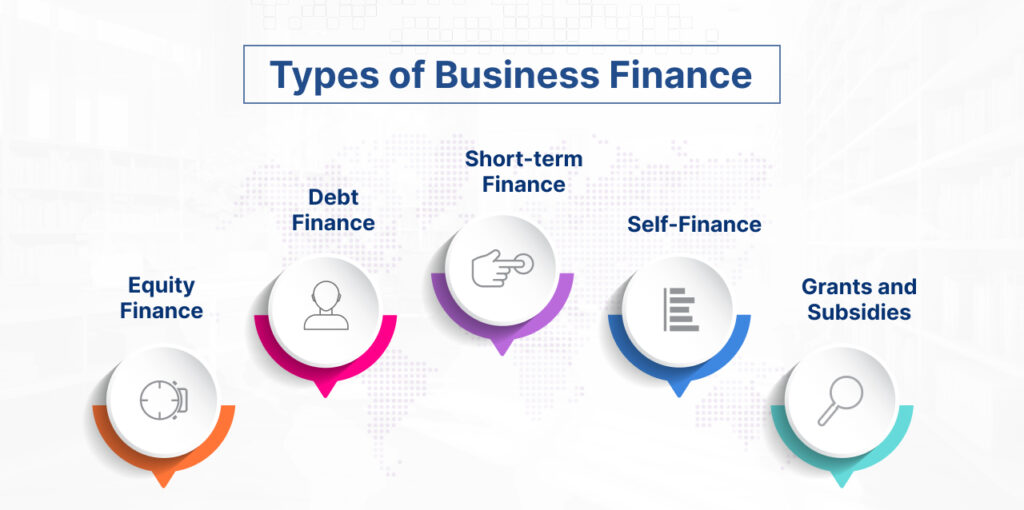
    1. Equity Finance: Refers to a process by which firms raise funds by selling ownership stakes in their businesses.Share purchasers are given a stake in the business; thus, share ownership means having a stake in it. Such finance does not come with repayment expectations; however, it implies an element of loss business controls.
    2. Debt Finance: This is another method where a business gets money by providing banking facilities. The business gets cash by agreeing to pay back a certain amount of cash plus interest. This may be in the form of bank loans, bonds, or other financial institutions. 
    3. Self-Finance: Self-finance, also known as bootstrapping, is a process whereby a business’s operations are funded through the owner’s profit. This profit can be cash reserves, borrowing from friends or family, or operating profits.Self-finance means that no external financier or creditor can ask for collateral in return for funding, and the owner must not surrender ownership of the business; however, this may limit the amount of capital available to support expansion.
    4. Grants and Subsidies: Now and then, you get some funds from the government or other sources, which you have to repay in the future. They are often awarded for a particular project, be it a research project, product development project, or community project.
    5. Crowdfunding: A company occasionally gathers small funds from many people, generally from the internet. This idea of fundraising may occur when the organisation is unwilling to take a payday loan or sell ownership stakes.

    Sources of Business Finance

    Sources of Business Finance​

    Now, let’s look at where businesses can get this money from:

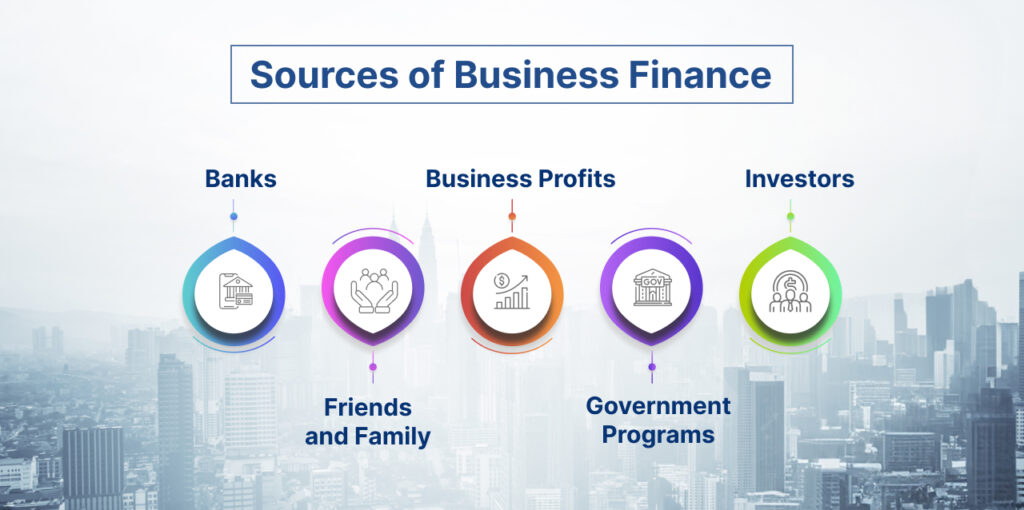
    1. Banks: Banks are one of the standby sources of business funding. They provide credit facilities such as loans, lines of credit, and any other form of financial accommodation that a business can use to manage its funds.

    However, funding availability normally depends on the bank’s credit status and feasible business plan, among other factors.

    2. Investors: Some of the sources of finance that investors provide include equity finance. These can be individuals funding the venture individually (like angel funding) or organisations that fund the venture (like venture capital funding firms).

    Businessmen unlock capital funds, to which investors contribute their cash, wanting to own stakes and a proportion of the profits.

    3. Government Programs: Most governments have introduced various schemes that will assist financial aid companies in funding their businesses.

    This may involve grants, loans, and subsidies. Such programs are usually targeted at particular types of undertakings or categories of beneficiaries.

    4. Business Profits: The business can use profit to carry out the work and expand its operations. This is preferred in many cases because it requires no borrowing and does not entail selling off equity.

    5. Friends and Family: There are opportunities to attract funds from friends and relatives at certain times. This can work well for small businesses or businesses with a recent start, but it is crucial to understand responsibilities, especially when they do not involve employment.

    Important Concepts

    1. Cash Flow Management: Cash flow is the money circulating in and out of the business. Proper cash flow management is vital to ensuring the adequate financing of business requirements, payments, and possible investments.

    It is still imperative to state that capital management, particularly cash flow, can cause financial issues if a business is profitable. 

    2. Financial Planning and Forecasting: Saving, on the other hand, involves identifying what we want to achieve financially and how we will achieve it. Financial planning, therefore, integrates definite objectives to be financially met with blueprints of how those objectives are to be met.

    3. Budgeting: It is also essential to prepare a budget strategy and adhere to it when it comes to spending so that the business does not overemphasise expenditures.

    A budget aids the organisation by helping to plan and allocate the resources needed by the business and constrain undesirable expenditures. Budgeting forms a core element of business finance and ensures that the finances are on track.

    4. Financial Statements: Knowing the meaning of revenue and expense statements, assets and liabilities, and cash receipts and payments is important for business financing.

    These genuine business papers show how a business organisation is doing in its operations and finances. Interpreting these statements is crucial in formulating various financial strategies within business organisations.

    5. Investment Analysis: Since it involves managing money for a business, the selection of an investment also presents a critical issue.

    In this particular analysis, information about an investment and possible investment opportunities is assessed to evaluate its profitability and risk. This assists in developing scaling up in the right financial manner to meet their goals and objectives.

    Conclusion

    Business finance is essential for any business, big or small. It helps businesses start, operate, grow, and succeed. By understanding the different types and sources of financing a business. It can make better financial decisions and ensure their long-term success.

    Business Finance: FAQs

    Q1. What is business finance?

    It refers to the department responsible for the overall control and management of funds and other financial processes in a business. This entails managing funds, including planning, controlling, saving, and future resource allocation, a.k.a. investing

    Q2. Why is business finance important?

    The concept of finance is essential as it aids businesses in many stages—from the establishment, running day-to-day operations, expansion, contingencies, or general growth and management for the best long-run results.

    Q3. What are the types of business finance?

    Some major types of finance are equity financiers, debt financiers, self-financers, grants/subsidies, and crowdfunding.

    Q4. Where can businesses get finance from?

    Business sources of finance include the availability of finance from banks, the sale of stock, government grants and loans, and profits from other businesses, friends, and families.

    Q5. What is the difference between equity finance and debt finance?

    Equity finance involves selling shares in a company, with the money gotten in return being used to finance the investment, while debt finance entails borrowing money, which has to be paid back with an additional cost known as interest.

      Enter Your Details To Get Counselling From Our Experts


      Our Programs

      Best MBA Project Ideas: Complete Guide

      Best MBA Project Ideas: Complete Guide

      Almost there, future business titan! You’ve crushed classes, aced presentations, and perfected the art of the all-nighter (we feel you). Now, it’s crunch time – the MBA project. But don’t let it turn into a stress monster! With the number of MBA project ideas available online in shops increasing daily, an individual can be overwhelmed when searching for the best fit. Fear not, aspiring MBAs!

      This guide will provide the best ideas and motivation to design a project aligned with program objectives. It sets you on the path toward professional and personal fulfilment.

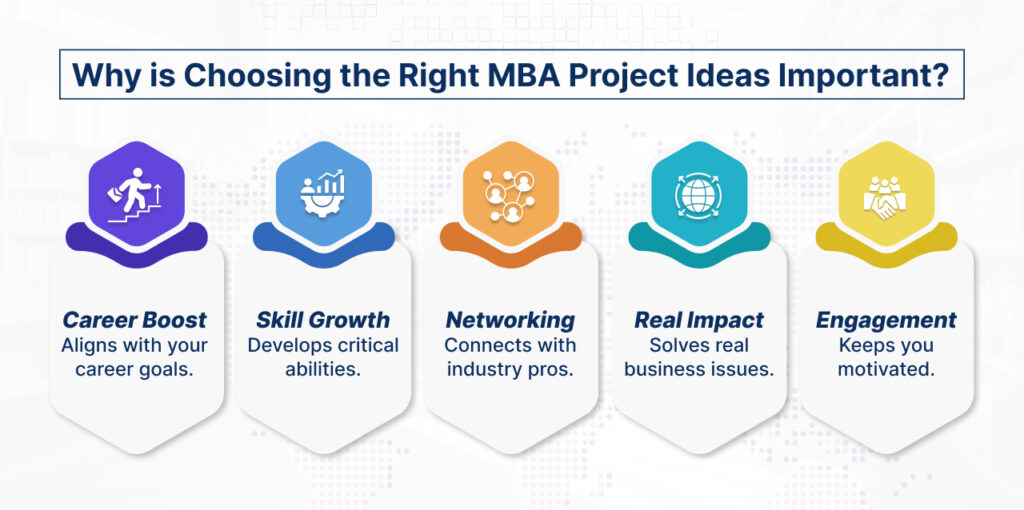
      Why Is Choosing the Right MBA Project Ideas Important?

      Here’s a concise explanation of why choosing the right MBA project is essential:
      Benefit Description
      Skill Development Enhances practical and managerial skills.
      Career Growth Improves job prospects and promotion opportunities.
      Networking Connects with industry professionals and potential employers.
      Industry Insight Provides deep understanding of specific industries.
      Practical Experience Applies theoretical knowledge to real business problems.
      Innovation Encourages creative problem-solving.
      Personal Satisfaction Boosts confidence and sense of achievement.
      Employer Value Demonstrates expertise and initiative to employers.
      Academic Excellence Enhances academic record with impactful projects.
      Future Opportunities Opens doors for future projects and professional development.

      Top MBA Project Ideas Across Specialisation

      Top MBA Project Ideas Across Specialisation​

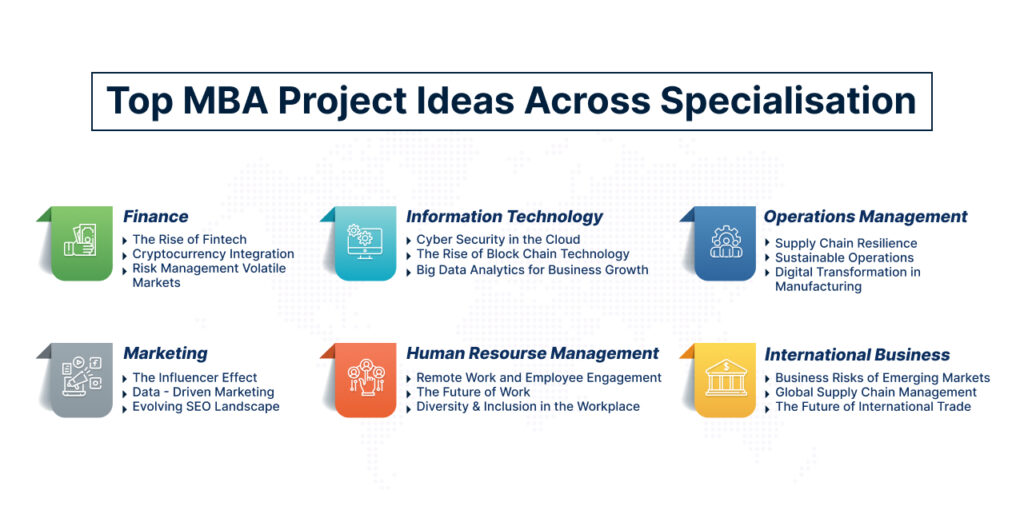
      MBA projects are distinct in that they can be readily altered to accommodate shifting circumstances, much like snowflakes. Here are some top MBA project ideas that you should know before starting your project : 

      1. Finance:


      The Rise of Fintech: Examine how FinTech has influenced and disrupted the traditional financial service sector. See how players disrupt various spaces, including payments, wealth management, and lending. Think about the lack of qualitative research and the subsequent implications for expanded access to financial services. This is a timely MBA project idea that explores a rapidly evolving field.

      Cryptocurrency Integration: Evaluate the two papers and the possibility of using cryptocurrency in investment decisions. Sensitise the risks and opportunities inherent in the asset class and recommend solutions for adequately integrating it into the portfolio.

      Risk Management in Volatile Markets: Utilize the risk management principles to manage this new sphere for interacting with market conditions. It could involve assessing the appropriateness of stress testing approaches, portfolio diversification methods and hedge programmes.

      Refrain from settling for generic MBA project ideas. Find a project that excites you and showcases your unique skills.

      2. Marketing:


      The Influencer Effect: Explore the effects of social media influence on the purchase process. This refers to engaging different categories of influencers, their reach to different audiences, and various ethical implications of the partnerships.

      Data-Driven Marketing: The topic is the use of Artificial Intelligence in the localisation of marketing campaigns. Insight into how the technology of AI can be used in delivering messages, product recommendations and preferences of each customer.

      Evolving SEO Landscape: Review the dynamic character of SEO activities since it is an essential and ever-evolving field.

      Because Google’s algorithms are a major factor in deciding how visible websites are, it is important to discuss the implications of these changes and the most effective strategies to deal with them.

      3. Operations Management:


      Supply Chain Resilience: Develop strategies for building resilience into supply chains in an era of global disruption. This could include diversification of suppliers, near-shoring initiatives, and investment in logistics technology.

      Digital Transformation in Manufacturing: Describe the various strategic manufacturing issues that may be affected by digital technologies such as robotics and automation in manufacturing. Explain to what extent new approaches to management, organisation, and work will directly impact the overall efficiency, workers’ productivity, and the quality of products.

      Sustainable Operations: Introducing the concept of a Sustainable Business Operations System to guide practice within an organisation. This might refer to reduced waste management practices, using energy conservation methods, and procuring materials in the best way possible.

      4. Human Resource Management:


      Remote Work & Employee Engagement: Examine how remote work affects personnel engagement and performance. Establish appropriate approaches for the organisation to adopt when creating a conducive environment for employees working remotely, communicating with them, and encouraging teamwork.

      Diversity & Inclusion in the Workplace: Analyze best practices for creating a diverse and inclusive workplace environment. Explore strategies for attracting and retaining talent from diverse backgrounds and promoting an atmosphere of respect and inclusion.

      The Future of Work: Future developments in the labour market, including trends such as automation processes and the gig economy, should also be investigated.

      As part of the analysis, job roles that may be affected by the implementation of emerging technology applications should be discussed critically, as should the relevant skill sets required for workforce development strategies.

      5. Information Technology:


      Cybersecurity in the Cloud: Develop a framework for secure cloud computing practices. This could include data encryption strategies, access control mechanisms, and disaster recovery plans.

      The Rise of Blockchain Technology: Analyze the potential applications of blockchain technology in various industries. Explore its use cases in areas like supply chain management, secure financial transactions, and data provenance.

      Big Data Analytics for Business Growth: The important next step is to establish the guidelines for using big data analytics for this purpose. This could include methods of data collection, methods of data presentation or visualisation, as well as usage of data in decision processes.

      6. International Business:


      Business Risks of Emerging Markets: Analyze the opportunities and challenges associated with doing business in emerging markets. Consider factors like political instability, currency fluctuations, and infrastructure development.

      Global Supply Chain Management: Formulate practical approaches to address logistical global supply chain requirements. This could include economic interconnecting policies such as trade, commerce, movement of people, products, services, and social factors.

      The Future of International Trade: Examine the potential impact of technological advancements and geopolitical shifts on international trade.  Examine how these  factors shape the global market . 

      Best Innovative Product Ideas for MBA Students

      Although the concept of conventional projects is decent, it’s high time you uncork the emerging entrepreneur within you, so here it comes.

      Product Idea Focus Tools/Technologies
      Smart Home Energy Systems Optimising Home Energy Usage IoT, Smart Sensors
      AI-driven Personal Finance Apps Financial Management AI, Mobile Apps
      Eco-friendly Packaging Sustainable Packaging Biodegradable Materials

      Let’s explore some innovative product ideas that leverage current trends and have the potential to disrupt the market:

      1. The Sustainable Shopping Assistant: Organise an app for consumers to make them informed and sensitive to environmental impacts. It is proposed that valuable features such as product life cycle assessments, carbon footprint comparison, and product origin be implemented to assist in proper purchasing.

        Remember, a well-chosen and executed MBA project idea can be a launchpad for your career. So, get ready to dive in and showcase your business prowess!

      2. The AI-Powered Mental Wellness Coach: Design an intelligent conversational agent app that will kindly offer a helping hand to those in need of mental healthcare services. This will require integrating features such as mood tracking, guided meditation features, links to mental health resources, and increased focus on solutions for well-being.

      3. The Hyper-Personalized Learning Platform: Propose an application that horizontally integrates technology solutions, allowing educators and learners to choose content and delivery modalities that align with their learning style and objectives.

        Introduce an artificial intelligence engine for improved review and analysis of student performance, and suggest an appropriate learning journey map suited to the dynamic market needs in the education sector.

      4. The Immersive Travel Experience App: Create an application that is not just an application to use variants of a travel guide. One should include aspects like the possibility of overlaying historical sightseeing sites with AR, virtual tours, and real-time translation services as a break from the traditional travel activity experience.

      5. The Smart Home Security System (Elderly Care Focus): Design a smart home security system specifically designed for elderly care. Integrate features like fall detection, medication reminders, and emergency contact buttons, providing peace of mind for families and promoting independent living for seniors.

      Tips to Choose the Right MBA Project Idea

      Picking a great MBA project idea is easy! Here’s how:

      1. Pick something you like & want to learn more about. This will keep you motivated.
      2. Make sure you can find info on it. No point in picking a topic with no research available.
      3. Focus on solving real business problems. Show you can use MBA skills in the real world.
      4. Try a new twist on an old idea. Can you look at it from a different angle?
      5. Talk to your teachers! They can help you pick a good topic and avoid issues.
      6. Keep it manageable. Don’t pick a giant project you can’t finish on time.

      Conclusion

      MBA project ideas selection is as much an investment in oneself as choosing the right program. Connecting your project with your interests and finding a place in the existing business environment creates favourable conditions for success.

      Bear in mind that while a solid academic grounding is essential for designing a good project, it is equally vital that the chosen idea stimulates your passion and demonstrates your ability to reason independently and creatively to the assessors. Thus, feel free to start from the ground and work on your chosen topic; make your project a starting point for your career.

      Best MBA Project Ideas : FAQs

      Q1. How long should my MBA project be?

      This depends on the kind of program you are pursuing. On average, students’ projects are 2000-4000 words or about 20-40 pages.

      Q2. Can I work on a project with a team?

      It is common practice to form groups for the assignment, but it is advisable to consult your program guidelines for special instructions.

      Q3. Is there external data available for my project?

      Several government and industry institutions offer open access to data, often free to download. Libraries may also be important in the given context.

      Q4. How can I showcase my project beyond the classroom?

      It is also advised to participate in various competitions or contribute to publishing articles in relevant publications online.

      Q5. What happens after I complete my project?

      Launching a project successfully is a ladder to the top of your career. Include it in interviews or simply use it to pave the way to getting freelance consulting jobs.

        Enter Your Details To Get Counselling From Our Experts


        Our Programs

        Equity Principle of Management: Importance, Advantages and More

        Equity Principle of Management: Importance, Advantages and More

        Employees, valuable assets of any organisation, are the driving force behind the Equity Principle of Management (EPM). This principle, pioneered by the father of management, Henry Fayol, advocates for a work environment free from inequity and biases, placing the utmost importance on every individual’s unique contribution. 

        In this article, we will learn about the scope, advantages, and more about EPM to understand its core aspects.

        What is the Equity Principle of Management?

        In Management, the principle of equity states that all employees should be treated equally and fairly. Henry Fayol believed that within the organisation, all employees should be given equal emphasis in terms of gender, caste, colour, position, religion, etc.

        The fundamental principles of equity include the following:

        1. Fairness- Ensures that no one should fall behind or be favoured in one group of circles.
        2. Transparency- Information should be accessible to all the stakeholders.
        3. Inclusiveness- Presenting the decision-making process to diverse groups.
        4. Accountability- Holding the responsibility of the group and individuals for their actions.

        Before discussing Equity further, let’s discuss the other equally important principles. 

        Henry Fayol's 14 Principles of Management

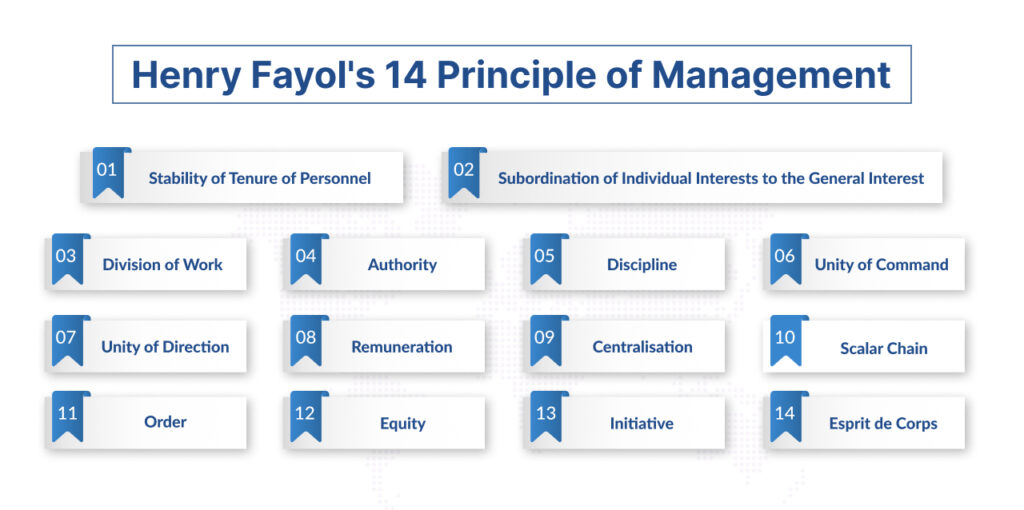
        In an organisation, the management principle helps the managers to get the best from employees and run a smooth culture within the industry. Here are the detailed principles to follow:

        Principle of Management 

        Descriptions

        Division of Work 

        • Splitting the work among teammates to maintain work efficiency and assign each person to a task they are good at.

        Authority

        • Managers have the right to give commands to their employees and expect to follow them, but they should maintain responsibility for their actions.

        Discipline

        • An organisation should run on discipline, which keeps the company reputed. 
        • Employees should follow the company’s rules and regulations to foster leadership and growth.

        Unity of Command

        • In an organisation, there should be only one person whose command you need to follow, whether it be the Team lead, Manager, CEO, etc. 

        Unity of Direction

        • A team with the same objective should be managed under one person using similar pain.

        Subordination of Individual Interests to the General Interest

        • The team’s interest should come before the interests of the single employee.

        Remuneration

        • Employees should be paid fairly for their distinctive job roles and responsibilities.

        Centralisation

        • It states that the power of decision-making is centralised at the top and is considered necessary.  

        Scalar Chain

        • It reflects a communication chain between employers and their superiors, defining their position in the organisational hierarchy. 

        Order

        • It states that everything in the organisation should be in the right place at the right time.

        Equity

        • There should be fairness between employers and managers to maintain loyalty and team-building.

        Stability of Tenure of Personnel

        • Working longer benefits in gaining work experience, which develops efficient skills and knowledge.

        Initiative

        • It states that employees should develop different ideas to implement progress in their work. 
        • This emphasises innovation and enthusiasm in their work responsibilities 

        Esprit de Corps

        • Teamwork is welcomed within the organisation to build a healthy and friendly workplace.

        What is the Importance of the Equity Principle of Management?

        In the work culture, everyone craves fairness and equality, and the principle of equity champions these values. It fosters a positive organisational environment, promoting transparency and employee well-being. A healthy work environment enhances productivity and employee satisfaction, ensuring a harmonious work atmosphere where all decisions are driven by equality. 

        Let’s learn the features of the principle of equity:

        1. Strong Trust– To have a healthy workplace, one must be transparent with stakeholders and promote fairness and equity.
        2. Enhanced Decision-Making– A diverse perspective is needed to make profound and insightful decisions that benefit the company.
        3. Risk Reduction– Limiting the risk of legal issues will adhere to equitable practices.
        4. High Productivity– Ensures all employees are highly motivated to provide their best work, emphasising increased productivity.

        Advantages of Fayol’s Principle of Equity

        Advantages of Fayol’s Principle of Equity​

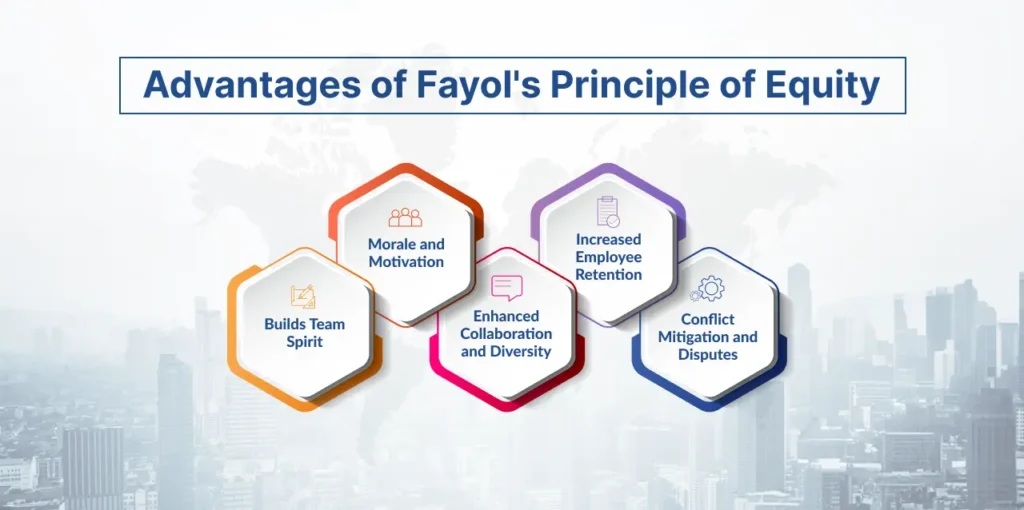
        The principle of equity in management promotes fairness and justice within the company, significantly changing the work environment. Here are the compelling advantages of the principle of equity to consider:

        1. Builds Team Spirit– If the company is friendly, healthy, nonjudgmental, and empowers you to grow, team spirit usually builds up with its positive surroundings. It becomes easy for the teammates to achieve the organisational goals that bring stability and successful growth.
        2. Enhanced Collaboration and Diversity– The equity principle of management brings various perspectives from different employees where ideas are valued and voices are heard. When an organisation understands your point of view, it leads to innovation, collaboration, and problem-solving
        3. Increased Employee Retention– Employees who feel appreciated and are treated fairly are less likely to seek employment elsewhere. When an organisation builds equity, it increases their desire to stay loyal to the company.
        4. Morale and Motivation– A defined equity principle of management creates a fair workplace, boosts employees’ morale, enhances work motivation, and creates a healthy and friendly environment. 
        5. Conflict Mitigation and Disputes– Justice in the decision-making process limits organisational conflicts and disputes. Employees are mature enough to avoid negative behaviours like favouritism, discrimination, or resentment to create a team spirit organisation.

        Conclusion

        The equity principle of management fosters a healthy environment within the organisation through a strategic approach which implements a productive and thriving work culture. The organisation’s goal is to maintain an equal standard of team building, which leads to outstanding achievement by building a solid foundation and guaranteeing fairness, justice, and respect to all employees.

        Equity Principle of Management: FAQs

        Q1. What is the Principle of Equity?

        Equity is defined as fairness to all employees regarding respect, work opportunities, etc., to establish teamwork within the company.

        Q2. Why is the Principle of Equity important?

        A workplace requires EPM to ensure equal opportunities for all employees. This principle provides the same chance of applying for a position, participating in team projects, and accessing professional development within the company’s surroundings.

        Q3. How is the Equity Principle of Management implemented in an organisation?

        In an organisation, EPM is implemented by defining objectives, enhancing stakeholder engagement, developing policies, and allocating resources to monitor effectiveness.

        Q4. Can equity impact an employer's performance?

        Indeed, when an employee is treated fairly and respectfully, the performance is impacted hugely.

        Q5. How can managers exercise equity?

        Managers had to be fair to all employees, reflecting teamwork and enhanced organisational productivity.

          Enter Your Details To Get Counselling From Our Experts


          Our Programs

          CAT Exam Syllabus for MBA: A Detailed Guide

          CAT Exam Syllabus for MBA: A Detailed Guide

          Are you aspiring to an MBA from top Indian institutes like the IIMs? The CAT exam is your ticket to success! This exam is one of the most important, and our detailed guide breaks down the CAT exam syllabus for MBA. The exam is divided into: Verbal Ability and Reading Comprehension (VARC), Data Interpretation and Logical Reasoning (DILR), and Quantitative Ability (QA). Mastering these areas is very important to clear the exam. 

          This blog will clear up all your confusion about understanding the CAT exam syllabus, pattern, eligibility, and more. Craft a winning study plan and boost your confidence for this highly competitive exam!

          Understanding the CAT Exam

          The Common Admission Test, or CAT, is one of the most critical management entrance tests used to select candidates for the Master of Business Administration or MBA courses in India. It is another nationwide MBA entrance examination organised by one of the IIMs annually and can also be considered among India’s most popular and competitive exams.

          It is crucial to learn and understand all the aspects of the CAT exam syllabus for an MBA to have a smooth preparation phase and a bright chance of succeeding in the exam phase.

          It covers different marketing areas, such as market research, social psychology, branding management, advertising campaigns, digital marketing, and strategic marketing management. Students are instructed on developing and using intelligent marketing approaches that involve attracting, keeping, and increasing brands and company profits.

          Exam Pattern for the CAT Syllabus

          Here is the overview of the exam pattern for the CAT exam syllabus:
          Aspect Details
          Number of Questions 100 questions, distributed equally between three parts
          Timing 60 minutes per section, a total of 180 minutes (3 hours)
          Question Types MCQs and non-MCQs
          MCQ Scoring Correct Answer : 3 Marks Each  Incorrect Answer: 1 Mark for Each
          Non-MCQ Scoring No penalties for incorrect answers; students type in their answers
          Scoring System Based on both positive and negative marks, positive marks are awarded according to proficiency level.

          Understanding the CAT Exam Syllabus for MBA

          The CAT exam syllabus is divided into three main sections:

          1. Verbal Ability and Reading Comprehension (VARC)
          2. Data Interpretation and Logical Reasoning (DILR)
          3. Quantitative Ability (QA)

          These sections test different skills and knowledge areas. Each section is equally important. Therefore, it is crucial to thoroughly study each part of the CAT exam syllabus for MBA.

          1. Verbal Ability and Reading Comprehension (VARC)


          This section tests your English language skills. This part of the CAT exam syllabus for the MBA includes questions on grammar, vocabulary, and reading comprehension. The goal is to assess your ability to understand and use English effectively.

          Topics Covered in VARC:

          1. Reading Comprehension: Passages followed by questions.
          2. Grammar: Sentence Correction and Usage.
          3. Vocabulary: Synonyms, Antonyms, Word Usage.
          4. Verbal Reasoning: Paragraph completion, Para-Jumbles.
          •  

          2. Data Interpretation and Logical Reasoning (DILR)


          This section comprises questions that can be answered by logically analysing and organising the information. Some questions test your ability to read information and data and interpret questions logically. This part of the CAT exam syllabus for MBA can be challenging, so practising regularly is essential.

          Topics Covered in QA:

          1. Arithmetic: Percentages, ratios, simple and compound interest.
          2. Algebra: Equations, functions, progressions.
          3. Geometry: Lines, angles, triangles, circles.
          4. Number System: Whole numbers, integers, fractions.
          5. Modern Math: Probability, permutations, combinations.
          •  

          3. Quantitative Ability (QA)


          The QA section is the mathematical section designed to check your level of mathematical proficiency. It consists of questions under arithmetic, algebra, and geometry categories or sections. 

          This part of the CAT exam syllabus for MBA is essential because it assesses your problem-solving skills by applying numbers and equations and offers time management skills.

          Topics Covered in QA:

          1. Arithmetic: Percentages, ratios, simple and compound interest.
          2. Algebra: Equations, functions, progressions.
          3. Geometry: Lines, angles, triangles, circles.
          4. Number System: Whole numbers, integers, fractions.
          5. Modern Math: Probability, permutations, combinations.

          CAT Exam Syllabus for MBA

          To make it easier to understand, here is a detailed table summarising the CAT exam syllabus.
          Section Topics Description
          VARC Reading Comprehension Passages with questions
          Grammar Sentence correction, usage
          Vocabulary Synonyms, antonyms, word usage
          Verbal Reasoning Paragraph completion, para-jumbles
          DILR Data Interpretation Charts, graphs, tables
          Logical Reasoning Puzzles, seating arrangements, blood relations
          Data Sufficiency Analysing data sufficiency
          QA Arithmetic Percentages, ratios, interest calculations
          Algebra Equations, functions, progressions
          Geometry Lines, angles, triangles, circles
          Number System Whole numbers, integers, fractions
          Modern Math Probability, permutations, combinations

          Eligibility for the CAT Exam

          Eligibility for the CAT Exam

          To be eligible for the CAT exam, candidates must meet the given criteria:

          Educational Qualification: The bare minimum qualification to apply for the CAT is a bachelor’s degree with at least 50% marks, or equivalent CGPA obtained (45% for SC, ST, and PWD categories).

          Age Limit: The CAT exam is open to anyone, irrespective of age, without a maximum age limit.

          Final Year Students: They can appear for CAT if they are in the final year of their Bachelor’s degree or equivalent examination or have completed their Bachelor’s degree and are awaiting their results.

          CAT Exam Month: Key Details

          It is a standardised test taken once a year by students anticipating admission into a top B- school like IIM. It is usually held in the last week of November. The final date to write the CAT is explicitly announced by the conducting IIM, usually in August or September. Thus, one should occasionally read the information on the official CAT website to get all the essential information.

          With the end of the academic year approaching, many candidates look forward to the CAT exam.

          To some learners, the syllabus applied in the CAT MBA online exam is well understood. As the proverb ‘fail to prepare; prepare to fail’ goes, preparation is essential in activities to be undertaken in the future.

          Pro Tips to Prepare for the CAT Exam

          Pro Tips to Prepare for the CAT Exam
          1. Create a Study Plan: In the exam,  you need to spread your time as 50 % for section one, 25% for section two, and 25% for section three—timely and judicious time distribution in each aspect of the CAT exam syllabus needed for an MBA.
          2. Practice Regularly: DILR and QA require extensive practice since practising makes it easier to handle them under any circumstance. The easiest way to do this is to start with a sample paper from that respective syllabus and visit the previous year’s question papers.
          3. Improve Your Vocabulary: To improve your English language skills and ability to understand written English, try to read as many books, newspapers, and articles as possible. This will assist you in the Logical Reasoning section and also in the VARC section.
          4. Take Mock Tests: Mock tests certainly have their benefits, the most important of which stems from the fact that they accustom you to the exam format, making it easier to organise your time and effort when solving problems.
          5. Focus on Weak Areas: The third thing to do is know which specific skills/subjects/activities you are not good at, then practice those particular things. Dedicate more time to concepts or lessons you intentionally or unintentionally left behind while endeavouring to cover as much ground as possible in a limited time.
          6. Time Management: Therefore, preparation time must be well managed to effectively cover the syllabus that the MBA CAT exam will cover. Every section has a time allocation, so emulate how to handle the set time well.

          Resources for Preparation

          There are many resources available to help you prepare for the CAT exam syllabus for MBA:

          1. Books: Some books are available in the market that include the syllabus of the MBA CAT exam. One of them are “Quantum Leap for CAT—A Guide to Tackle Any Quantitative Aptitude for CAT” and “Word Power Made Easy” by Norman Lewis.
          2. Online Courses: Numerous Websites and blogs provide online classes and self-study resources that cover the syllabi required to take CAT for MBA.
          3. Coaching Centers: If you would like to be in a class, many coaching centres provide courses for preparation.

          Conclusion

          With the help of the above-mentioned aspects, one can plan and complete the CAT exam syllabus for MBA. So, it is always important to remember that no examination is impossible, and preparing for any competitive exam requires an equal amount of consistent and determined effort. An MBA aspirant has to go through the syllabus for the CAT exam and thus revise each section, practising a lot. 

          Hike Education wishes all the MBA aspirants the best of luck for the exam. 

          The two specialisations you can choose from should be related to your interests, talents, and future job dreams. By crafting advertising campaigns and brand strategies, you can promote behavioural change among consumers or opt to be in the world of numbers and finance(s) and, in turn, create a successful career.

          CAT Exam Syllabus for MBA : FAQs

          Q1. What are the main sections of the CAT exam syllabus for an MBA?

          The CAT exam syllabus for MBA includes three main sections: Verbal and Reading Comprehension (VARC), Data Interpretation and Logical Analysis (DILR) and Mathematical skills (Quant)

          Q2. How can I improve my performance in the VARC section?

          The following tips will help improve your VARC score: Read books, newspapers, and articles as often as possible to build your vocabulary and comprehension. Practising your grammar skills and verbal reasoning part of the exam is also essential

          Q3. What topics are covered under Quantitative Ability in the CAT exam syllabus for an MBA?

          The subject generally covers areas like arithmetic skills, algebra, geometry and measurement, number systems, and modern math, which includes probability, permutations, and combinations.

          Q4. Are mock tests necessary for CAT exam preparation?

          Yes, mock tests are critical because they familiarise you with the actual exam, including the setting and how to organise your time and discover your strengths and weaknesses.

          Q5. What resources can help me prepare for the CAT exam syllabus for an MBA?

          Books, online courses, coaching centres, and practice papers can be very helpful in preparing for the MBA CAT exam. So many books are available today that it can be challenging to pick the right one to practice with.

          Some popular books are “How to Prepare for Quantitative Aptitude for CAT” by Arun Sharma and “Word Power Made Easy” by Norman Lewis

            Enter Your Details To Get Counselling From Our Experts


            Our Programs

            Online MBA vs Distance MBA: Advantages, Salary, and More

            Online MBA VS Distance MBA: Advantages, Salary, and More

            Getting an MBA is a big step towards moving up in your job and becoming a better professional. However, because business management education is changing, people who want an MBA now have to decide which learning style is best for them: the standard regular MBA, the more modern online MBA, or the open distance MBA.

            In this blog, we will explore and discuss the difference between an online MBA vs distance MBA.  It will also help you make a well-informed decision that aligns with your career goals.

            What is an Online MBA Course?

            The online MBA is a two-year graduate degree programme that can be done entirely online without having to go to a university or institute. With an online MBA, you can study at your own pace and on your own time, which can be very helpful for people who are already working. Online MBA programmes are easier to get into and cost less than traditional MBA programmes because you don’t have to move or pay for transportation.

            Even though the classes are online, many MBA programmes give students chances to interact with their teachers and peers. It also allows them to enhance their knowledge through virtual group discussions, workshops and other online activities. Students who want to get an MBA can choose from several specialisations, such as finance, marketing, human resources, and more.

            What is a Distance MBA Course?

            Distance MBA is abbreviated to DMB or D.MBA, which means learning via a distance mode without the requirement of physically attending classes. Students will receive study materials either by post or online platforms, and while doing assignments and the expedition, they will be required to work by themselves.  

            For a long time, it was called as correspondence course but now it is known as distance MBA. Students receive their study materials and learning tools, including video lessons, PDFs, and other files, in the mail or via email.

            Also, distance MBA programs have hybrid flexibility, which may intrude on the interactive elements common in traditional classroom settings. 

            Difference between Online MBA VS Distance MBA

                Aspect Online MBA Distance MBA
            Delivery Method Primarily conducted over the internet. Relies on physical study materials and correspondence.
            Interaction Virtual classrooms, forums, and chats for discussions. Limited interaction, often asynchronous.
            Flexibility High flexibility with 24/7 access to course materials. Flexible, but may require more self-discipline.
            Accreditation Accredited by recognised institutions. Accredited by recognised institutions.
            Exams and Assessment Often conducted online with remote proctoring. Exams may be taken at designated centres or via mail.

            What are the Benefits of doing an Online MBA?

            Benefits of Online MBA
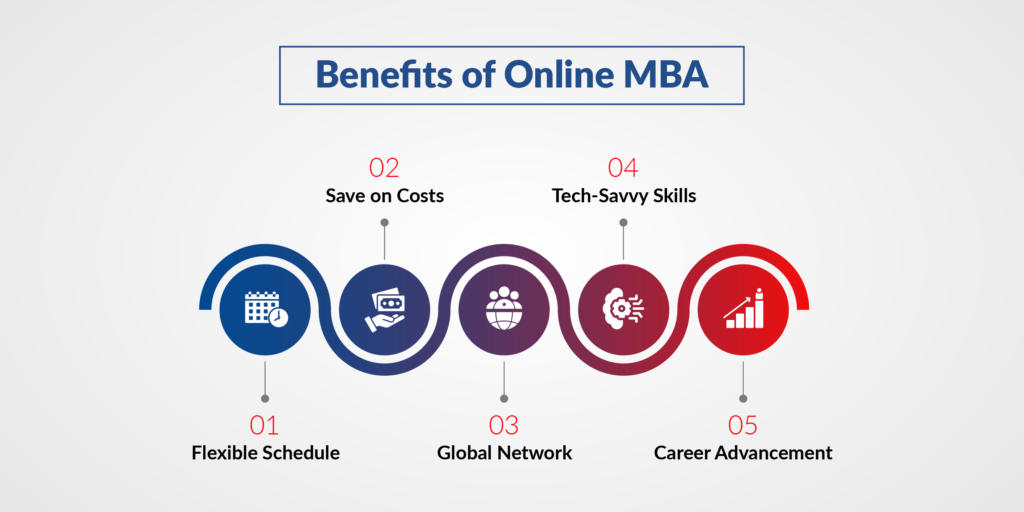
            1. Flexibility: Such online and distance MBA degrees ultimately offer an alternative to the traditional on-campus MBA program that allows students to study at the pace and timing chosen. 
            2. Accessibility: Online and distance education MBA pathways remove physical restrictions. Thus, those with various backgrounds can accomplish higher learning without changing their places of origin.Through this openness, the students are empowered to learn from each other, encouraging and building diversity within the institution.
            3. Cost-effectiveness: While conventional on-campus MBA programs may have higher tuition fees compared to online and distance learning programs, the elimination of extra expenses such as commute or accommodation makes them much less costly. 
            4. Career Advancement: Besides online delivery and distance education, students acquire all the much-needed skills and knowledge they need to steer their careers forward. This opportunity to remain employable and gain the necessary experience makes for a combination that can’t be found in plain education.

            Online MBA Best Colleges and their Fee Structure

            Several colleges stand out for their quality education and reputation when considering Online MBA programs. Here are a few top colleges offering Online MBA programs, along with a brief overview of their fee structures:

                         College

               Fee (INR)

            Amity Online

            1,95,000

            Manipal Online

            1,75,000

            LPU Online

            1,63,000

            DPU Online

            1,70,000

            Symbiosis

            1,50,000

            Amrita Vishwa Vidyapeetham

            1,70,000

            Note: These approximate fee structures can vary depending on residency status, scholarships, and additional fees. It’s essential to check the official websites of these universities for the most accurate and up-to-date information on tuition and fees.

            Online MBA Eligibility Criteria

            The online MBA Eligibility differs throughout Educational Institutions. The requirement for an online MBA program is a bachelor’s degree. To be admitted to the best online MBA programs in India, applicants must fulfil the following qualifying requirements:

            Educational Qualifications:

            •  
            1. A bachelor’s degree from an accredited university in a related field.
            2. A minimum of 50% overall (45% for SC/ST students)
            3. Students in their last year may also apply to take online MBA courses.

            Aptitude Test:

            1. Certain universities use the results of the XAT, CAT, MAT, CMAT, and SNAP tests to consider admission. Therefore, candidates must take management entrance exams.
            2. Applicants had to meet the minimum online MBA cut-off in order to be eligible for the exam.

            Work Experience:

            1. Although not required, a certain amount of job experience in a related subject would be beneficial.
            2. The minimum required work experience is three years following graduation, though the requirements may differ amongst institutions.

            Age:

            1. In India, there is no upper age limit for applying to online MBA programs.

            Online MBA and Distance MBA Salary in India as per the Roles

            Exploring the salaries individuals with Online MBA or Distance MBA degrees can expect to earn in India, categorised by different job roles or positions. However, earning potential may vary due to conditions like the program’s reputation and networking.

            There will mostly be positions such as Marketing Manager, Financial Analyst, and Operations Manager, offering lucrative salaries to fresh MBA graduates in India. Here’s a comparative overview of the salary ranges for these roles based on Online and Distance MBA qualifications: 

            Role

            Average Annual Salary (Online MBA)

            Average Annual Salary (Distance MBA)

            Marketing Manager

            INR 8-15 lakhs

            INR 7-13 lakhs

            Financial Analyst

            INR 6-12 lakhs

            INR 5-10 lakhs

            Operations Manager

            INR 9-16 lakhs

            INR 8-14 lakhs

            These remuneration ranges are exemplary and change depending on the situation, e.g. company size, geographic location, industry demand, and individual negotiation skills, among other factors. 

            Meanwhile, online and distance MBA graduates can anticipate competitive compensation packages based on their certifications and expertise.

            Online MBA vs Distance MBA: Which one is better?

            Online MBA vs Distance MBA: Find Your Fit

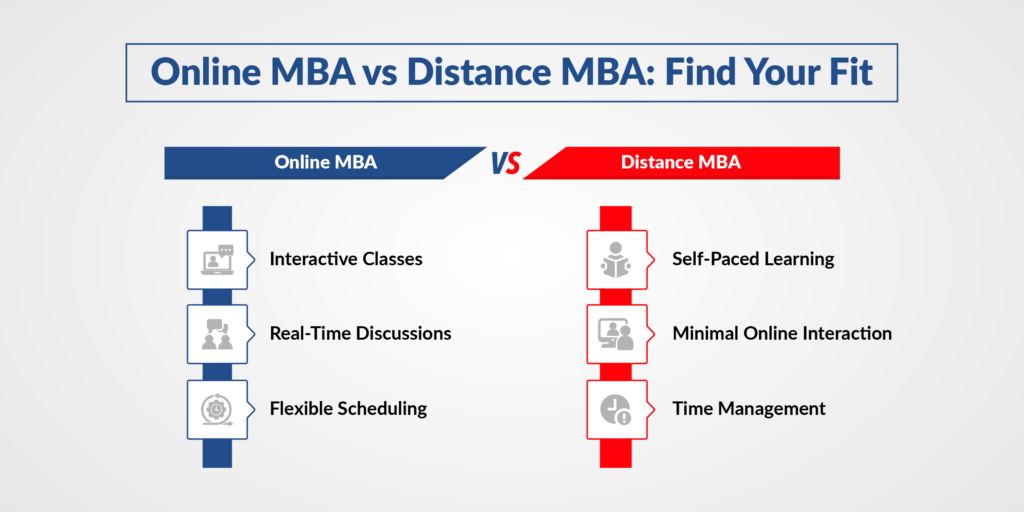
            It would be answered to a varying degree depending on an individual’s taste, learning styles, and career goals. However, both vary as teachers will either switch to the audial mode of teaching or the online part, which suits their day-to-day schedule as it is flexible, affordable, and accessible.

            Students attending an online MBA program likely want interactive learning experiences, virtual teamwork, and real-time feedback. These initiatives utilise technology to form immersive learning spaces in their true sense that imitate the usual classroom architectures.

            On the one hand, those who are self-motivated to study but would rather not be location-bound are drawn to distance MBA or online MBA programs because they introduce them to online learning and flexibility. Online programs’ nonlinearity is clearly advantageous, but this is only sometimes the case for distance-learning courses that provide study guides and other tools. 

            Also, prospective students deliberating between an online MBA and vs distance MBA should consider their preferences for flexibility and convenience, as both programs cater to working professionals seeking to balance career commitments with academic pursuits.

            Choosing between an online MBA vs distance MBA necessitates a thorough assessment of factors such as lifestyle, learning preferences, and desired levels of interaction and support throughout the academic journey.

            Conclusion

            When comparing the benefits of an online MBA vs distance MBA, it’s essential to consider factors such as flexibility, interaction, and course variety. Considering educational opportunities is not just about choosing a program.

            Also, students should take the time to compare and contrast programs offered, the accreditation, the faculty’s expertise, and the success of their alumni before making a decision.
            Hike Education offers comprehensive guidance for individuals seeking to elevate their careers through quality education. For more information, visit the official website.

            Online MBA vs Distance MBA : FAQs

            Q1. Are online MBA programs recognised by employers?

            The online MBA degree from accredited institutions’ online programs is welcome everywhere. Employers look at the qualifications, knowledge, and experience acquired as submerged irrespective of the teaching model applied.

            Q2. May I simultaneously enrol in MBA programs while working full time?

            Working individuals benefit from remote and virtual MBA programs. You gain from the simplicity of obtaining the course materials and the flexibility of scheduling, which enable you to balance your job and study obligations. 

            Q3. What is the salary package after an online MBA?

            Depending on the specialisation they selected throughout the course, working individuals with an online MBA degree might anticipate a significant pay increase. A recent graduate of an online MBA program may make between INR 5 – 6 LPA.

            Q4. Is an online MBA applicable?

             People who have completed an online MBA program are frequently paid more than those who have not. Additionally, you may have an advantage over other candidates when applying for jobs if you have an online MBA. After you get hired, it can also help you progress in your career more swiftly.

            Q5. Can I get a job after an online MBA?

            Enrolling in an online MBA program will give you the same employment chances as a traditional MBA program. Given the extensive curriculum that online MBA students follow, many multinational corporations are eager to hire recent graduates.

              Enter Your Details To Get Counselling From Our Experts

              I consent to be contacted by Hike Education via Call, SMS, Email, or WhatsApp, even if I'm registered on DND/NDNC.