Best MBA Finance Colleges in India: Route to Your Financial Career

Best MBA Finance Colleges in India: Route to Your Financial Career

The Indian economy, a significant player in the global financial landscape, is rapidly evolving. As projected by the Statista report, this growth is set to reach USD 9.34 Million in 2022 with a CAGR rate of 14.02%. By 2027, the market value is expected to be USD 19.55 Million. This robust growth not only underscores the importance of choosing the best MBA finance college in India but also paints a promising picture of a future career in finance, where you can be at the forefront of this growth, shaping the financial landscape and reaping the rewards of your efforts.

In India, students can choose from prestigious colleges offering top-notch MBA finance programs. These programs stand out for their unique blend of academic rigour, industry exposure, and networking opportunities, which are crucial for a thriving career in finance. 

With a comprehensive curriculum covering all aspects of real-world financial scenarios, choosing the best MBA finance colleges in India ensures you for the challenges and opportunities in your finance career. Rest assured, you will gain a holistic understanding of the finance industry and the skills needed to excel in it.  

What is MBA in Finance in India?

In India, an MBA in finance is a renowned specialisation that provides a comprehensive curriculum in financial management, market strategies, and investment analysis. This degree imparts knowledge of financial management that provides a deep understanding of the business landscape and prepares aspirants to learn company reports, predict economic trends, balance risk management and how to profit from stock values. 

Completing an MBA in finance in India opens many lucrative career options in diverse industries such as banking, finance, investment management, and economic consulting. It’s not just a job but a fulfilling and rewarding career that awaits you. The high salary trends in finance further add to the excitement and aspiration of pursuing an MBA in finance in India.

To advance in the financial landscape, you must choose the best MBA finance colleges in India and equip yourself with the skills to navigate and manage financial problems and make insightful decisions. 

Skills Set Required for an MBA in Finance

Embarking on an MBA in finance requires specific skills to enhance your financial knowledge. These skills include Financial Accounting, Analytical Thinking, Effective Communication, Risk Management, and more. Mastering these skills is not only essential for your studies but also your future career in finance. 

Here are the skills that are not only necessary for your studies but also for your future career in finance.

Financial Accounting: One of the essential skills involves a comprehensive understanding of financial statements such as balance sheets, cash flow statements and income statements. You will also learn to analyse financial statements to improve the company’s financial health by performance and profit.

Analytical Thinking: In this, you will develop solid analytical skills to recognise complex problems and solve them simultaneously. This includes problem breakdown, evaluating data and using financial models to make insightful business decisions.

Effective Communication: Enrolling in the best MBA finance colleges in India enhances your communication skills and helps you deliver concise information regarding financial concepts to stakeholders, both in written and oral form. This ensures that all non-financial audiences profit from the information they access.

Risk Management: As a finance graduate, it’s crucial to identify and remove financial risks to ensure the profitability and stability of the company by using different strategies and tools.

Financial Reporting: These skills enhance your ability to prepare detailed reports that impact your financial performance and the organisation’s position, ensuring transparency and regulatory compliance.

Business Intelligence: Analysing data and business intelligence tools to gather insights and interpret financial data to drive business decisions.

Advantages of Pursuing From the Best MBA Finance Colleges in India

Here are the key advantages of pursuing an MBA in finance from the best colleges in India:

Increased Economy: The Indian economy is proliferating in diverse sectors of banking, insurance, finance, and investment services, which offer numerous business opportunities.

Demand for Financial Professionals: There is an increased demand for finance professionals providing job and career opportunities in India.

Solid Industry-Connection: The business schools in India have solid connections with the finance industry, facilitating job-ready programs, internships, and live projects.

Placement and Internship Opportunities: The business schools in India have strong ties with industrial organisations, which help students find secure jobs and internships to gain practical experience. 

Career Upliftment: The MBA program in finance advances your career path and prepares you for different financial roles in top companies. It offers high salaries and significant career progression. 

What are the Best MBA Finance Colleges in India?

An MBA in finance is one of the top specialisations with many career opportunities. Here are some popular B-schools you can aim for that will guide you in reaching your goals.

Indian Institute of Ahmedabad (IIM A)

IIM Ahmedabad is one of the renowned institutions in India for MBA programs. It is also known for its excellent credentials in finance and consulting. Pursuing an MBA degree from IIM Ahmedabad is a dream of many aspirants who have qualified for a CAT entrance exam before entering the highly recognised and competitive institute. The campus infrastructure is iconic and filled with green spaces that attract the liveliest minds to study here.

  •  
  • Below is the table of other parameters that define the institute in a better way. 
  •  

Course Offered

PGPM

Accepted Exam

CAT, GRE, GMAT

Accreditation

EQUIS, AMBA, AACSB

Fees

23 Lakhs

  •  
  • Indian Institute of Calcutta (IIM C)
  •  
  • The IIM Calcutta was established in 1961 by the government of India and is the first national institute of postgraduate studies and research in management. It is one of the best MBA finance colleges in India, known for its excellent credentials and other related domains. The campus is located in Joka, on the outskirts of Kolkata. It offers full-time MBA specialisations in various subjects. 

The table below reflects other essential factors provided by IIM Calcutta.

Course Offered

PGPM

Accepted Exam

CAT, GMAT, GRE

Accreditation

AACSB, AAMBA, EQUIS, CEMS

Fees

27 Lakhs

  •  
  • SP Jain Institute of Management and Research (SPJIMR)
  •  

It is a highly recognised business school in Mumbai, India, offering renowned management, finance, and related domain programs. SPJIMR prepares students for successful careers in the business market and boosts a strong alumni network for vast industry connections. The campus focuses on innovation and experiential learning, which equips graduates to handle real-world challenges.SPJIMR has designed its courses to guide students in acquiring efficient skills in the field of finance, which will connect them with industry-based companies.

Below are the other parameters to look forward to.

Course Offered

PGDM

Accepted Exam

CAT, GMAT

Accreditation

UGC, AICTE

Fees

17.5 Lakhs

  •  
  • Xavier’s Labour Research Institute, Jamshedpur (XLRI)
  •  

Enrolling in XLRI for finance can enhance your career path. It’s one of the recognised institutes in Jamshedpur, known for its quality education and comprehensive course curriculum for in-depth knowledge. The college offers two years of PGDM in finance and allows students to experience practical and goal-oriented learning that covers essential concepts of finance. 

Here is the other list of parameters that define the institute’s prospects.

Course Offered

PGDM

Accepted Exam

CAT, MAT, XAT, ATMA, CMAT

Accreditation

AACSB, AMBA

Fees

8.93 Lakhs

  •  
  • Faculty of Management Studies (FMS)
  •  

When choosing the best MBA finance colleges in India, FMS stands out as the top-ranking university. Established in 1954, it is owned by the government and is well-known for its rigorous academic excellence. The university is valued because of its strong alum network and aspiring professionals who impart students knowledge on finance and prepare them to reach their career goals. 

Below is the list of parameters for a clear understanding before selecting the institute.

Course Offered

MBA 

Accepted Exam

CAT

Accreditation

NAAC

Fees

2.0 Lakhs

  •  
  • Symbiosis Management of Business Management (SIBM)
  •  

When choosing the best MBA finance colleges in India, never miss out on SIBM, another top institute that offers MBA specialisation in Finance, Marketing, Operations, Human Resources, etc. SIBM was established in 1982 and boasts a highly qualified faculty that provides students with profound financial knowledge and practical skills that prepare them for excellent placement records.

Here is a list of parameters a student can consider before enrolling in SIBM.

Course Offered

MBA

Accepted Exam

SNAP

Accreditation

NAAC A++

Fees

20.5 Lakhs

  •  
  • Narsee Monjee Institute of Management Studies (NMIMS)
  •  

One of the top MBA colleges in India, NMIMS was established in 1981, focusing on emerging as a recognised and reputed university. It provides a wide range of programs, but its speciality is that it offers a course in Banking, which covers all the finance concepts such as risk management, corporate finance, investment management, etc. NMIMS has ranked 4th in Outlook 2020 and has increased its academic reputation.

Here are some other parameters to check for NMIMS:

Course Offered

MBA

Accepted Exam

NMAT

Accreditation

NAAC A+, AACSB, ABET, NBA

Fees

21.9 Lakhs

  •  
  • Institute of Public Enterprise (IPE)
  •  

One of the finest MBA colleges in Hyderabad, India, was established in 1995 for a full-time management program. The institute provides a structured program for PGDM, PGDM-RM, PGDM-HRM, etc. 

The table below contains other factors to check before considering the college.

Course Offered

PGDM

Accepted Exam

CAT, XAT, GMAT, CMAT, ATMA, MAT

Accreditation

AICTE, AIU, NBA

Fees

8.15 Lakhs

  •  
  • Lal Bahadur Shastri Institute of Management (LBSIM)
  •  

LBSIM is a well-known B-school in Delhi NCR that was established in 1995. It offers the finest PGDM program in finance specialisation and features a vital course curriculum that includes treasury management, risk management, investment management, etc. The institute also provides dual specialisation in finance and ensures that the students gain world-class learning experiences that foster industry-based knowledge.

Check out the list of other parameters before selecting the college:

Course Offered

PGDM

Accepted Exam

CAT, GMAT

Accreditation

NBA, AICTE

Fees

13.34 Lakhs

  •  
  • K J Somaiya Institute of Management Studies and Research (KJSIM)
  •  

Established in 1981, it is a prestigious institution in Mumbai. It is renowned for its qualified faculty and solid industry connections, which bind it to top companies. The PGDM (financial service) provides management concepts that enhance students’ knowledge of financial services and enable them to make effective decisions. The institute was ranked 56th for private MBA by NIFR in 2021 and holds a valuable academic record.

Below is the list of other parameters of KJSIM:

Course Offered

PGDM

Accepted Exam

CAT, CMAT

Accreditation

AACSB, AICTE, NBA

Fees

18.79 Lakhs


Please Note: The fees above are subject to change based on the institution.

Best Colleges for Online MBA in Finance

Several universities offer online MBA in finance. Below is the table that lists the popular colleges you can opt for.

Top Colleges for Online MBA in Finance 

Accreditation

Duration

Course Fees (INR)

Amity University

NAAC A+, UGC

2

1,95,000

Online Manipal Academy of Higher Education University

NAAC A+, ACU, NBA, AICTE

2

1,75,000

Symbiosis School For Online & Digital Learning

UGC, AICTE

2

1,50,000

Dr. D.Y. Patil University Online

UGC, AICTE

2

1,69,200

Jain University 

UGC, AICTE

2

2,60,000

LPU Online

NAAC A++, UGC

2

1,62,800

Chandigarh University

NAAC A+, AICTE

2

2,00,000

O.P Jindal Global University

NAAC A, UGC

2

1,75,00


Please Note: The fees above are subject to change and can vary according to institutes, locations and chosen courses

How to Select the Best MBA Finance Colleges in India?

An MBA builds your entire career, so before enrolling in any college, check for its authenticity and consider the points below.

Ranking and Accreditation: When selecting an MBA in finance program in India, opt for colleges accredited by renowned bodies like EQUIS, AICTE, or AACSB, which provide valuable education insight. 

Comprehensive Syllabus: Check the course curriculum before selecting the best MBA finance colleges in India that align with your career goals and provide you with a deep knowledge of the finance subject.

Qualified Faculty Members: Research the faculty profile and the area of specialisation that aligns with your core subject to help you experience advanced learning that connects you with industry sectors. 

College Location and Infrastructure: Selecting a college can be challenging, so before considering it, check its location, learning environment, and infrastructure.

Top Recruiters for MBA Finance in India

Here are the top recruiters who look for candidates specialised in finance programs:

  1. City Bank
  2. HSBC
  3. American Express
  4. Axis Bank
  5. Morgan Stanley
  6. McKinsey
  7. Lehman
  8. Tata Capital
  9. Standard Chartered
  10. Bain & Co

Career Opportunities and Salary Trends in MBA Finance in India

MBA leads you to numerous career options and prepares you for different job roles in finance. Here are some key job roles that can be considered after your degree.

Job Profile

Descriptions

Average Salary in INR

Financial Analyst

  • Their task is to analyse financial data to make profitable investments.

6,00,000 

Finance Manager

  • They check companies’ financial activities and ensure a healthy financial report.

15,00,000

Business Analyst

  • Their work is identifying business problems, making an efficient solution, and improving the organisation’s performance.

8,00,000

Equity Analyst

  • Their core task is to review and recommend stocks using financial reports and modelling.

7,00,000

Investment Banker

  • They raise capital for the government and companies by issuing stocks.

17,00,000

Financial Advisor

  • Their responsibility is to guide the clients with proper financial advice and help them meet their goals.

5,00,000

Chief Financial Officer

  • Guide the entire financial department and is responsible for budgeting, strategic financial planning, and reporting. 

18,00,000

Accounting Manager

  • Their work is to manage accounting operations daily, ensuring precise financial records.

8,00,000

Management Consultant

  • Their task is to give expert advice on various financial areas to improve business performance.

27,00,000

Cash Manager

  • They oversee a company’s cash flow-in and flow-out for smooth financial operations.

8,00,000


Please Note: The salary above can vary according to job roles, location or company.

Conclusion

Choose the best MBA finance colleges in India and conquer your career in the finance sector that prepares you for various job roles such as finance manager, finance analyst, accounting manager, financial advisor, etc. Prepare today and polish your skills to meet industry-based challenges. India has top-ranked institutes like IIM Ahmedabad, IIM Calcutta, SPJIMR, etc., with high academic records and certified mentors to help you reach your career goals.

Join Hike Education today for similar content, which provides academic information to enhance your knowledge and help you make the right career decision.

Best MBA Finance Colleges in India : FAQs

Q1. Which is the best MBA finance colleges in India?

There are many renowned universities for MBA finance, but these are the most sought-after colleges:

  1. IIM Ahmedabad
  2. IIM Calcutta
  3. SP Jain Institute of Management and Research (SPJIMR)
  4. Lal Bahadur Shastri Institute of Management (LBSIM)
  5. Narsee Monjee Institute of Management Studies (NMIMS)

Q2. Which is the best field for an MBA in finance?

The best fields in MBA finance are:

  1. Global Taxation
  2. Corporate Finance
  3. Finance Analytics
  4. Commercial Banking
  5. Wealth Management

Q3. Is MBA in Finance worth it in India?

Yes, it is one of the popular specialisations provided during an MBA degree and has promising career opportunities in the future.

Q4. What is the highest package in MBA finance in India?

The average finance salary in India ranges from INR 15,00,00 to INR 30,00,000 per year, and it is offered mainly by IIMs.

Q5. Which MBA specialisation is in most demand?

While there are many MBA specialisations, these are the most in-demand:

  1. MBA in Finance
  2. MBA in Marketing
  3. MBA in Operations
  4. MBA in Business Intelligence
  5. MBA in Supply Chain
  6. MBA in Healthcare Management
  7. MBA in Human Resources

    Enter Your Details To Get Counselling From Our Experts


    Our Programs

    MBA Programs For Working Professionals: Types, Specialisation, Colleges, & More

    MBA Programs for Working Professionals: Types, Specialisation, Colleges, & More

    In the fast-paced digital era, education has evolved to cater to the needs of ambitious working professionals like you. An MBA program could be the perfect fit to boost your qualifications while maintaining your professional commitments. These programs offer many benefits and career opportunities, simplifying the lives of many professionals by providing specialised courses that can significantly shape their careers. 

    In today’s world, MBA programs for working professionals offer many practical benefits, including flexible schedules, leadership development, and the potential for higher salaries. This blog will explore how these programs can empower you to make a significant difference in your career trajectory.

    Types of MBA Programs for Working Professionals

    Types of MBA Programs for Working Professionals
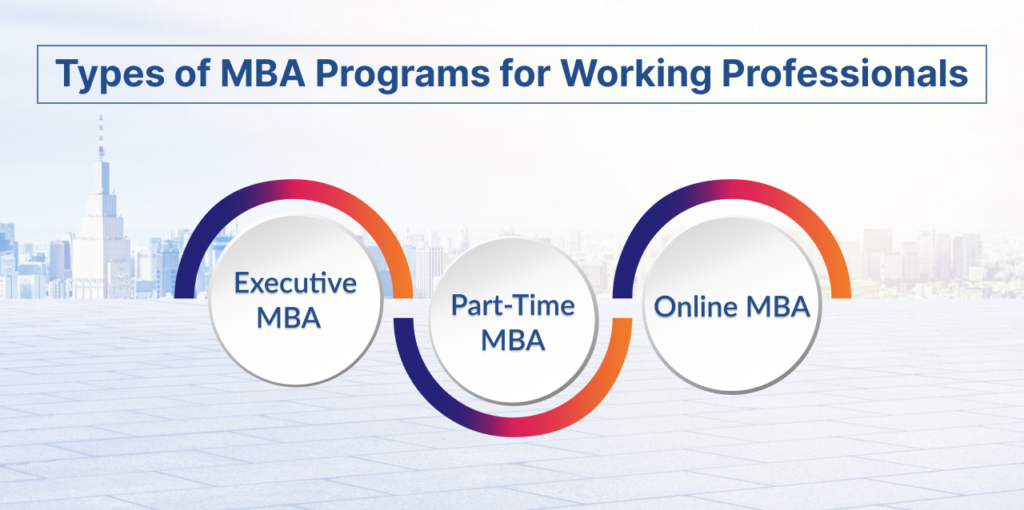
    An MBA is a prestigious degree sought after by many finance, banking, operations, and marketing professionals. Once you enter the program, you’ll learn from industry experts, experienced mentors, and qualified trainers. In this section, we’ll provide a comprehensive understanding of the different types of MBA programs available for working professionals:
    1. Executive MBA– This one-year program is designed for professionals already ahead in their careers who want to upgrade their educational qualifications for better business knowledge, salary potential, and advanced skills.
    2. Part-Time MBA– In an institution, it is generally called an evening or weekend class that provides contemporary learning. It is designed for working professionals who want to advance their careers while doing their jobs. 
    3. Online MBA– This program is conducted entirely online and covers the whole syllabus of a traditional MBA. It offers flexibility and a convenient learning mode, allowing aspirants to study without hindering personal commitments. 
    Now that you’ve learnt the meaning of each type of MBA program, let’s dig into its parameters for better insight:
    Parameters  Executive Year MBA Part-Time MBA Online MBA
    Eligibility Criteria Bachelor’s degree with a minimum of 50% marks in any discipline. Bachelor’s degree in any stream from a reputed institute with at least 50% of the score. Bachelor’s degree in any subject with up to 50% of marks. 
    Duration 12 to 18 months 2 to 3 years 2 years
    Required Entrance GMAT, CAT, GRE, etc. XAT, CAT, MAT, CMAT, GMAT, etc. Depends on the university’s eligibility criteria.
    Work- Experience 2 to 5 years 2 to 4 years 2 to 3 years
    Fees (INR) 4,00,000 to 25,00,000  80,000 to 6,00,000  30,000 to 3,00,000 
    Mode of Learning Regular online classes, evening or weekend classes Evening or weekend classes Online classes
    Please Note: The fees above vary according to the opted stream or colleges.

    Pros and Cons of MBA Programs for Working Professionals

    An MBA program is a sought-after career and is highly demanding in the business world. Earning an MBA degree is like a jackpot for many aspirants who want to enhance their careers and develop much-needed leadership and managerial skills to build professional growth. 

    This degree is highly valued in the job market and can significantly boost your career. Let’s look at some of its key advantages and disadvantages:

    Advantages of the MBA Programs for Working Professionals


    1. Skill Development: The MBA program helps working professionals understand their core subjects and gain in-depth skills to expand their marketing, accounting, and finance knowledge. Additionally, it equips them with leadership, strategic thinking, and management skills, which are highly valued in today’s competitive job market.
    2. Flexible Mode: One of the key advantages of MBA programs for working professionals is their flexibility. You can choose the learning mode that suits your schedule, whether regular online classes, evening or weekend classes, or even entirely online. This flexibility empowers you to learn at your own pace without the stress or difficulty of balancing work and study.
    3. Career Advancement: The MBA program is not just a degree, it’s a stepping stone to a brighter future. It equips you with the knowledge and skills needed to excel in various fields like healthcare, finance, operations, sales, management, and analysis. This diverse skill set opens up a world of potential career opportunities, allowing you to align yourself with the current job market and potentially earn a higher salary. 
    4. Personal Growth: Enrolling in MBA programs for working professionals is not just about gaining a degree; it’s a transformative journey of personal growth. It’s about building your confidence, honing your leadership skills, and gaining a deeper understanding of the business market. With an MBA degree, you open doors to exciting career opportunities that motivate you to reach new heights.

    Disadvantages of MBA Programs for Working Professionals


    1. Time Commitment: As a full-time employee, your biggest concern is time management, which can become challenging if you cannot handle it. Before applying for an MBA program, prepare yourself for its side effects, which come with its advantages. It might look feasible, but juggling your job and studies is the task. 
    2. High Cost: Obtaining an MBA program can be costly, and it might require additional tuition fees that are not affordable for many working professionals. Financial issues can hinder their study and work, making it complicated to advance their careers. However, an online MBA costs much less than a traditional MBA, so plan your budget and choose wisely.
    3. Lack of Classroom Training: MBA Programs for working professionals can cease peer-to-peer interaction and limit interaction with faculty members. Pursuing an MBA degree while working becomes difficult to manage, which is the biggest challenge. It also limits your knowledge of the chosen specialisation. 
    4. Ever-changing Job Market: Digitalisation is evolving in the business market, and the demand for MBAs can vary depending on market and economic conditions. Market trends can fluctuate hugely, impacting an MBA holder’s ability to progress with his degree. To overcome this, aspirants should research and opt for a college that offers an MBA curriculum that aligns with market trends.

    Popular MBA Specialisation for Working Professionals

    Popular MBA Specialisation for Working Professionals

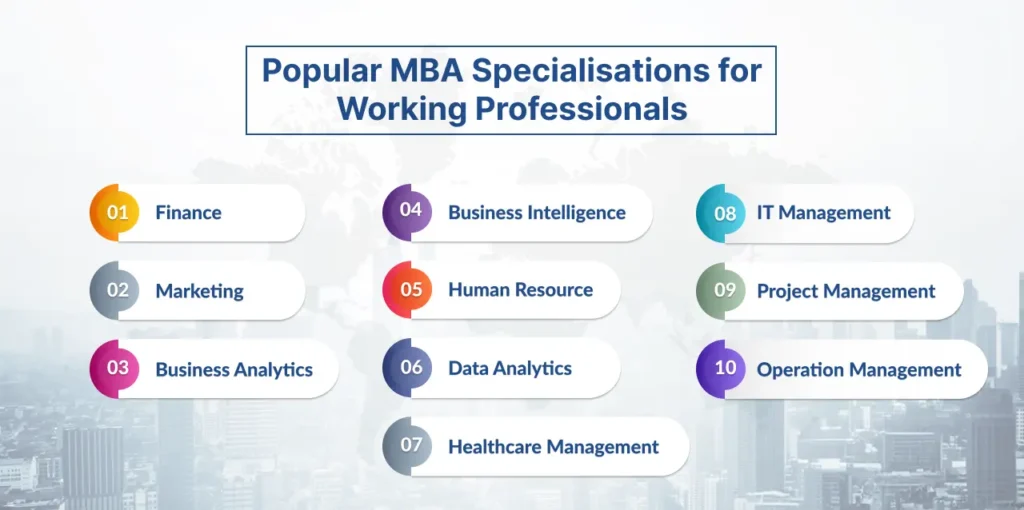
    MBA provides diverse specialisations which can impact your career for a lifetime. Here are the top MBA specialisations to consider for working professionals:

    1. Marketing: In this specialisation, you will learn to oversee the marketing campaign and manage all social media work. It covers significant topics like consumer behaviour, digital marketing and brand management.
    2. Finance: Learning the financial investment and resources to analyse the company’s profit and loss. The candidates also learn to make strategic decisions to ensure the company’s financial health. 
    3. Business Analytics– Analysing data to make informed decisions for the organisation’s welfare. In this specialisation, the aspirants learn to optimise market trends and data-driven decisions for the business market. 
    4. Business Intelligence– Collecting and analysing data for better insight to make informed decisions.
    5. Human Resources– This specialisation involves managing the workspace, overseeing employee relations, and hiring authentic employees to support the organisation’s growth and success.  
    6. Healthcare Management– Managing the business side of healthcare that deals with patient care, operation systems,  and financial efficiency.
    7. Data Analytics– Using statistical tools, this specialisation extracts data to uncover trends and patterns.
    8. IT Management– This specialisation deals with all the IT functions and supports the operation systems. 
    9. Project Management– The process of project execution and reaching its absolute result is the goal of learning this specialisation that prepares you to complete the target on time before meeting the deadlines.
    10. Operation Management– The process of optimisation and designing to deliver efficient production of goods and services.

    Best Colleges for MBA Programs for Working Professionals

    In India, several MBA programs are available for working professionals who want to hone their skills, apply to industry-based organisations, and improve their careers. Here is the list of top MBA colleges to consider:

    Courses

    Top MBA Colleges for Working Professionals

    Executive MBA

    • OP Jindal Business Education
    • IIM Raipur
    • IIM Rohtak
    • NMIMS Mumbai
    • FMS Delhi
    • Amity University

    Part-Time MBA

    • Symbiosis Centre for Distance Learning
    • IIFT Delhi
    • MIT School of Distance Education
    • IMT Centre of Distance Learning
    • KJ Somaiya Institute Mumbai
    • Chandigarh University

    Online MBA

    MBA Programs For Working Professionals: Potential Job Roles and Salary

    An MBA program opens doors to numerous career opportunities and allows the aspirants to grow in their respective fields. MBA aspirants can choose from a list of job roles with average salaries to build their career trajectory. 
    Job Role  Average Salary (Annual)
    Marketing Manager INR 14,00,000 
    Finance Manager INR 16,00,000
    Human Resource Manager INR 10,00,000
    Business Analyst INR 9,00,000
    Business Intelligence Analyst INR 8,00,000
    Operation Manager INR 11,00,000
    Project Manager INR 10,00,000
    Sales Manager INR 12,00,000
    Management Consultant INR 24,00,000
    Data Analyst INR 9,00,000
    Please Note: The salary mentioned is subject to change depending on education, job location, and work experience. 

    Conclusion

    MBA programs for working professionals have a promising future scope and demand. As digitalisation continues to shape the careers of aspirants, enrolling in an MBA program will help you build your educational pathways and job lives. The skills and knowledge gained during an MBA course prepare you for an industry-based job role and help you establish a better career. 

    To learn more about the program, please visit Hike Education, an ed-tech platform that helps broaden your education horizon.

    MBA Programs For Working Professionals : FAQs

    Q1. What is the difference between a part-time and executive MBA?

    A part-time MBA is designed especially for professionals at various career stages who prefer classes during the evening or weekend. 

    An executive MBA is for those ahead of their careers and want to pursue further education to build leadership or managerial skills.

    Q2. Which MBA Course is best for Working Professionals?

    A working professional should opt for executive management of business administration that allows you to take a break from your career and pursue a full-time executive MBA program. However, someone who wants to pursue their career while doing an MBA can also opt for an Online MBA.

    Q3. Which MBA is most in demand?

    Some of the most in-demand MBA specialisations are-  Finance, Marketing, Information Technology, and Operations.

    Q4. Is MBA programs for working professionals worth it?

    Indeed. Working professionals can pursue an MBA program to advance their careers while learning leadership and management skills to enhance their knowledge.

    Q5. How can I balance work, study, and personal life while pursuing an MBA?

    Traditional MBA programs require a practical time commitment to balance work, study, and personal life. Aspirants must choose the right specialisation that aligns with their daily schedule and responsibilities. However, professionals who want to balance studies and work can also opt for an online MBA program.

      Enter Your Details To Get Counselling From Our Experts

      I consent to be contacted by Hike Education via Call, SMS, Email, or WhatsApp, even if I'm registered on DND/NDNC.


      What is MBA in marketing management: Eligibility, Top Colleges, High Salary Job Roles and more

      MBA in Marketing Management: Eligibility, Top Colleges, Salary, Job Roles and More

      Marketing has become crucial in helping organisations fuel their growth and develop new ideas in today’s fast-changing business world. Businesses today look for employees or service providers who are capable of planning for and implementing strategic promotional techniques that can outcompete those of equal trade.

      Mastery of an MBA in Marketing Management enables individuals to shoulder the responsibilities and challenges imposed on marketing managers. But what is MBA in Marketing Management? How does it benefit aspiring marketers? Let’s explore this in detail.

      What is MBA in Marketing Management?

      An MBA in marketing management is a postgraduate degree in business administration that focuses on studying marketing activities and principles. This program deals with different approaches to marketing, including the analysis of market trends and consumer behaviour, brands and advertising, and digital marketing.

      This program combines theoretical approaches with methods of practical strategy, which helps students design integrated marketing concepts.

      While studying, the learners master the newest trends, tools, and technologies used in global marketing. They also get to explore the importance of marketing in providing value to customers and achieving corporate goals. The curriculum usually entails courses such as marketing insights, sales tactics, new product development, and effective global marketing.

      Who Should do an MBA in Marketing Management?

      An MBA in Marketing Management is ideal for individuals who:

      1. Marketing-minded and possess an artistic bent as well.
      2. Wish to have further promotion in their career in marketing.
      3. Eager to have a better insight into the subject that focuses on consumers’ behaviour and market fluctuations.
      4. Aspire to take on leadership roles in marketing and sales.
      5. Seek to enhance their strategic thinking and decision-making skills.
      • Regardless of a person’s position, whether directly out of college or already in the workforce, seeking to gain more knowledge and recognition, this MBA can offer the instruments and accreditation.

      For those wondering what is MBA in marketing management and if it’s the right path, the program is ideal for individuals with a passion for marketing and a desire to advance their careers.

      MBA Eligibility Criteria

      To enrol in an MBA in Marketing Management program, candidates generally need to meet the following criteria:

      1. A bachelor’s degree in any discipline from a recognised university.
      2. A minimum percentage (usually around 50-60%) in undergraduate studies.
      3. Valid scores from entrance exams like CAT, MAT, GMAT, or XAT.
      4. Work experience (preferable but not mandatory) for specific programs.
      5. Personal interviews and group discussions are part of the selection process.
      • The admission methods may vary depending on the colleges that a student is considering, so he or she should look for admissions requirements for the desired colleges. In addition to the provided definition of an MBA in marketing management, there is a need to identify the requirements that are necessary to take this program.


      Top Colleges for MBA in Marketing Management

      Choosing the right institution is essential since it will determine your degree of return on the MBA program. Here are some of the top colleges in India offering an MBA in Marketing Management, along with their approximate fees:

      College

      Location

      Full Fees (approx)

      Indian Institute of Management (IIM)

      Ahmedabad

      23 Lakhs

      Indian Institute of Management (IIM)

      Bangalore

      23 Lakhs

      Indian Institute of Management (IIM)

      Kolkata

      22 Lakhs

      Faculty of Management Studies (FMS), Delhi University

      Delhi

      2 Lakhs

      SP Jain Institute of Management and Research (SPJIMR)

      Mumbai

      18 Lakhs

      Note- Given above, the fees may be subject to change in time.

      Top Colleges to Do Online MBA in Marketing Management Course

      Top Colleges to Do Online MBA in Marketing Management Course​

      For those who prefer the flexibility of online education, understanding an MBA in Marketing Management includes knowing the top online programs.

      For students looking to pursue an MBA in Marketing Management online, here are some reputable institutions, along with their approximate fees:

      College

      Full Course Fees (INR)

      Amity University Online

      2.50000

      Manipal University Online

      200000

      Symbiosis Centre for Distance Learning (SCDL)

      100000

      OP Jindal Global University

      300000

      Indira Gandhi National Open University (IGNOU)

      37,800

      Note- Given above, the fees may be subject to change in time. Students can connect to Hike Education official website for further information.

      What are the Job Profiles in MBA in Marketing Management?

      What are the Job Profiles in MBA in Marketing Management?​

      An MBA in Marketing Management opens doors to various high-paying and influential job roles. Understanding what is MBA in marketing management is crucial in appreciating the breadth of opportunities it can provide. Below are some prominent job roles and their respective average salaries in India.

      1. Marketing Manager


      A marketing manager is responsible for designing and developing marketing strategies to sell products and/or services.

      They are involved in the planning, monitoring, and strategic direction of campaigns and have market research and financial responsibilities. The amount of money that one is likely to earn when working as a Marketing Manager in India varies between 8 lakhs and 12 lakhs per year.

      2. Brand Manager


      Brand managers ensure they keep a brand’s image, and in most cases, they improve the appearance of a brand. Mainly, they are associated with brand positioning, marketing communication and new product launches. 

      The average remuneration paid for a Brand Manager with experience in India is 10 to 15 lakhs annually.

      3. Digital Marketing Manager


      The Social Media Marketing Managers manage the firms’ social networking profiles. At the same time, the Search Engine Optimization Marketing Managers promote the firms’ websites on search engines, and the Content Marketing Managers are entrusted with developing the firms’ content marketing strategies.

      The strategies employed by the respective individuals involve using information management to improve visibility in the cyber world. Digital marketing manager salaries vary according to experience and skills but usually fall between 8 to 14 lakhs annually.

      4. Sales Manager


      Sales managers are responsible for ensuring annual target figures are achieved, guiding and leading the sales forces, and designing sales tactics. They also look for new entrepreneurial opportunities and meet and manage customer needs. The payment structure for a sales manager ranges from approximately INR 7 lakhs to 10 lakhs per annum.

      5. Market Research Analyst


      Market Research Analysts survey the market and consumers to help companies understand the market and respond accordingly. They also offer solutions for better marketing endeavours. The pay structure for a Market Research Analyst in India ranges between 6 to 8 lakhs per annum.

      6. Product Manager


      Product Managers are involved with creating and implementing products that different markets offer. They must exhibit qualities that make them suitable for this role. According to Payscale, the average salary for a product manager in India ranges from 10 lakhs per annum to 18 lakhs per annum.

      7. Advertising Manager


      Advertising Managers coordinate advertising and branding processes, coordinate with teams to agree on the goals and objectives of advertising campaigns and target the right audience. The remunerations paid to an Advertising Manager in India can thus be said to be average and lie between 8 and 12 lakhs per annum.

      8. Business Development Manager


      The duties of a Business Development Manager involve the ability to seek existing and prospective businesses by analysing the market, establishing business relationships with new clients, and planning and formulating growth plans.

      The salary range for a Business Development Manager in India depends on the employer and the industry; it ranges between 7 lakhs to 12 lakhs per annum.

      To fully explain what is MBA in marketing management, students must appreciate these jobs and demonstrate how they can influence business outcomes. Many of these positions also come with high remuneration packages, and the employees are given a chance to grow in their careers.

      To explore the best MBA programs and make an informed decision, visit Hike Education’s official website for expert guidance tailored to your career goals. Unlock your potential with an MBA degree.

      Conclusion

      Understanding what is MBA in marketing management entails is an essential starting point for anyone seeking valuable knowledge.

      This specialisatopn MBA ensures that students have the skills and knowledge to tackle the ever-emerging market trends, from conventional techniques to the present state of stylish approaches like digital marketing. Therefore, graduates should be ready for a future of well-paid jobs provided that they undergo the right course of study

      What is MBA in Marketing Management : FAQs

      Q1. What is MBA in marketing management?

      MBA in marketing management is a postgraduate program course designed to equip students with deep knowledge of the marketing domain, covering market analysis, customer behaviour, brand management, and various forms of online marketing.

      Q2. Who should pursue an MBA in marketing management?

      This MBA specialisation is for people who love marketing and want to enhance their careers in the same field. Those interested in marketing like Directors of Marketing and Sales.

      Q3. What are the eligibility criteria for an MBA in marketing management?

      Entry requirements for an MBA in marketing include a graduation degree, acceptance in Competitive Management Entrance Tests like the CAT or GMAT, work experience, and engagement in group discussions and interviews.

      Q4. Which top colleges in India offer an MBA in marketing management?

      Several premier institutes recognised and accepted by these include:

      1. Indian Institute of Management Ahmedabad
      2. Indian Institute of Management Bangalore
      3. Indian Institute of Management Calcutta
      4. Faculty of Management Studies Delhi
      5. SP Jain Institute of Management and Research Mumbai
      6. Xavier School of Management Jamshedpur
      7. Management Development Institute Gurgaon

      Q5. What are the job roles and average salaries for graduates with an MBA in marketing management?

      A marketing manager heads other positions, including Marketing, Brand, Digital Marketing, Sales, and Product Management, with annual salaries ranging from 6 to 18 lakhs based on the rank or position of the particular employee.

        Enter Your Details To Get Counselling From Our Experts

        I consent to be contacted by Hike Education via Call, SMS, Email, or WhatsApp, even if I'm registered on DND/NDNC.


        The History of MBA Degree: A Journey Through Time

        The History of MBA Degree: A Journey Through Time

        Welcome to a fascinating journey through the history of  MBA degree! Have you ever wondered how the Master of Business Administration (MBA) degree came to be? This blog will take you through its origins, evolution, and how it has shaped the world of business education. By the end, you’ll know all about the history of an MBA and its impact on careers and industries around the globe.

        Key Milestones in the History of MBA Degree

        Key Milestones in the History of MBA Degree
         

        Given below are the key events shaping the history of MBA degree evolution:

        Year

        Milestone

        1900

        First MBA program launched by Tuck School of Business at Dartmouth College

        1908

        Harvard Business School introduces its MBA program

        1950

        Rapid growth of MBA programs in the United States

        1970s

        International expansion of MBA programs

        1980s

        Introduction of specialised MBA programs

        2000s

        Rise of online and part-time MBA programs

        Present

        Emphasis on leadership, innovation, and global collaboration


        With a clear understanding of the history of MBA degree, we can appreciate its significant impact on business education and its continued relevance in today’s dynamic world.

        The Birth of the MBA: Early Beginnings

        1. The Industrial Revolution


        It was propagated during the Industrial Revolution in the late 19th century as an educational program for business. The 1970s and 1980s were crucial decades in the history of MBA degree as the program began to gain international recognition.’

        Companies were expanding, and society’s demands required management professionals to deal with massive organisations and new ventures. Management education also started at this period and developed into a modern institution.

        2. The First MBA Program


        The Tuck School of Business at Dartmouth College introduced the first MBA program in the United States in 1900. This program was a response to the growing need for advanced business education. It marked a significant milestone in the history of  MBA degree, setting a precedent for future business schools.

        3. Harvard Business School’s Contribution

        The first MBA program was developed at Harvard in 1908, setting the standard for business education worldwide. The current convenient vehicle for teaching at HBS is the case method. This innovative pedagogy was hailed as revolutionary at the onset of the MBA movement and remains central to the MBA experience. 

        Harvard’s influence on the history of MBA degree is immense. It popularised it and made it a prestigious qualification.

        The Growth and Expansion of MBA Programs

        1. The 20th Century Boom

         
        The history of MBA degrees saw significant growth during the 20th century. By the early half of the twentieth century, specifically in the 1950s and 1960s, MBA programs had evolved and expanded their stake across the United States. Thus, there was an emergent need for professional managers, and the program expanded its reach as several universities responded to the demand by offering MBA degrees.
         

        2. International Expansion


        The 1970s and 1980s were crucial decades in the history of MBA degrees as the program began to gain international recognition. The expansion of MBA education reached new heights as numerous business schools across Europe, Asia, and other regions started offering the program to the global public. This expansion helped foster a healthy, complex, intricate society filled with professional businesspeople.

        3. The Rise of Specialised MBA Programs


        MBA programs also changed their forms during business changes and became more developed. The causes of the history of  MBA degree brought about the development of MBA specialities in finance and marketing, healthcare, and technology. These programs enabled students to choose the specialisations of their MBA courses about various sectors, thereby making the MBA course even more beneficial.

        Modern MBA Programs: Adapting to a Changing World

        1. Online and Part-Time MBA Programs


        In the recent past, the MBA degree has undergone several changes, including the development and widespread use of online and part-time programs. There are abundant opportunities for flexibility that ensure working professionals do not have to quit their jobs to attend MBA schools. Online programs have contributed to MBA accessibility for international students wishing to earn their degrees.

        In recent years, the history of MBA degrees has seen the rise of online and part-time MBA programs, offering flexibility for working professionals. Some of the best online MBA programs are available at Amity University, Manipal University, Symbiosis, OP Jindal University, and many more, making quality education accessible globally.

        2. Focus on Leadership and Innovation


        Current MBA schools stress leadership, creativity, and ventures. The curriculum is structured to prepare the learners to work effectively in the challenging business environment of the current world. The development of the MBA degree is a sign of an expanding view of how to teach management, which has moved away from being solely a technical curriculum to incorporating more interpersonal and moral aspects of leadership.

        3. Global Accreditation and Standards


        Standard-setting bodies such as the Association to Advance Collegiate Schools of Business (AACSB) and the European Quality Improvement System (EQUIS) are essential in ensuring the high quality of MBA programmes. BGSOC members’ accreditation is necessary to guarantee that business schools deliver quality programs, thus adding reliability to the MBA degree.

        The Impact of MBA Graduates on Business and Society

        MBA graduates can have positive impacts on businesses and society in general. Let’s explore some of them:

        1. Career Advancement


        When one considers how the MBA degree has developed throughout the years, one can identify the promotion of career growth as a critical factor. Due to the popularity of the MBA, most of its recipients have leadership responsibilities in most organisations. An MBA degree provides employability for various fields through the skills and knowledge imparted to candidates while pursuing the program.

        2. Entrepreneurship and Innovation


        Many MBA graduates become successful entrepreneurs by taking stiff business risks and chasing growth. The narratives from completing an MBA degree are rich, with many examples of true success and dynamic entrepreneurs who have impacted the business world through start-ups.

        MBA programs promote an environment of new venture creation, as students are encouraged to develop innovative ideas worth betting on.

        3. Social Impact and Corporate Responsibility


        Today’s MBA programs also focus on social and company responsibility. Until recent years, graduates have been unduly preoccupied with the financial returns of business policies and plans. They have not been given similar stimulus to contemplate the favourable incidence of their policies and plans for society.

        It is essential to understand this aspect of the history of MBA degree, which concerns the transformations of the role of business education aimed at ethical and sustainable change.

        The Future of MBA Programs

        The Future of MBA Programs

        1. Technological Advancements


        The future of the history of MBA degrees continues to be incorporated with technological advancements. Technological advancement is inevitable; thus, MBA programs require change by embracing advanced technology in instructional tools or methods to meet the ever-evolving market.

        This will bring about positive changes for the future, starting with creating competent graduates who can face the problems and complexities of the digital world.

        2. Global Collaboration


        Another significant trend in the history of MBA degree is globalisation. New developments in this area include alliances between business schools and other institutions in various parts of the globe for twinning and exchanges. This comprehensive approach to MBA learning provides students with a global outlook on today’s interconnected business world.

        3. Lifelong Learning


        Learning as a continuous process throughout the life cycle is one of the issues that has received a boost in the history of MBA degree. Through knowledge, business professionals must ensure that they develop skills to be relevant in the constantly changing market.

        MBA programs are evolving to offer alumni ongoing education and support, helping them navigate their careers long after graduation.

        Conclusion

        The existence of an MBA degree is quite an interesting topic in terms of telling the story of establishing and developing this degree and giving vital evidence of postmodernism in action. Initially offered in only a few specialised universities, such as Dartmouth College MBA, the concept has evolved over the years to provide a standard for MBAs worldwide.

        No other system in the world has given careers to numerous people and revolutionised industries all over. The history of the MBA degree is to help students learn more about this type of degree so they can ask for it when it comes to advancing their careers in the business world.

        To explore the best MBA specialisations and make an informed decision, visit Hike Education’s official website for expert guidance tailored to your career goals. Unlock your potential with an MBA degree.

        History of MBA Degree: FAQs

        Q1. What is the origin of the MBA degree?

        The MBA program was started at the Tuck School of Business at Dartmouth College in 1900 to address the need for skilled managers during the Industrial Revolution.

        Q2. How did Harvard Business School influence the MBA degree?

        In 1908, Harvard Business School launched an MBA, which helped establish the use of the case method with students and emerged as the global model in business education.

        Q3. When did MBA programs start gaining international recognition?

        MBA programs got more attention in the early 1970s and 1980s, and during this period, most of the business schools in Europe, Asia and other parts of the world started offering MBA programs.

        Q4. What are some modern trends in MBA programs?

        Contemporary tendencies comprise the popularity of such online and part-time MBA programs, the stress on leadership, innovation, international cooperation, and mastering a continuous learning perspective.

        Q5. Why is the MBA degree valuable for career advancement?

        The MBA degree is worthwhile because MBA graduates acquire critical skills for doing business, get access to leadership roles, and grow a network of contacts.

          Enter Your Details To Get Counselling From Our Experts


          Our Programs

          Understanding the Principles of Organisation

          Understanding the Principles of Organisation: Benefits and Importance

          Think of a team building a giant sandcastle at the beach. Everyone has a specific role, from digging the moat to sculpting the towers. To make something unique, they need to work together clearly and organizationally. That’s precisely what the principles of organisation do for any group or project, big or small. They’re like the instructions for building a successful sandcastle, helping everyone work together smoothly and efficiently to achieve their goals.

          Understanding the Principles of Organisation

                            Definition

          Principles guiding structured and efficient organisational operations.

          Importance

          Foundation for efficiency, clarity, and adaptability in organisations.

           Benefits

          Efficiency, better decisions, employee satisfaction, adaptability and culture

          The principles of organisation are the general rules we encounter in our daily lives, and they dictate the lives and dining of any organisation. They specify who does what, where, and when in a system and how responsibilities are subdivided and communicated.

          These principles allow organisations to accomplish specific goals, policies and objectives without creating disharmony.

          Key Principles of Organisation

          Key Principles of Organisation​

          Given below are the top key principles:

          1. Unity of Command: This principle emphasises that each individual should have only one direct supervisor. This ensures clear lines of authority, prevents confusion, and avoids conflicting instructions. 

          For example, a sales representative should only report directly to their sales manager, not the marketing manager or the CEO.For instance, a sales representative should be required to report to their sales manager only and not the marketing manager or the CEO, among others.

          2. The Span of Control: This principle refers to the number of subordinates a manager can effectively supervise. Having too many subordinates can overwhelm a manager, leading to decreased efficiency and communication breakdowns.

          The ideal span of control depends on various factors like the complexity of the tasks, the manager’s experience, and the available resources.

          3. Scalar Principle: This principle outlines a definite line of authorship, clearly showing how a certain level of management supervises the lower level of management or personnel and is responsible to the next higher level.

          This establishes the flow of authority and promotes responsibilities and accountability among personnel. For instance, we can have Chief Executive Officers, Vice Presidents, Directors, Managers, or even employees performing at an organisational level lower than the managerial level.

          4. Specialisation: This principle advocates for dividing work into specialised tasks based on individual skills and expertise. They can allocate their time and energy to their strengths, making the work more effective and productive.

          For instance, a company’s marketing division may have subspecialties such as content creation, social media marketing, and data analysis.

          5. Parity of Authority and Responsibility: This principle states that authority should be commensurate with responsibility. Individuals should have the necessary power and resources to fulfil their assigned tasks effectively. For example, a project manager should have the authority to make decisions about resource allocation and budget within their project scope.

          6. Delegation: This principle involves entrusting subordinates with authority and responsibility for specific tasks. This empowers individuals, promotes ownership, and frees up managers to focus on strategic planning and oversight.

          For example, a manager might delegate the task of writing a report to a team member while still providing guidance and support.

          7. Coordination: This principle emphasises the importance of aligning the efforts of different departments and individuals towards achieving common goals. Effective communication and collaboration are crucial for successful coordination. Regular meetings, cross-functional teams, and clear communication channels can facilitate coordination.

          8. Efficiency: This principle aims to work hard to produce as much as needed, which will entail using as little input as possible. Organisation is crucial in introducing concepts that help remove forms of waste in an undertaking. 

          For instance, applying technology in a particular working environment to eliminate routine duties and instituting standardised procedures that do not entail a lot of paperwork could enhance efficiency.

          9. Effectiveness: This principle’s aim is the intended outcome. In essence, the organisational principles support effectiveness by ensuring that organisational successes and resources fit the broader organisational goals and objectives.

          Direction in function, feedback, and correction translate to superior efficiency as far as goals are concerned.

          10. Flexibility: This principle recognises that circumstances in the environment also change, and organisations need to fit in with the new environment. 

          The principles must be implemented in a manner that allows them to be modified or altered with relative ease.

          11. Continuity: This principle underlines the necessity of constant work and organisational dynamics to run an enterprise or business effectively. 

          This includes preparing for the continuity of the management team, passing on managerial expertise and leadership, and being prepared for worst-case scenarios.

          Benefits of Applying the Principles of Organisation

          By adhering to the principles, individuals and organisations can reap a multitude of benefits, including:

          1. Increased efficiency and productivity: Organised structure, role definition, and communication make the job easier, more productive, and more efficient as the resources and time are optimised.

          2. Improved decision-making: Effective communication and responsibility reporting enable well-informed and well-timed decisions from hierarchical management.

          3. Enhanced employee satisfaction: Employees remain motivated by tackling an organised environment with goals and chances for self-improvement which is concise and equitable for everyone.

          4. Greater adaptability: These features help organisations adjust to environmental fluctuations and deliver performance that is compliant with market requirements.

          5. Stronger organisational culture: Implies that when the principles of organisation are well followed, it leads to the enhancement of performance, coordination, and constant evaluation and improvement.

          The Importance of Principles of Organisation

          The principles are not abstractions that are just nice to think about; they are the premier asset of any enterprise. Their importance lies in their ability to: Their importance lies in their ability to:

          1. Provide Structure and Clarity:

          Internal organisation machinery acts as a framework that provides a fixed business form in an organisation. In facilitated processes, this leadership structure increases accountability, prescribed responsibilities, and specifies how work is done. 

          This helps reduce confusion and duplication and also brings everyone on the same page regarding a particular project.

          2. Enhance Efficiency and Effectiveness:

          A structured and fair environment with clear expectations and opportunities for growth fosters a sense of purpose and satisfaction among employees.

          These constitute key pillars of organisation that greatly enhance efficiency and effectiveness. By doing this, organisations can attain the goals and objectives set apart from achieving more with less investment.

          3. Stronger Organisational culture: 

          Consistent application of the principles of organisation fosters a culture of collaboration, accountability, and continuous improvement.

          4. Motivate and Empower Individuals:

          This is because when people understand why they do what they do, where they are going, the part they are supposed to play, also they take ownership of their work. 

          This also enhances motivation and commitment in most cases since people want to be associated with the organisation’s success.

          5. Promote Adaptability and Change:

          The principles of organisation provide a framework that is flexible and adaptable. This allows organisations to respond effectively to changing circumstances, market demands, and unforeseen challenges. By embracing continuous improvement and adjusting structures and processes as needed, organisations can ensure their long-term sustainability.

          Conclusion

          It is important to note that the principles of organisation are not mere policies; they are the basic tenets that can lead people, groups, and organisations to success. With these principles in mind and following their guidance in practice, establishing more structure and clarity, organisation enhances outcomes and makes the path to goals more meaningful.

          Principles of Organisation : FAQs

          Q1. What are the principles of organisation?

          The fundamental guidelines and values that shape the organisation’s culture and decision-making processes are called organisation principles.Fundamental guidelines that shape how an entity structures and operates.

          Q2. Why are principles of organisation important?

          They bring order, productivity, work outputs, and accomplishments in delivering tasks and missions, amongst other benefits.

          Q3. What is this principle of “unity of command”?

          Principle of unity of command refers to every employee directly reports to a single manager and receives managerial oversight from him or her.

          Q4. What's the "span of control" principle?

          The principle of the span of control refers to the capacity to manage and control the number of employees in the delegation.

          Q5. What's the "specialisation" principle?

          The principle of specialisation refers to a strategy where the work is divided into specific sections with people assigned to each area of their expertise.

            Enter Your Details To Get Counselling From Our Experts


            Our Programs

            Difference Between Diploma and Degree: Roadmap to Career Pathways

            Difference Between Diploma and Degree: Roadmap to Career Pathways

            Choosing your career path is a pivotal moment that can significantly influence your professional life. Understanding the difference between diploma and degree is a crucial step in this journey, one that can be both enlightening and challenging. 

            In this blog, we’ll delve into the differences, benefits, and employer expectations of diplomas and degrees, providing a comprehensive guide to help you make an informed decision.

            An Overview of the Diploma and Degree Program

            A diploma is a focused educational program that equips students with specific knowledge and skills in a particular area. It’s usually shorter in duration and prepares students for industry-specific roles. Community colleges, technical schools, and some universities often offer diploma programs. Many students opt for diploma programs due to their affordability and the opportunity to gain practical experience quickly. 

            On the other hand, a degree course is a long-term educational program that deals with theoretical and practical knowledge. A degree provides a comprehensive and detailed study of a particular field of research and is broadly categorised as a Master’s, Postgraduate, or Doctorate. 

            Furthermore, diploma and degree programs are classified into different types, each providing popular courses.

            Types of Diploma and Degree Programs

            The diploma courses are often conducted at the graduation level right after the 10th and 12th exams, whereas diplomas in PG are provided after graduation. Here are some of the popular courses to choose from: Graduate Diploma Course:
            1. Diploma in Graphic Design
            2. Diploma in Engineering
            3. Diploma in Digital Marketing
            4. Diploma in Fashion Designing
            5. Diploma in Event Management
            •  
            PG Diploma Course:
            1. PG Diploma in Law
            2. PG Diploma in Management
            3. PG Diploma in Business Analytics
            4. PG Diploma in Human Resources
            5. PG Diploma in Journalism
            • Degrees provide structured courses at the college and university level to equip the students with the chosen field of study in which to graduate. Here are the different types of degree one can choose:
            Bachelor’s Degree Master’s Degree
            Bachelor of Science (BSc) Master of Science (MSc)
            Bachelor of Commerce (BCom) Master of Commerce (MCom)
            Bachelor of Arts (BA) Master of Arts (MA)
            Bachelor of Business Administration (BBA) Master of Business Administration (MBA)
            Bachelor of Computer Applications (BCA) Master of Computer Applications (MCA)

            Difference Between Diploma and Degree: Key Highlights

            For a better understanding of diploma and degree programs, let’s see its key highlights.
            Highlights Diploma Degree
            Program Requirements Completing one field of study. It requires completion of the course with a project or a thesis.
            Duration 1-2 Years  3-4 Years (depends on bachelor’s or master’s)
            Job Opportunity Less High
            Eligibility High-school pass out Higher-secondary pass out
            Fee Low High
            Flexibility Yes No
            Salary Low Income High Income
            Admission Process Half-yearly Annually
            Accreditation Vocational Schools or Community Colleges. Universities offer UGC and AICTE-approved degrees.
            Learning Environment  Comprehensive Intense and Deep

            Diploma vs Degree: Benefits

            Diploma vs Degree: Benefits​

            The difference between diploma and degree is vast, and each has unique benefits that cater to different academic goals. Let’s explore the exciting world of diplomas and degrees.

            Diploma Benefits:

            1. Focused Learning Environment– The program is designed to equip you with vocational knowledge and practical skills in one field. For instance, if you choose a diploma in videography or coding, the curriculum is designed to prepare you for the specific demands of these industries, providing you with a reassuringly practical and relevant education.
            2. Less Cost– Most students choose a diploma because of its cost-effective features. The program is less expensive than degree courses and provides in-depth knowledge and hands-on experience
            3. Industry-Specific Skills– A diploma offers industry-specific skills in your chosen field. It prepares students for valuable skills required to perform specific tasks in an organisation through hands-on training.
            4. Low Duration– The difference between diploma and degree is that a diploma takes less time than a degree to complete and enhances your knowledge, which gets you a job faster. 
            5. Career Advancement– Even with less qualification, a diploma provides proper skills and knowledge to prepare you for job-ready prospects in various industrial sectors.:
            Degree Benefits: 

            1. Broader Knowledge– A degree provides a deeper understanding of the chosen field, which can lead to numerous job opportunities.
            2. High-Salary Boost– Obtaining a graduate or postgraduate degree often reflects positively on your resume, which increases your hiring chances with an increased salary structure. 
            3. Higher Education– A degree doesn’t just open doors at the job level; it can also propel you towards higher academic positions. Many individuals pursue a postgraduate or master’s program to broaden their learning prospects and advance their careers, inspiring hope and ambition for the future.
            4. Flexible Career Option– Students with a degree earn educational skills and are ready to perform in the industry sectors. A degree often comes with numerous career options in marketing, technology, retail, banking, finance, supply chain management, etc.

            Tips to Choose Between Diploma and Degree

            When considering the difference between diploma and degree, aligning your decision with your career goals is crucial. Here are some tips to help you navigate this important choice and take control of your future.
            Parameters Diploma Degree
            Defined Career Goals
            • If you want early employment, a diploma program is beneficial.
            • Some industries value diploma certification, like healthcare, IT, automotive repair, etc.
            • On the other hand, a degree offers broad and deep education knowledge, which opens doors for high-job profiles.
            • If you want a higher academic value, a degree can level up you with a PG or doctorate.
            Commitment of Time
            • Diplomas generally last 1 or 2 years, making them a good choice for joining the industrial workplace.
            • A bachelor’s degree is mostly three years long, but if you consider a master’s, it might take two or four years for an MA or BTech.
            Low Financial Structure 
            • Diplomas are a cost-effective choice due to their shorter duration and comprehensive course curriculum, providing financial relief for many students.
            • Degrees are mostly more expensive than diplomas because of their longer duration.
             
            • Since degrees are costly, they provide high-paying jobs with better career opportunities.
            Personal Preferences
            • A diploma provides a hands-on learning experience to concentrate on your specific field.
            • A diploma is the right choice if you prefer learning by doing in your field.
            • A degree provides fulfilled academic options that come with discipline, in-depth course curriculum and research work.
            • A degree from a renowned institute increases your chances of being hired by top companies.

            Diploma or Degree: What Do Employers Expect?

            In an organisation, job candidates require a specific level of education, and certificates can differ based on industry, job position, and seniority level. Typically, more than a diploma, a degree is considered a higher level of education required for more advanced or specialised positions. 

            However, a diploma or certificate program can provide the necessary skills and knowledge for entry-level or mid-level jobs in vocational or technical fields. Ultimately, what employers expect regarding degree or diploma will depend on job requirements and industry norms.

            Conclusion

            The difference between diploma and degree will clear your doubt spontaneously if you follow the guidance thoroughly. If you are still trying to figure out what to do after 10th or 12th grade, then take time to understand your career goals that align with the program. Each program comes with its preference and choice of demand. Reading this article, one must thoroughly understand the differences and select the right program to achieve career goals. 

            Enroll today in a reputed college or university for the diploma program if you want to acquire knowledge and skills immediately after completing the course. On the contrary, students who wish to earn a degree program in their preferred specialisation can take degree courses from top universities. 

            If you still need clarification about which one to choose, contact Hike Education for free counselling. All the best for your future!

            Difference Between Diploma and Degree : FAQs

            Q1. Can I opt for the degree after a diploma?

            Yes, to those who want to upgrade their education, many colleges and universities offer career pathways to diploma holders who wish to pursue a degree.

            Q2. What is a better diploma or degree?

            While both are equivalent in their respective way, a degree holds more power as it covers all-rounded and in-depth studies. A degree will open the door to numerous career opportunities, leading you to high-paying jobs.

            Q3. Is a Diploma a good career choice?

            Indeed. The vocational and comprehensive training provided during the diploma program allows you to jump straight into the job market. A diploma is achieved in a shorter period and gives you early employment.

            Q4. What is the difference between diploma and degree?

            A diploma is a short-term degree and is less cost-effective. On the other hand, a degree lasts for two or four years and is more expensive than a diploma.

            Q5. Is work experience required for diploma programs?

            Most diploma programs do not require prior work experience, though some may prefer it for specific courses.

              Enter Your Details To Get Counselling From Our Experts


              Our Programs

              Strategic Implementation: The Crucial Link Between Vision and Value

              Strategic Implementation: The Crucial Link Between Vision and Value

              An organisation’s future vision is not just a dream but a practical goal that can be achieved through the strategic roadmap. Like a light, this roadmap guides your organisation towards its goals and fuels its passion, translating your vision into tangible results for long-term success. 

              This article will cover all the essential strategic implementation processes to uncover their crucial significance, methods, benefits, and challenges.

              Defining Strategy Implementation: From Vision to Action

              Imagine a puzzle. Your company’s vision is the picture on the box, and strategy implementation is the process of putting all the pieces together to create that picture in reality. Effective implementation, a process that empowers your team, requires the development of plans, resource allocation, and team management to achieve common goals. A strategy must ensure meticulous planning, management, and communication for a correct execution. 

              Here are some vital pillars to follow:

              1. Goal Setting– Maintain clear and time-bound targets that everyone can understand and match individual’s goals.
              2. Action Planning– Take your work slow and break it down into smaller processes to achieve your goals.
              3. Resource Management Determine what you need to get the job done, such as money for expenses, the right skills, confidence, and technology tools. 
              4. Communication– Effective communication is not just a part of strategy implementation; it is the backbone that ensures the smooth flow of strategy plans that match the organisation’s visions. Make sure that everyone understands their role and that their work contributes a positive impact within the organisation.

              Importance and Benefits of Strategic Implementation

              The business world is facing unseen challenges, and to overcome them, we need a defined strategy with clear instructions. Strategy implementation is vital because it involves action, not just ideas, which helps the team understand that the discussed methods are practical. It is also helpful for team members to communicate thoroughly and implement the right tools and strategies to facilitate productive results. These benefits instil confidence and optimism in the team, knowing that their efforts lead to success.

              Lets now delve into its benefits that are in the tabular form:

              Benefits

              Descriptions

              Improved Clarity

              • A defined roadmap limits the problem of uncertainty.

              Enhanced Efficiency

              • Positions the resources into value-generating activities. 

              Increased Accountability

              • Clear and concrete goals lead to better performance.

              Informed Decision-Making

              • The data-driven approach initiates a better decision-making process. 

              Positive Emlopyee Engagagement 

              • Understanding the ‘why’ policies motivate the workers and bring effective change within the work culture.

              Aligning Vision with Strategy Implementation

              A successful strategy implementation is needed to bring an innovative approach towards the company. Here are the points that align with the future vision to achieve a stable perspective:

              1. Articulation of Vision– When communicated effectively, a clear vision sets a tone for the strategy, inspiring the employees and guiding them in a purposeful direction.
              2. Planning Strategically– Strategy development is needed to achieve long-term goals, and it also includes understanding market demands, competitive prospects, and internal and external capabilities. 
              3. Alignment of Culture– The organisation should respect the vision and strategy to foster improved work culture, innovation and constant improvement.

              Essential Highlights of Strategy Implementation

              Essential Highlights of Strategy Implementation​

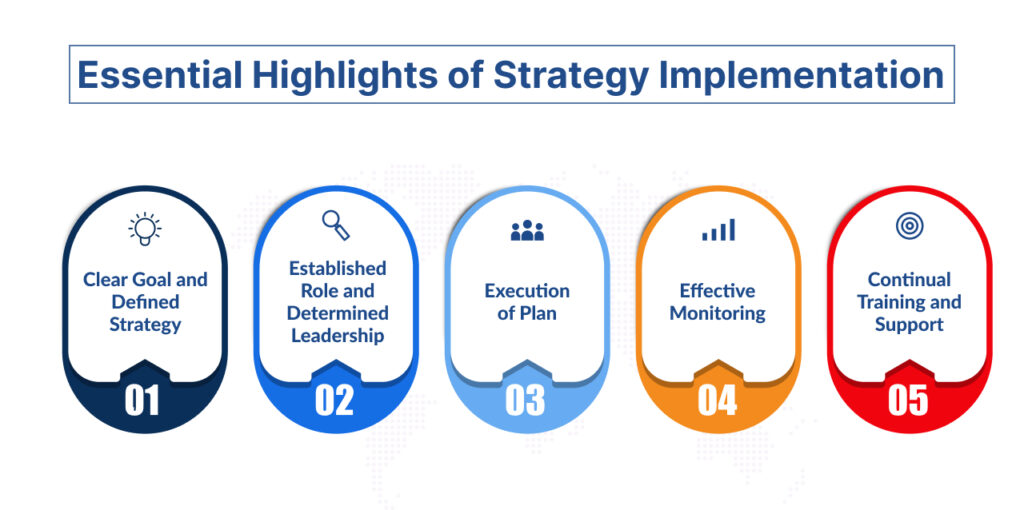
              A project reaches its goals with the help of well-planned thoughts and applying strategic implementation to reach the final goal. Here are the potential highlights that cover the implementation process completely:

              1. Clear Goal and Defined Strategy– Setting a well-defined and clear goal helps an organisation achieve it quickly. Break down your strategy into a chart or PowerPoint presentation for the team to maintain the workflow. A visual draft of the strategy always prompts a positive response, making the team’s goals achievable. A company with a precise alignment of the strategy always meets the vision’s goal.
              2. Establish Roles and Determined Leadership– Defining the role of the team brings excellent performance and accountability. When working on a project that defines and succeeds in the goal, transparency is needed. Choose a determined leader who can lead the entire project until its deadline. Ensure each team member handles their responsibilities and collectively overcomes the project challenges to meet its end goal.
              3. Execution of Plan– Once the plan and project are assigned to their team, start the execution process. When working on a project, take the initial steps and make a progress report to check its direction. Finally, use your critical thinking and problem-solving skills to reach the end of the goal.
              4. Effective Monitoring– Update the team on the project’s progress to understand where you face challenges and how to overcome them with new ideas. Motivating the team for the project is an excellent way to reach the final point while maintaining productivity. Additionally, each team’s progress must be monitored to identify the challenging areas of the project and improve it after that.
              5. Continual Training and Support– A supportive team extends and addresses a great deal of knowledge and solves problems effectively using innovative ideas. The team must encourage each other’s work performance to reach one common goal. 

              Tips for Powerful Strategy Implementation

              A project needs step-by-step consideration and strategic implementation of the ideas to reach its goal. Here are the following tips that include:

              1. Promote Fair Honesty– Ensure fair and honest communication between you and your team. This will reflect a team spirit and help you grow within the organisational space. Honest leadership builds trust among team members and fosters an accomplished environment. It will also help the team grow and give unbiased reviews of their work performance.
              2. Verify Clarity– The final goal in the plan requires clarity so that a strategy can be implemented to achieve it. Once all the team members are clear, productivity work will only occur. Hence, a clear vision is necessary to meet structured-oriented goals.
              3. Supportive Team– In an organisation, there should be understanding between teammates who inspire and support each other whenever a problem arises. A supportive team member always overcomes challenging issues with an effective solution.
              4. Provide the Right Tools– Every workspace requires concrete tools to complete the task successfully. Team members should have the right tools to reach the goals in time. 
              5. Establish Enhanced Communication– In every large company, effective communication between the managers and team members is required to run the work smoothly. Every company provides a messaging app and some right tools to measure the proficiency of work and informed-driven outcomes.

              Strategic Implementation: Overcoming Challenges

              While implementing the strategy, the team can face challenges while reaching its goals. Here are some common pitfalls to guide them:

              1. Shortfall of Clarity: Before the project starts, ensure your strategy is clear, concise, and well-communicated to all stakeholders. Clarifying project doubts is useful before they hinder the implementation process.
              2. Resistance to Change: Misunderstandings while working on a project can lead to confusion and work delays. People naturally resist change, and to overcome this situation, Anticipating resistance can impact the whole team’s ability to reach the common goals. 
              3. Miscommunication: Miscommunication can occur in any team, so it’s advised to have open and transparent communication throughout the implementation process to address concerns and celebrate successes.
              4. Absence of Monitoring and Evaluation: Don’t set an autopilot strategy. Be Regular in your work and monitor your progress to adopt a strategic approach.

              Bottom Line

              Strategic implementation is a multifaceted approach that turns vision into value and requires attentive planning, project execution and continuous improvement to reach the final evaluation of the goal. In an organisation, to achieve an objective strategy, the team needs a clear and defined vision before attaining significant growth. 

              Turning the vision into value is challenging, but the proper methods and approach can lead to achievable growth and stability.

              Strategic Implementation: FAQs

              Q1. Define the role of leadership in strategic implementation.

              The role of leadership is emphasised because leaders process the plan strategically and guide the team to reach its goals. They implement clear decisions, motivate the team, and manage conflicts properly. Influential leaders ensure the strategy is executed as planned to achieve the result without facing any challenges.

              Q2. What do you mean by strategic implementation?

              Strategy implementation is about executing a plan to reach the desired goals. In this process, brainstorming ideas can help formulate action by implementing strategic plans.

              Q3. What are the five stages of strategy implementation?

              1. Define your Vision
              2. Collect Analysed Information
              3. Implement Your Strategy 
              4. Formulate a Clear Strategy
              5. Control and Evaluate

              Q4. What are the seven factors of strategic implementation?

              1. Set clear goal
              2. Determine roles and responsibilities of team members
              3. Assign work
              4. Process and Monitor
              5. Conclude the job
              6. Reflect and Review
              7. Revise and Adjust

              Q5. What are the four aspects of strategy implementation?

              Strategic implementation follows four aspects: Quality, Quantity, Time and Information.

                Enter Your Details To Get Counselling From Our Experts

                I consent to be contacted by Hike Education via Call, SMS, Email, or WhatsApp, even if I'm registered on DND/NDNC.


                MBA After CA: What You Need To Know

                MBA After CA: What You Need To Know

                While many aspire to become chartered accountants, it’s crucial to recognise that this field often confines your knowledge to a specific domain. However, in the era of digitalisation, the job market highly values individuals who can adapt and expand their skill set. This is where the unique benefits of pursuing an MBA after CA come into play, as it can truly transform your career trajectory, offering many options that can propel you beyond the boundaries of your current role.

                An MBA can significantly shift and grow your professional life, equipping you with enhanced learning and development skills. This article is designed to provide a comprehensive exploration of the benefits and career prospects of an MBA Program, ensuring you have all the information you need to make an informed decision. 

                Why Pursue an MBA after CA?

                The candidates decide to pursue an MBA program after CA for various reasons. Here are some:

                1. Broadening Career Options– As a qualified chartered accountant, you already possess fundamental accounting, taxation, and finance knowledge. However, an MBA can provide diverse specialisations in Marketing, Human Resources, Logistics, Operations, and more. The skills you learn during CA and MBA are equally important, but the business market has expanded. An MBA requires a more enhanced skillset for growth and stability in career prospects, offering a wide range of comprehensive career options that can take you beyond the finance sector.
                2. Networking Opportunities– Pursuing an MBA after CA can open doors to significant networking options that benefit you personally and professionally. An MBA program provides a diverse group of students and executives, fostering a great exchange of valuable ideas. This helps build growth and stability in the organisational sector and expands your professional network, which can be invaluable for future career opportunities. 
                3. Diverse Skillset– An MBA program provides multiple skills to CA professionals to explore opportunities in Strategic Thinking, Business Analytics, Entrepreneurship, Team-Management, Problem-Solving, Leadership, etc. The benefit of an MBA Program is that it enhances your overall ability to attain any business challenges. 

                MBA After CA: Key Benefits to Consider

                MBA After CA: Key Benefits to Consider

                In recent times, no one wants to be restricted to one domain, so they choose an MBA program to inherit new skills, upscale their higher education to match industry-based challenges and learn new business fundamentals. 

                Here are the reasons why an MBA can be your turning point after earning a CA degree:

                1. Growth in Career– An MBA program introduces you to several business domains, such as Marketing, Human Resources, Operations, Supply Chain Management, and others. The chances of getting hired become easy if you are an MBA graduate with fundamental skills like leadership, management, problem-solving, critical thinking, and many more to present in the industrial sector. 
                2. Overall Business Knowledge– An MBA degree enhances your business knowledge and widens your strategic, managerial, and leadership skills beyond CA, mainly specified in the finance sector. Business knowledge helps you make insightful decisions and manage all business functions. 
                3. Boosts Confidence– MBA graduates upscale themselves with much-needed confidence to excel in the job market and face the interview without hesitation. The hiring team checks your educational qualifications and emphasises soft skills that reflect how fit you are in diverse roles. The environment where you study hugely impacts your surroundings, which helps you boost your confidence and shapes your career.
                4. Better Understanding of Management—There’s no doubt that CA can secure you financially, but what if you want to explore different leadership roles in the current business market? Here comes an MBA program that can help you with diverse specialisations and equip you with various learning and knowledge relating to business areas that will significantly lead you to higher management positions. 
                5. Entrepreneurial– The crucial advantage of doing an MBA after CA is that it prepares you with solid leadership and management skills to help you become your own boss. Gone are the days when people prioritised a 9-to-5 job; now, in the evolving digitalised world, everyone wants to build their start-up and witness its success over the years.

                Choosing the Right MBA Program After CA

                Choosing the Right MBA Program After CA

                Selecting an MBA program that correctly aligns with your career goals is essential. Here are the points to consider before choosing the MBA program:1. 

                     1. Global Accreditation and High Reputation—When choosing an MBA program, check the global accreditation bodies like The Association of MBAs (AMBA), The International Accreditation Council for Business Education( IACBE), The European Quality Improvement System( EQUIS), and The Association of Advanced Collegiate Schools of Business (AACSB), which ensure high-quality academic standards. 

                •      2. Multiple Specialisation– Being a CA professional, you already have a jackpot of financial knowledge, and to expand yourself in the field of business, you can choose different specialisations in that MBA program. Here are some:
                •  

                MBA in General Management
                MBA in Consulting
                MBA in Project Management
                MBA in Marketing
                MBA in Human Resources Management
                MBA in Information Technology
                MBA in Business Analytics
                MBA in Healthcare
                MBA in Digital Marketing
                MBA in Strategic Management

                •     3. Flexibility– The MBA program comes in different formats: full-time, part-time, online, and executive. The choice of an MBA program depends on candidates’ availability, family commitment, work-life balance and learning convenience. If you opt for a full-time MBA course, you can learn immensely from university, whereas a part-time or executive MBA provides learning alongside working side by side. The last is an online MBA, which ensures you can learn at your own pace and preference without hindering your studies and other responsibilities.

                MBA After CA: Advanced Career Scope

                While CA is a renowned program, pursuing an MBA makes it more significant and preferable. Let’s learn the career scope an MBA degree provides:

                1. Diverse Career Opportunities

                Job Role 

                Descriptions

                Marketing Manager

                • They manage the overall campaign for the social media platform and also ensure that the company is gaining profit from customer interaction. 

                HR Manager

                • Their task is the recruitment and training process, and they also deal with employee-related issues to find easy solutions.

                Project Manager

                • They plan, organise and execute the entire project with the help of the team leaders.
                • They define the project and document its progress.

                Business Analyst

                • They identify the problem and make informed decisions for the organisational sector to maintain positive performance.

                Business Intelligence Analyst

                • Their task is to organise data points, deploy data, and warehouse data.
                • They also review customer files and ensure coherence of data collection. 

                Investment Banker

                • Their work involves raising client capital through strategic advisory and improving financial statements by regulating client value. 

                Product Manager

                • Their task involves meeting customers’ needs and crafting a product vision that delivers different values.
                • Their responsibilities also include setting strategies and evaluating ideas. 
                  •  
                  • 2. High Salary Boost– According to a Glassdoor source, one crucial benefit of doing an MBA after CA is the potential salary, which ranges from INR 1,20,568 per month. The demand for MBA graduates is projected to be most valuable worldwide, and therefore, they command higher salaries based on job role, skills, and work experience.
                  •  
                  • 3. Global Exposure– An MBA can provide a gateway to global career opportunities. Many MBA programs have a strong international focus, offering global immersion experiences, international internships, and exchange programs. This global perspective is particularly beneficial for CAs looking to work in multinational corporations or explore opportunities abroad.

                Conclusion

                Pursuing an MBA after a CA is a prominent choice made by those who want to upgrade their education and financial status. It comes with numerous job opportunities and specialisations to build a stable career. MBA brings advancement in salary prospects, defining one’s skills to bring impact in the business sector. 

                If you are planning career growth, Hike Education is here to help you with all the advantages and guidance you need to transform your career.

                MBA After CA: FAQs

                Q1. Is an MBA necessary after a CA?

                Pursuing an MBA after CA entirely depends on the candidates who want to enhance their careers by delving into an MBA program. An MBA offers a broad specialisation that benefits your diverse job options and increases your salary potential. 

                Q2. Which MBA course is better after CA?

                While there are many courses, opting for these options will improve career paths. Here are some:

                • MBA in Consulting
                • MBA in Marketing
                • MBA in Human Resources
                • MBA in Product Management
                • MBA in Information Technology

                Q3. What is the salary after a CA MBA?

                The average salary of MBA professionals after doing a CA is generally around INR 20,00,000 to 22,00,000 annually. 
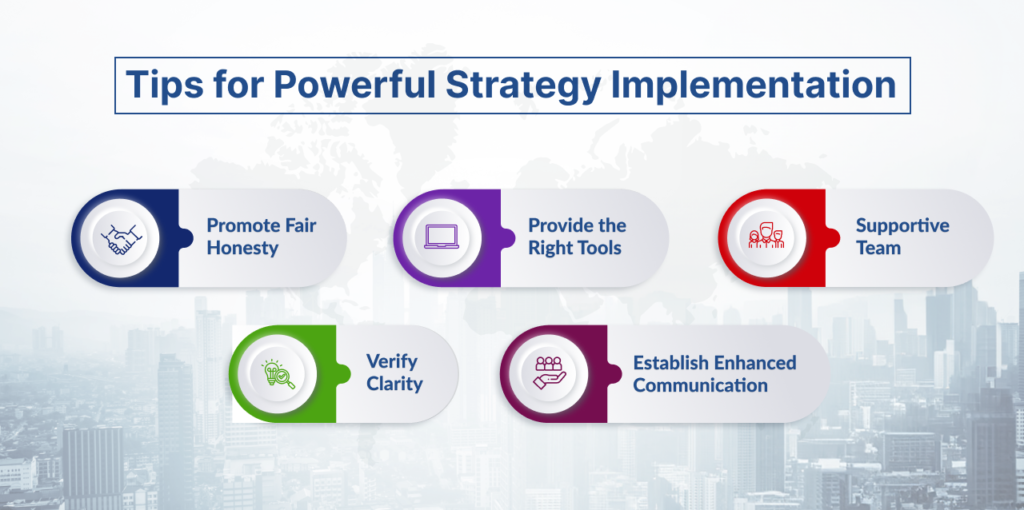
                Q4. How does an MBA complement a CA qualification?

                An MBA provides comprehensive business knowledge, strategic management ability, and leadership skills, which is how it complements a CA-qualified professional. At the same time, CA limits itself to finance and accounting experience, while an MBA focuses on broader fields such as Marketing, HR, Sales, Operations, Consulting, etc.

                Q5. Which is the toughest, CA or MBA?

                CA is considered more challenging than an MBA because it delves into the subjects of Taxation, Financial Accounting, Business Environment, Auditing, Reporting, etc., which requires detailed knowledge of each course curriculum.

                  Enter Your Details To Get Counselling From Our Experts

                  I consent to be contacted by Hike Education via Call, SMS, Email, or WhatsApp, even if I'm registered on DND/NDNC.


                  Exploring Top BBA Career Options: Your Gateway to Success

                  Exploring Top BBA Career Options: Your Gateway to Success

                  In the fast-paced business world, a Bachelor of Business Administration (BBA) degree stands out as a powerful credential that opens doors to many career opportunities. Whether you aim to climb the corporate ladder, start your venture, or specialise in finance, marketing, or human resources, a BBA provides the essential knowledge and skills to thrive. In this blog, we will discuss the best BBA career options, salary, and the best companies to apply to. Let’s explore!

                  Introduction to BBA Career Options

                  BBA is a general, flexible undergraduate degree program with essential business knowledge. It is a field that encompasses elements like management, marketing, finances, human resources, and operations. This is true as the BBA embraces a generalised learning process that prepares graduates for any job market.

                  If your goal is to be employed with an MNC, want to have your own business, or be part of a government organisation, then BBA can be the perfect stepping stone for you. Now, let us explore some promising job profiles that successful candidates in BBA are likely to enter.

                  Top 8 BBA Career Options

                  Top 8 BBA Career Options​

                  Here is a table summarising the career options, their average salaries in India, and the top companies that hire for these roles: 

                  Career Option

                  Salary (India)

                  Top Companies

                  Data Scientist

                  10 lakhs per annum

                  TCS, Infosys, IBM, Accenture

                  Digital Marketer

                  7 lakhs per annum

                  Google, Facebook, Amazon, Flipkart

                  Business Analyst

                  8 lakhs per annum

                  Deloitte, McKinsey, Accenture, Infosys

                  Product Manager

                  10 lakhs per annum

                  Google, Microsoft, Amazon, Apple

                  HR Manager

                  10 lakhs per annum

                  Tata Consultancy Services, Accenture, Deloitte, Wipro

                  Advertising Manager

                  12 lakhs per annum

                  Ogilvy & Mather, JWT India, McCann Worldgroup, DDB Mudra

                  Financial Expert

                  12 lakhs per annum

                  HDFC Bank, ICICI Bank, SBI, Axis Bank


                  Note – Average salaries are subject to change based on market conditions and individual qualifications.


                  1. Data Scientist


                  In today’s world, data is everywhere. It seems impossible to avoid it, yet it is impossible not to embrace it. The insights derived from such analyses help firms formulate business strategies that enhance the appeal of their offers and satisfy consumers’ needs.

                  This is where data scientists come into play. Data science is a professional field in which a data scientist collects data and analyses it to make policies, decisions, or strategies.
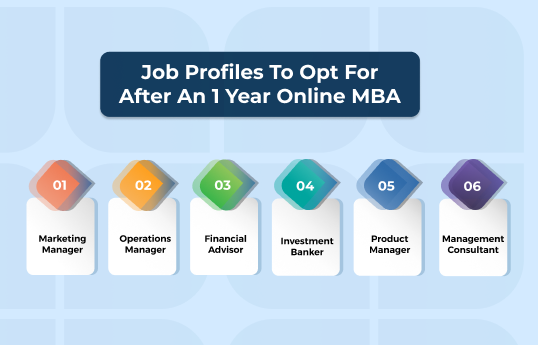
                  After getting your BBA degree, you can choose to be a data scientist by learning more about data analysis, with data programming and improving your IT skills in statistics. As the business landscape evolves, BBA career options expand, offering graduates more opportunities to excel.

                  2. Digital Marketer


                  The digital marketing industry is evolving very fast. It is a marketing technique that includes selling products and services through technological themes like social media, search engines, and emails.

                  Marketing is one of the basic areas of a Business Management degree and also a field that offers knowledge regarding marketing strategies, customer psychology, and marketing analysis. This is one of the BBA career options for the future generation.

                  3. Business Analyst


                  Business analysts are crucial in helping organisations improve their processes, products, and services. They analyse business needs, identify areas for improvement, and recommend solutions to enhance efficiency and profitability.

                  When you complete your BBA, you’re ready to understand the business environments you intend to serve, mechanical and organic analysis, and business strategy.

                  To transition into the business analyst position, some extra education in data analysis, project management, and business intelligence may be necessary. This career opportunity is an excellent opportunity to be involved in different processes and contribute to the organisation’s performance. Business Analyst is the best-known BBA career option nowadays. 

                  4. Product Manager


                  Product managers create products and are held accountable for their success/independence. This team collaborates and engages with other functional teams, such as engineering, marketing, and sales departments, to guarantee that products comply with customers’ needs and business objectives. Product managers can also be the best BBA career options for the future generation. 

                  5. HR Manager


                  Human resource managers manage human capital, commonly referred to as HR, in carrying out organisational affairs. These include issues of staffing, training employees, maintaining good employee relations, and compensation and benefits.

                  The larger roles of HR managers comprise making sure that the work environment is congenial and that employees do not experience dissatisfaction.

                  To obtain this position, one requires knowledge and skills that may be obtained by pursuing a BBA degree with a major in human resources. Further, it is possible to acquire experience by working as an intern or as a holder of an initial position in the field of HR to achieve great performance as a human resources manager.

                  Human Resources (HR) offers compelling BBA career options, with job profiles such as HR manager and recruitment specialist, focusing on talent management and employee relations

                  Read More: One-Year Online MBA Program: Eligibility, Fees, and more

                  6. Advertising Manager


                  They supervise advertising campaigns for products or services, ensuring customer awareness and demand. They collaborate with creative groups, media planners, and the client to ensure that advertisement campaigns and indexes reach the targeted people.

                  With a focus on creative and analytical skills, BBA career options like advertising manager and data analyst offer graduates diverse opportunities to thrive in various industries.

                  Therefore, having a BBA degree emphasising marketing or advertising will enable one to be fit for this position. It’s about consumers’ consumption and utilisation patterns, along with marketing and communication tools.

                  7. Financial Expert


                  Financial experts or Advisors are people with expertise in finance who assist people and firms in making sound financial decisions. They interpret business data, evaluate the prospects of an investment, and advise on how to acquire funding to fulfil certain objectives.

                  With this BBA degree focused on finance, you will develop a solid understanding of financial concepts, financial accounting, and investment analysis. You can pursue further academic credentials, such as CFA or CFP programs.

                  8. International Business Specialist


                  In a world experiencing higher degrees of globalisation, it is imperative to have international business specialists to help operating companies expand into other countries.

                  International business roles are prominent among BBA career options, providing job profiles like international trade specialist and global supply chain manager for those interested in global commerce.

                  They grasp elements of international business, the import/export of goods and services, and cultural variations, which assist organisation in managing business operations in international markets.

                  To perform this role, an individual must possess specific fundamental skills and knowledge, which can be obtained from a BBA degree and a focus on international business.

                  You may also add other skills, such as learning new languages to communicate well with independent or developing countries, experience in international business or trade, or knowledge of global economic trends, that may help as well.

                  Government Jobs After BBA

                  In addition to the diverse career options in the private sector, BBA graduates can also explore opportunities in the public sector. Government jobs offer stability, competitive salaries, and various benefits. Here are some government job options for BBA graduates.

                  Sector

                  Roles

                  Salary (Annual)

                  Banking Sector

                  Probationary Officer (PO), Clerk

                  8 Lakhs

                  Civil Services

                  IAS, IPS, IRS

                  10 Lakhs

                  Public Sector Undertakings (PSUs)

                  Management Trainee, Assistant Manager

                  8 Lakhs 

                  Railways

                  Station Master, Commercial Apprentice

                  8 Lakhs 

                  Defence Services

                  Officer in the Indian Army, Navy, and Air Force

                  15 Lakhs 

                  State Government Jobs

                  Municipal Officer, State Public Service Commission roles

                  8 Lakhs 


                  Note: Average salaries are subject to change based on market conditions and individual qualifications.

                  Civil Services


                  In India, the civil services examination, conducted by the Union Public Service Commission (UPSC), is one of the most recognised examinations in the country. Any BBA graduate can take this examination and opt for a brilliant Administrative Service like IAS, IPS, or IFS.

                  These roles are patriotic, and the candidate must be ready to play a vital role in transforming society. 

                  Banking Sector


                  Candidates with a BBA degree can opt for various posts in Indian public sector banks, such as Probationary Officer (PO), Clerk, and Specialist Officer. These jobs require candidates to undertake tests conducted by the Institute of Banking Personnel Selection (IBPS). 

                  Banking is a good profession because of the numerous employment and training prospects, security, and outstanding benefits.

                  Public Sector Undertakings (PSUs)


                  Public Sector Undertakings, otherwise known as PSUs, are government enterprises that offer job openings in different streams for BBA graduates. 

                  The Bachelor of Business Administration (BBA) holder is, therefore, very marketable and may find opportunities in firms such as Bharat Heavy Electricals Limited (BHEL), Oil and Natural Gas Corporation (ONGC), and Steel Authority of India Limited (SAIL).

                  Combine your passion for public service with your business knowledge acquired from a BBA degree by exploring the diverse career paths in civil services, one of the many rewarding BBA career options.

                  The versatility of BBA career options is evident in government roles like tax examiner and customs officer, where graduates can play a crucial role in revenue collection and regulation.

                  State Government Jobs


                  They also have the option to work in state government departments for employment after they complete their BBA degree. For any administrative, finance or manager post, there are examinations that each of the States sets for their people. These jobs are many, well-paid, rooted in the community and serve many people.

                  Read More:- What is the entrance exam for MBA?

                  Options for Further Study After BBA

                  Options for Further Study After BBA​
                  1. Master of Business Administration (MBA): Offers advanced knowledge in business administration and management, with specializations available in areas like finance, marketing, entrepreneurship, and international business.
                  2. Master of Science (MSc) in Business Analytics: Focuses on advanced statistical and analytical techniques for interpreting complex data sets, making graduates highly desirable for data-driven decision-making roles.
                  3. Master of Science (MSc) in Marketing: Provides advanced coursework in marketing strategies, digital marketing, market analysis, and consumer psychology, preparing graduates for leadership roles in marketing management and market research.
                  4. Master of Human Resource Management (MHRM): Specializes in talent acquisition, employee relations, compensation management, and  organisational development, opening up opportunities for leadership roles in HR departments.
                  5. Chartered Financial Analyst (CFA) Program: Ideal for those interested in finance and investment management, covering topics such as investment analysis, portfolio management, and ethics in finance, leading to careers in investment banking, asset management, or financial consulting.

                  Note – If you’re feeling uncertain about which path to take for further studies after your BBA, check out Hike Education’s website for personalised career guidance. We’re here to assist you every step of the way!

                  Conclusion

                  Acquiring a BBA degree is one way of being assured of getting into a fulfilling and successfully positioned employment field. This shows that the possibilities are incredibly diverse regardless of whether you decide to work for a private company, to do government service, or to further your education.

                  One of the most appealing aspects of a BBA degree is the diverse BBA career options it offers aspiring business professionals.

                  Moreover, gear yourself with the time to manage your spare time by engaging in activities that you are interested in developing skills in or finding the career you really want.

                  The key is to stay curious, keep learning, and seize the opportunities that come your way. With a BBA degree, the sky’s the limit!

                  BBA Career Options : FAQs

                  Q1. What are the best BBA career options?

                  The BBA degree, upon completion, opens up a number of vocational prospects in different sectors of the economy, including managerial positions, marketing, financial services, and human resources. Some of the employment opportunities for graduates are in private organisation or sectors, going into business on their own, or seeking a government position.

                  Q2. Can I pursue higher studies after BBA?

                  Many BBA graduates further their education to advanced levels, such as Master of Business Administration (MBA), Chartered Accountancy (CA), or other specialised master’s programs.

                  Q3. What skills are essential for a successful career after BBA?

                  It is  essential to develop practical communication skills, leadership, problem-solving, analytical thinking, and adaptation abilities to be successful after receiving the BBA degree. It is also possible to gain specialised knowledge in particular fields, including data analysis, online marketing, or projecting financial results.

                  Q4. Are internships important for BBA graduates?

                  Internships are a necessity for BBA students because they help them gain hands-on experience and a view of what awaits them in the field by applying the theory learned at school. Internships can also be beneficial in building your resume increasing your chances of getting a job.

                  Q5. Can I get 1 lakh salary after BBA?

                  Pay disparities exist in India for individuals who complete a BBA degree. The typical yearly compensation for graduates of business administration programs ranges from INR 1.5 Lakhs to INR 10 Lakhs, contingent on industry, region, experience, and employer standing.

                  More Information:-

                  The Ultimate Guide to MBA After 12th: Eligibility, Job Profiles, Exams and Career

                  MBA Dual Specialization: A Complete Roadmap


                    Enter Your Details To Get Counselling From Our Experts

                    I consent to be contacted by Hike Education via Call, SMS, Email, or WhatsApp, even if I'm registered on DND/NDNC.


                    Business Finance: Definition, Importance, Types and More

                    Business Finance: Definition, Importance, Types and More

                    Hey there! Have you ever wondered how businesses manage all the money stuff? It’s like being the boss of your piggy bank but on a much bigger scale. Welcome to the world of business finance! Don’t worry if you still need to become a money whiz; we’re here to break it down for you in the easiest way possible. It is all about handling the dough (not the pizza kind, though that’s important, too).

                    Business finance is the secret sauce behind every successful company, from starting a business to running smoothly and making it grow big and strong.

                    So, grab a comfy seat and get ready to dive into the exciting business world. We promise it’s going to be a journey worth taking!

                    What is Business Finance?

                    It is the practice of financing a business. Like any other person, organisations also require managing money, though it could be on a large or small scale, depending on the type of business involved.

                    It is the management of funds for businesses, including how to raise funds and the proper utilisation, allocation, and control of such funds.

                    Business finance refers to the management and regulation of financial resources in a business to ensure the proper functioning of its business processes, the determination of funds required for specific activities, the accumulation of funds, and their allocation.

                    Importance of Business Finance

                    While you have an idea of what business financing is, let’s get to know more about its importance:

                    Category

                    Description

                    Starting a Business

                    Startup funds are essential for buying equipment, leasing a location, and compensating employees at the initial stage of launching a business.

                    Running Day-to-Day Operations

                    Businessmen and businesswomen require capital to operate their businesses. This includes paying bills, purchasing business-related items, and paying employees’ wages.

                    Growth and Expansion

                    Growing businesses require more money to expand, open outlets, purchase machinery, or employ staff. Funds are crucial for a business’s financial needs.

                    Unexpected Expenses

                    Extra cash may be needed for equipment failure or business losses. Sufficient funds are a buffer against unexpected expenses, ensuring the business is hardly affected by surprises.

                    Long-Term Success

                    Organising the funding process is crucial for sustainable success. This includes developing long-term business strategies, securing its wealth, and averting future dangers.

                    Types of Business Finance

                    Types of Business Finance

                    It is worth noting that various finances exist for business organisations. Being familiar with these types assists a business in choosing which type suits its needs.

                    1. Equity Finance: Refers to a process by which firms raise funds by selling ownership stakes in their businesses.Share purchasers are given a stake in the business; thus, share ownership means having a stake in it. Such finance does not come with repayment expectations; however, it implies an element of loss business controls.
                    2. Debt Finance: This is another method where a business gets money by providing banking facilities. The business gets cash by agreeing to pay back a certain amount of cash plus interest. This may be in the form of bank loans, bonds, or other financial institutions. 
                    3. Self-Finance: Self-finance, also known as bootstrapping, is a process whereby a business’s operations are funded through the owner’s profit. This profit can be cash reserves, borrowing from friends or family, or operating profits.Self-finance means that no external financier or creditor can ask for collateral in return for funding, and the owner must not surrender ownership of the business; however, this may limit the amount of capital available to support expansion.
                    4. Grants and Subsidies: Now and then, you get some funds from the government or other sources, which you have to repay in the future. They are often awarded for a particular project, be it a research project, product development project, or community project.
                    5. Crowdfunding: A company occasionally gathers small funds from many people, generally from the internet. This idea of fundraising may occur when the organisation is unwilling to take a payday loan or sell ownership stakes.

                    Sources of Business Finance

                    Sources of Business Finance​

                    Now, let’s look at where businesses can get this money from:

                    1. Banks: Banks are one of the standby sources of business funding. They provide credit facilities such as loans, lines of credit, and any other form of financial accommodation that a business can use to manage its funds.

                    However, funding availability normally depends on the bank’s credit status and feasible business plan, among other factors.

                    2. Investors: Some of the sources of finance that investors provide include equity finance. These can be individuals funding the venture individually (like angel funding) or organisations that fund the venture (like venture capital funding firms).

                    Businessmen unlock capital funds, to which investors contribute their cash, wanting to own stakes and a proportion of the profits.

                    3. Government Programs: Most governments have introduced various schemes that will assist financial aid companies in funding their businesses.

                    This may involve grants, loans, and subsidies. Such programs are usually targeted at particular types of undertakings or categories of beneficiaries.

                    4. Business Profits: The business can use profit to carry out the work and expand its operations. This is preferred in many cases because it requires no borrowing and does not entail selling off equity.

                    5. Friends and Family: There are opportunities to attract funds from friends and relatives at certain times. This can work well for small businesses or businesses with a recent start, but it is crucial to understand responsibilities, especially when they do not involve employment.

                    Important Concepts

                    1. Cash Flow Management: Cash flow is the money circulating in and out of the business. Proper cash flow management is vital to ensuring the adequate financing of business requirements, payments, and possible investments.

                    It is still imperative to state that capital management, particularly cash flow, can cause financial issues if a business is profitable. 

                    2. Financial Planning and Forecasting: Saving, on the other hand, involves identifying what we want to achieve financially and how we will achieve it. Financial planning, therefore, integrates definite objectives to be financially met with blueprints of how those objectives are to be met.

                    3. Budgeting: It is also essential to prepare a budget strategy and adhere to it when it comes to spending so that the business does not overemphasise expenditures.

                    A budget aids the organisation by helping to plan and allocate the resources needed by the business and constrain undesirable expenditures. Budgeting forms a core element of business finance and ensures that the finances are on track.

                    4. Financial Statements: Knowing the meaning of revenue and expense statements, assets and liabilities, and cash receipts and payments is important for business financing.

                    These genuine business papers show how a business organisation is doing in its operations and finances. Interpreting these statements is crucial in formulating various financial strategies within business organisations.

                    5. Investment Analysis: Since it involves managing money for a business, the selection of an investment also presents a critical issue.

                    In this particular analysis, information about an investment and possible investment opportunities is assessed to evaluate its profitability and risk. This assists in developing scaling up in the right financial manner to meet their goals and objectives.

                    Conclusion

                    Business finance is essential for any business, big or small. It helps businesses start, operate, grow, and succeed. By understanding the different types and sources of financing a business. It can make better financial decisions and ensure their long-term success.

                    Business Finance: FAQs

                    Q1. What is business finance?

                    It refers to the department responsible for the overall control and management of funds and other financial processes in a business. This entails managing funds, including planning, controlling, saving, and future resource allocation, a.k.a. investing

                    Q2. Why is business finance important?

                    The concept of finance is essential as it aids businesses in many stages—from the establishment, running day-to-day operations, expansion, contingencies, or general growth and management for the best long-run results.

                    Q3. What are the types of business finance?

                    Some major types of finance are equity financiers, debt financiers, self-financers, grants/subsidies, and crowdfunding.

                    Q4. Where can businesses get finance from?

                    Business sources of finance include the availability of finance from banks, the sale of stock, government grants and loans, and profits from other businesses, friends, and families.

                    Q5. What is the difference between equity finance and debt finance?

                    Equity finance involves selling shares in a company, with the money gotten in return being used to finance the investment, while debt finance entails borrowing money, which has to be paid back with an additional cost known as interest.

                      Enter Your Details To Get Counselling From Our Experts


                      Our Programs