Can I Do MBA After BA? An Ultimate Guide

Can I Do MBA After BA? An Ultimate Guide

If you are wondering, can I do MBA after BA? The answer is yes. Imagine the doors that could open for you, transforming your BA degree into a powerhouse of career options with an MBA. Whether you seek history, literature or environmental studies, an MBA will enhance your skills and widen your horizons, propelling you into the business world.  

Earning a BA lays a solid foundation and opens many career paths. If you’re considering leaping your career from BA to MBA, you’re on the fast track to success. An MBA can propel you to new heights, providing endless career opportunities, growth, and an enhanced skill set. 

According to the Allied Market Research report, the MBA education market size was valued at $7.3 billion in 2023 and is anticipated to reach $12.9 billion by 2032  at a CAGR of 6.1%. This robust growth underscores the value and relevance of an MBA in the job market, assuring you of the promising career prospects that await you. 

This article will cover all the key areas of an MBA and how it will shape your career, instilling confidence and assurance in you. 

Smooth Transformation from BA to MBA

Here are the points that justify the transition from BA to MBA.

1. The Versatility of a BA Degree

A Bachelor of Arts degree is often regarded as a versatile qualification offering a wide range of education in various fields of Science, Commerce, Arts, etc. Pursuing a BA graduate degree helps you gain critical thinking, problem-solving, and practical communication skills. 

Moreover, some people mistakenly think that BA graduates might need help to pursue an MBA, which is usually considered suitable for those with a background in business or technical fields.

2. Why Consider an MBA?

An MBA Programme is two years long and designed to provide advanced knowledge in business and management, ensuring the students equip themselves with the latest knowledge. The course curriculum covers key business areas such as marketing, finance, operation, supply chain, and strategic management, offering a complete understanding of the corporate industries.

3. Bridging the Gap

It may seem troubling for BA graduates to transform into an MBA Programme, but the process is relatively straightforward. You’ll start by researching and choosing the right MBA Programme; then, you must meet the academic and entrance exam requirements. Once you’re accepted, you’ll begin your MBA studies, which will help you open your mind and learn from diverse domains. 

To enrol at MBA colleges, the curriculum covers a broad perspective, believing that educational experience will enrich the learning space. Furthermore, a complete understanding of communication and analysis is needed when considering business studies.

How Can I Do MBA After BA? Understanding its Requirements

Indeed, a BA graduate can pursue an MBA Programme after meeting the following requirements:

  1. Academic Qualification: A bachelor’s degree in any discipline with a minimum of 60% marks and 55% for the reserved category. 
  2. Entrance Exam: Scoring well on MBA entrance exams like CAT, MAT, and XAT is considered by most B-schools. These exam patterns include Logical Reasoning, Quantitative Aptitude, Verbal Ability, Reading Test, etc. 
  3. Research MBA Programme: Before opting for an MBA degree, check for accreditation bodies like AICTE, EQUIS, AACSB, etc., to ensure the quality of the education. Check for the specialisation and colleges that align with your career goals.

What is the Scope of an MBA after BA?

An MBA is a sought-after degree with immense scope or potential to thrive in a career. Below are some compelling and considerable scope or career paths to check:

  1. Career Upliftment: Earning an MBA degree will help you advance your career and provide you with roles like marketing manager, finance analyst, data analyst, business intelligence analyst, etc. 
  2. Enhanced Skillset: An MBA Programme is designed to equip you with a wide range of highly valued skills in the business world. These include leadership, strategic thinking, problem-solving, management, and effective communication. 
  3. Smooth Career Switch: An MBA can help you swiftly change your career path and adapt a new learning approach.
  4. High Salary Potential: An MBA graduate earns more than a person with a BA degree. Top companies actively hire MBA graduates because they possess the required skills and knowledge to bring growth and success.
  5. Broad Networking Opportunities: Pursuing an MBA course provides you with a diverse group of people who facilitate wide networking among peers and faculty members. The MBA Programme facilitates candidates’ strong alumni networks, which help them build valuable connections with various industries. 
  6. Business Knowledge: The MBA Programme provides students with a comprehensive and practical understanding of business.
  7. Diverse Job Options: MBA graduates can explore many career options from Finance, Marketing, Operations, Supply Chain, IT, Human Resources, etc.

Entrance Exam to Take Admission in MBA After BA

If you are thinking, can I do MBA after BA? The answer is yes, but you must take an entrance exam and score well to be eligible for top-ranking colleges. Listed below are some popular exams for which aspirants can apply.

1. CAT: The Common Entrance Exam is one of the most popular annual annual exams IIMS conducts. The question paper format consists of 3 segments- Qualitative Ability, Logical Reasoning & Data Interpretation, Verbal Ability $ Comprehension Reading, etc., with 300 marks. 

Qualifying for this exam opens doors to top B-schools to seek advanced academic qualifications and uplifting career options.

2. MAT: The Management Aptitude Test, conducted by the All India Management Association (AIMA), is a little more accessible than the CAT; another option is to crack this exam and pursue an MBA after a BA. 

This exam is conducted 4 times yearly in February, May, September and December. The question paper for the MAT exam consists of 5 sections- Data Analysis & Sufficiency, Language Comprehension, Mathematical Skills, Indian & Global Environment and Intelligence & Critical Reasoning.

3. XAT: The Xavier Aptitude Test is conducted by its institute, Xavier Institute of Management, Jamshedpur. The exam pattern consists of four sections: General Knowledge, Decision-Making, Quantitative Ability, and Verbal and Logical Ability.

The exam lasts three hours, and once you qualify, you can apply to top B-schools, including IMT, XLRI, and XIMB.

4. GMAT: The Graduate Management Admission Test is a management exam mainly conducted for aspirants who want to study business at a deeper level. The exam paper consists of four sections: Quantitative Aptitude, Verbal Ability, and Data Insights. 

5. SNAP: Symbiosis International University conducts the Symbiosis National Aptitude Test, also known as SNAP, each year. The exam format consists of three segments: Data Interpretation, General English, Data Sufficiency, Analytical and Logical Reasoning.

MBA After BA: Top B-Schools and Fees

Below is a list of top B-Schools for MBA after BA and their fee structures. This information can help you plan your budget and choose the right college for your MBA studies.

Top B-Schools

Average Annual Fees in INR

IIM Ahmedabad

25,00,000

IIM Calcutta

27,00,000

NMIMS School of Business Management

16,00,000

XLRI Xavier School of Management

10,72,000

SP Jain Institute of Management and Research 

17,00,000

Amity University

1,95,000

Manipal University, Jaipur

1,75,000

Symbiosis School for Online and Digital Learning 

3,00,000

Jain University

2,60,000

Lovely Professional University

1,62,800

Please Note: The fees mentioned above can vary depending on the institution and course chosen. 

MBA After BA: Popular List of Specialisation

Here is the list of popular MBA specialisations a BA graduate can consider to start a journey to the business world.

  1. MBA in Marketing
  2. MBA in Finance 
  3. MBA in Operation Management
  4. MBA in Human Resource Management
  5. MBA in Information Technology
  6. MBA in International Business
  7. MBA in Risk Management
  8. MBA in Banking
  9. MBA in Project Management
  10. MBA in Insurance

Career Scope and Salary Potential in MBA After BA

When thinking can I do MBA after BA, also think about all its benefits, such as diverse job roles and potential salaries. Here is a list of different job profiles with their average salary to look after.

Job Profile

Job Descriptions 

Average Salary in INR

Financial Analyst

Making financial and investment decisions of an organisation.

7,00,000

Marketing Manager

Implementing and planning market strategies to promote goods and services.

13,00,000

Data Analyst

Collecting and interpreting data to make insightful decisions for the organisation’s profit. 

7,00,000

Sales Manager

Inspire and motivate the sales team to achieve sales targets.

9,00,000

HR Manager

Oversee the recruiting and training process while also maintaining employee relations among each other.

10,00,000

Business Analyst

Identifying business patterns and finding effective solutions to improve processes.

9,00,000

Finance Manager

Managing the financial budget and report of the company 

15,00,000

Project Manager

Plan, execute and give an end to the project within given deadlines.

19,00,000

Product Manager

Develop the lifecycle of the product from its concept to launch. 

16,00,000

Operations Manager

Oversee business activities to ensure resource allocation and process efficiency to meet organisational goals.

11,00,000

Please Note: The salary mentioned above is subject to change and can vary depending on the company, location, academic qualification, etc.

Summary

Can I do MBA after BA? The answer is Yes. Pursuing an MBA after BA can be a strategic decision to advance your career and help you build skills like leadership, problem-solving, business acumen, time management, etc. Acquiring these skills will guide you to a managerial position with a high-paying salary in the diverse sectors of manufacturing, retail, banking, finance, etc. 

Embrace the challenges and join Hike Education today to get detailed information about the MBA Programme and achieve success.

Can I Do MBA After BA : FAQs

Q1. Can I do MBA after BA?

Indeed! An MBA can be done after a BA in commerce or Science and build your future career in the business and management sector. Aspirants need to score 50% of their marks in their bachelor’s degree to be eligible for an MBA entrance exam and get into top B-schools. 

Q2. What is the MBA scope after the BA?

An MBA provides diverse specialisations in marketing, finance, agriculture, and supply chain management. This course imparts valuable knowledge and helps students earn high salaries. It also allows students to gain managerial skills and a strategic mind. 

Q3. Can I do MBA after BA in any specialisation?

Indeed. If you scored well in your entrance exam, you can choose from various specialisations, such as finance, marketing, banking, data analytics, business analytics, human resources, etc. 

Q4. Which MBA has the highest salary?

Some of the highest-paying MBA specialities are:

  1. Finance 
  2. Marketing
  3. Business Analytics
  4. Data Analyst
  5. Banking
  6. Human Resources

Q5. Which MBA is best for BA students?

Below are some of the top specialisations to check:

  1. MBA in Biotechnology
  2. MBA in Data Analytics
  3. MBA in Marketing
  4. MBA in Entrepreneurship
  5. MBA in Fashion Management
  6. MBA in Event Management

    Enter Your Details To Get Counselling From Our Experts


    Our Programs

    Is Online MBA Valid in India: A RoadmapTo Explore

    Is Online MBA Valid in India: A RoadmapTo Explore

    In today’s technology-driven world, where flexibility and career advancement are paramount, there are alternatives to the traditional MBA programme. Online Learning has emerged as a flexible and convenient option for working professionals like you. The MBA is a highly respected and sought-after degree, but the question that often arises is: Is online MBA valid in India, and could it be the right choice for you?

    This blog will explore an online MBA programme’s advantages and critical highlights, illuminating its potential to catapult your career to new heights and open doors to exciting opportunities. 

    Increased Popularity of Online MBA Courses in India

    Online education has benefits, such as allowing candidates to balance work and study simultaneously. Let’s understand the critical reasons for the growth of online MBAs in India.

    Flexibility and Convenience

    One of the primary catalysts for the surge in popularity of online MBA degrees in India is their unmatched convenience and flexible learning mode. Unlike traditional MBA degrees, online MBA empowers you to learn at your own pace and time while juggling other work commitments. This Programme is a game-changer for working professionals who aspire to strike a perfect work-study balance. Aspiring candidates can access study materials and recorded sessions and participate in interactive group discussions from anywhere in the world, giving them the reins of their learning journey.

    Diverse Range of Specialisations

    Another reason for the growing popularity of online MBA Programmes is the wide range of specialisations they offer, catering to various interests and career goals. Professionals can choose from numerous domains like marketing, finance, human resources, operations, and entrepreneurship, providing an online MBA Programme that aligns with their aspirations. This diversity of courses aligns with their career path and helps them make the most of their degree, which is valuable and relevant.

    Cost-Effective Education

    When the question arises, is online MBA valid in India? Before enrolling in an online MBA Programme, students check the cost and its worth in the job market. Once they learn that there is a vast opportunity and that the course is cost-effective, they provide the admission process. An online MBA programme costs relatively less than a traditional MBA. Professionals choosing an online MBA make higher education accessible and save much money on accommodation, travel, course materials, etc. 

    Recognition and Accreditation of Online MBA in India

    The value of an online MBA degree in India is firmly rooted in the recognition and accreditation bodies held by prestigious universities. Rest assured, an accredited online MBA Programme holds immense value in the job market and can swiftly pave your way to a promising career. 

    Here are some accreditation bodies that help hold higher credibility for the online Programme. 

    1. UGC Recognition: UGC grants that an online MBA has the same syllabus and reputation as a traditional MBA, and the syllabus is the same to provide equal education. The online MBA Programme in India offers UGC-entitled universities that are legitimate and recognised globally. 
    2. NAAC Accreditation: The National Assessment and Accreditation Council process the quality of education provided in the Indian education system. An NAAC-accredited Programme evaluates a higher academic standard and further enhances its reputation. 
    3. AICTE Approved: To those who ask questions like, is online MBA valid in India? The answer is yes because AICTE (All India Council for Technical Education) usually approves online MBA institutions. 

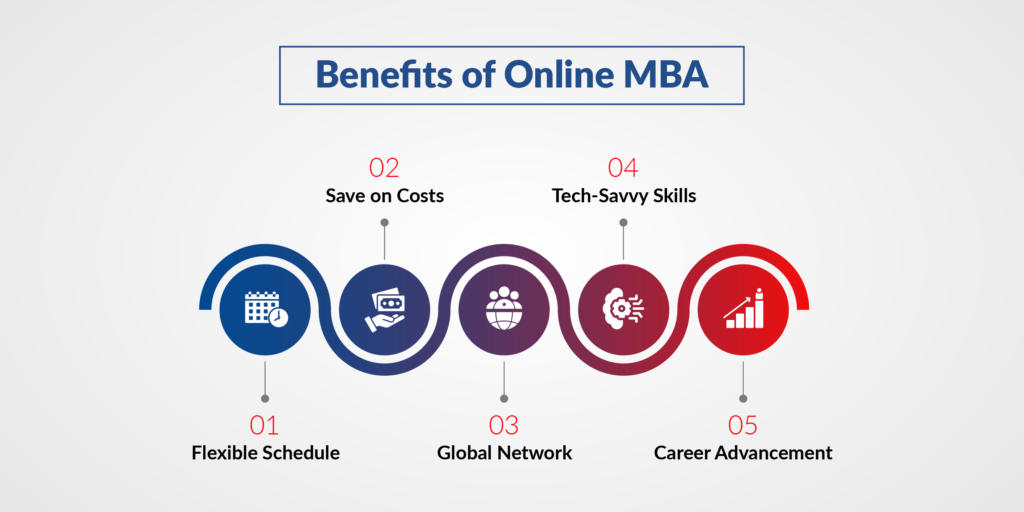
    Benefits of Pursuing Online MBA Courses

    Online MBA courses offer various options for ambitious professionals seeking to advance their careers. Here are some of the vital advantages to consider:

    1. Flexible Mode of Learning: Flexible study enables students to learn at their own pace and provides a balanced form of learning. This opportunity allows students to learn from anywhere without leaving their work responsibilities.
    2. Affordable: An online MBA Programme is relatively inexpensive compared to a traditional MBA, as there are no charges for travel, accommodation, allowance, etc. This Programme can be taken from home or anywhere at one’s convenience. It has equal value to a traditional MBA and prepares you for industrial-based jobs. 
    3. Diversity: The online MBA Programme attracts diverse groups of students from different backgrounds and cultures, which provides them with broad learning opportunities from a variety of other learning perspectives.
    4. International Outreach: Most professionals ask is online MBA valid in India? The answer is yes because it offers significant international outreach, allowing professionals to interact and connect globally with peers and faculty members. This fosters a rich interchange of ideas, new perspectives and grabbing knowledge from one another to experience diverse business learning.This benefits professionals on a high level by allowing them to learn and advance their future career growth by learning about international business ventures.
    5. Improved Credibility: If higher academic bodies or universities accredit an online MBA Programme, it adds value to your resume, and getting hired becomes easier.

    Importance of Online MBA in India

    In India, digital learning is evolving, and there is a promising future for those seeking to build a significant career out of their MBA degree. An online MBA can provide a vital return on investment and equip aspiring professionals with much-needed skills and knowledge to enhance their leadership and managerial qualities. An online MBA can benefit individuals in several ways and help them find career trajectories with high-earning salaries. 

    Is Online MBA Valid in India: Key Highlights

    If you are considering pursuing an online MBA in India, below are the vital parameters that can help aspirants understand better. 

    Features of Online MBA in India

    Descriptions

    Course Name 

    Online MBA

    Eligibility Criteria

    Bachelor’s degree in any stream from a recognised university with a minimum mark of 50%.

    Work Experience

    It is not mandatory but is preferable for some courses for 2 to 5 years.

    Duration

    2 years

    Accepted Entrance Exam

    CAT, MAT, XAT, and CMAT vary by institution.

    Admission Process

    Registration, Document Submission, Selection Test/Personal Interview (if any), Fee Payment, Confirmation.

    Delivery Format

    Live online classes, interactive sessions, asynchronous learning.

    Is Online MBA Valid in India: Popular Courses, Specialisation and Fees

    Listed below are the best colleges, popular specialisations, and fees for a better understanding of the online MBA course in India. Aspirants can choose from diverse fields of study and achieve their career goals.
    Top B-Schools Specialisation Average Annual Fees in INR
    Amity University Online
    • Global Finance Market
    • Hospitality Management
    • Human Resource Management
    • Insurance Management
    • Operation Management
    1,95,000
    Manipal University Jaipur
    • Marketing Management
    • Human Resource Management
    • Finance Management
    • Supply Chain Management
    • Retail Management
    1,75,000
    Symbiosis School for Online and Digital Learning
    • Information Technology
    • Insurance Business Management
    • Banking and Financial Services
    • Export and Import Management
    • Supply Chain Management
    3,00,000
    Jain University
    • Marketing Management
    • Finance Management
    • Technology Management
    • Operations Management
    • Human Resource Management
    2,60,000
    Dr. DY Patil Vidyapeeth
    • Financial Management
    • Marketing Management
    • Supply Chain Management
    • Agribusiness Management
    • Healthcare Management
    1,40,200
    Lovely Professional University
    • Supply Chain Management
    • Finance Management
    • Operations Management
    • Marketing Management
    • Human Resource Management
    1,62,800
    Pondicheery University
    • General Management
    • Healthcare Management
    • Finance Management
    • Marketing Management
    • Insurance Management
    75,000
    Chandigarh University
    • Human Resource Management
    • Retail Management
    • Operations Management
    • Marketing Management
    • Finance Management
    2,00,000
    Narsee Monjee Institute of Management Studies
    • Wealth Management
    • Operations Management
    • Supply Chain Management
    • Human Resources Management
    • Retail Management
    3,00,000
    O.P. Jindal Global University
    • Marketing Management
    • Finance Management
    • Supply Chain Management
    • Operations Management
    • Digital Finance Management
    2,10,000
    Please Note: The fees provided here are subject to change and can vary depending on the university and course chosen.

    Career Opportunities With Online MBA in India

    MBA provides a plethora of career opportunities, ensuring online MBA graduates have lists of options to choose from. Below are some respected job lists to consider.

    Job Profile

    Average Annual Salary in INR

    Marketing Manager

    13,50,000

    Finance Analyst

    7,00,000

    Operation Manager

    11,00,000

    Supply Chain Manager

    14,95,000

    Human Resource Manager

    10,00,000

    Retail Manager

    12,00,000

    Investment Banker

    17,00,000

    Business Analyst

    8,90,000

    Data Analyst

    7,00,000

    Sales Manager

    12,00,000

    Please Note: The above salary can vary according to company, academic qualifications, and location.

    Top Online MBA Recruiters

    Below is the top list of recruiters who hire potential online MBA graduates in India:

    1. eBay
    2. HCL
    3. Flipkart
    4. Amazon
    5. Zomato
    6. Nestle
    7. Raymonds
    8. Puma
    9. Future Group
    10. Croma

    Conclusion

    Is an Online MBA valid in India? Many professionals ask this vital question, and the answer is yes because, in recent times, online education has soared and provided a new learning environment to those who want to pursue an online MBA degree at an affordable rate without decreasing its quality level. 

    An Online MBA in India offers several advantages, such as flexibility, convenience, cost-effectiveness, and work-life balance, for developing essential skills. Carefully considering each factor and staying determined to study can help them achieve career heights by pursuing an online MBA in India.

    Is Online MBA Valid in India: FAQs

    Q1. Is online MBA valid in India?

    Indeed. With the fast-paced digitalised world, the value of an online MBA is rising, and it provides education in a virtual mode along with other benefits like flexible learning time, cost-effectiveness, recorded sessions, interactive sessions, capstone projects, etc. Many professionals choose an online MBA apart from doing the job to develop academic excellence and diverse career opportunities.

    Q2.Is an online MBA equivalent to a regular MBA in India?

    Yes. According to UGC, an online MBA is equal to a regular MBA, and it provides the same academic structure and course syllabus to help students stay caught up while studying virtually. UGC’s decision to promote the same learning, whether provided online or offline, is ideal.

    Q3. Which College is best for pursuing an online MBA Programme?

    Several online MBA colleges are available, but the most sought-after and renowned are listed below.

    1. Amity University Online
    2. Manipal University Jaipur
    3. Chandigarh University
    4. Lovely Professional University
    5. O. P Jindal Global University

    Q4. Are there any benefits of an online MBA in India?

    For a working professional, an Online MBA provides numerous benefits, such as

    1. Flexibility
    2. Career Advancement
    3. Cost-effective
    4. Global Reach
    5. Salary Boost

    Q5. What is the fees for an Online MBA in India?

    The fees for an online MBA in India range between 2,00,000 to 3,00,000 for an entire course.

      Enter Your Details To Get Counselling From Our Experts


      Working Professional MBA: Finding the Right Program

      Working Professional MBA: Finding the Right Program

      Choosing the right MBA program is vital to stay connected with business and market trends. According to a Custom Market Insight report, the market value of an MBA program was projected to reach USD 47.1 billion by 2022 and is anticipated to reach up to USD 83.08 billion with a CAGR (Compound Annual Growth Rate) of 15.6%. As you can see, a working professional MBA is in high demand; go for the right specialisation to boost your leadership and managerial qualities that guide you towards a prosperous future.

      In this article, we will understand the advantages of MBAs, the different types, and how to select the right MBA program for working professionals. 

      Advantages of Pursuing an MBA for Working Professional

      Here are the benefits of an MBA that can be considered when pursuing one as a working professional. 

      1. Career Upliftment: Pursuing an MBA can be a game-changer in building a tremendous career. Many companies value an MBA degree and hire them immediately as they possess business knowledge and skills like leadership, strategic thinking, risk management, etc. For working professionals, an MBA degree not only helps in promotion, potential salary, and career shift to different managerial positions but also empowers them with the confidence and capability to take on new challenges.
      2. Flexibility: One of the most empowering aspects of pursuing a working professional MBA is its flexibility. You can choose from various learning formats, including online or blended learning, that allow you to study independently without quitting your job. This flexibility is particularly beneficial for those with busy schedules, as it provides access to the necessary course curriculum, projects, and case studies while maintaining your professional commitments. 
      3. Skill Development: An MBA degree helps you possess diverse skills, from leadership to strategic thinking and business acumen. Working professionals can learn and develop these skills to take on critical organisational projects. 
      4. Building a Strong Network: Another advantage of an MBA degree is developing a solid networking group with your faculty or peer group members to upskill your knowledge and business insights. A strong network with industry helps you get job referrals, mentorship, and business partners. A strong network can also give you access to job opportunities that may not be advertised publicly and can offer support and advice as you navigate your career.
      5. Personal Growth: An MBA can significantly boost your knowledge and develop much-needed skills to enhance your career performance. But more than that, it fosters personal growth, encouraging self-discipline, innovation, and staying updated with business trends. This aspect of personal growth should inspire and motivate you to take the leap and pursue an MBA.  

      How to Balance Work and MBA Together?

      We understand that pursuing an MBA and balancing work simultaneously can be challenging but manageable with correct planning and organisation. It’s essential to be aware of the potential challenges, such as the need for effective time management, the increased workload, and the possible impact on your personal life. 


      Here are some essential tips to help you achieve that balance:

      1. Time Management: Managing time when planning to work and study together can be challenging, but being determined will help you schedule your time and other commitments effectively. Prioritise your work and set reminders to stay focused. 
      2. Stay Motivated: Managing to study and work can be challenging, but staying motivated will help you overcome this situation. Prepare your schedule to align with your career goals, and be determined to achieve your goals.
      3. Take Employee Support: Many employers offer various forms of support to MBA-qualified employees, including tuition fees, access to work from home, and paid time off for study. This support system is designed to reassure and support you in achieving your educational goals, making working professional MBA less daunting and more effective. 
      4. Plan Your Schedule: Make an effective schedule to reach your goals. Minimise screen time and maintain your timetable to make progress in your studies. An MBA is a challenging degree that requires attention, focus, and a positive attitude to crack the entrance exam.
      5. Be Organised: Your progress in study is classified by how organised you are in keeping track of your exams, assignments, and work projects. Make notes and use digital tools to stay dedicated without feeling burdened. Ensure that you meet all your exam objectives.

      Popular Specialisation Options For Working Professional MBA

      Working professionals need clarification while choosing an MBA specialisation, so check the courses below, which are highly demanded in the job market.

      1. Marketing: This specialisation deals with understanding consumer behaviour, developing social strategies, and creating advertising through brand management. It is a versatile domain that will lead you to the most demanding job roles, such as marketing manager, market strategy manager, social media manager, etc. If you are considering an MBA, you can choose a marketing specialisation to gain overall business knowledge. 
      2. Business Analytics: This specialisation helps you emphasise using statistical analysis, modelling and insightful data to make informed business decisions. This field area explores interpreting complex data sets to identify patterns and trends and brings easy solutions to optimise business performance.
      3. Finance: This specialisation involves studying financial reports, managing monetary resources, and managing risk to improve financial investment. Pursuing this course will help you gain concrete knowledge of the finance domain and open doors to multiple career options. 
      4. Human Resources: This area of specialisation helps manage an entire organisation. It involves hiring, training, overseeing day-to-day employee issues, and maintaining friendliness among workers. This domain will upscale your knowledge and expand your communication, teamwork, decision-making, and leadership qualities. 
      5. Data Analytics: This domain covers analysing raw data and uncovering insights to make significant decisions and improve organisational performance. This specialisation uses tools and techniques like data mining, machine learning, and data visualisation to interpret data trends and patterns. 
      6. Project Management: This domain involves planning, execution, and meeting the conclusion efficiently. In this process, you will have a defined project scope, manage deadlines, and meet the end goal of the projects within a constrained time.
      7. Supply Chain Management: It involves overseeing the flow of goods and services from production to the final delivery date. It covers logistics, procurement, and product distribution to reach its final destination. 
      8. Strategic Management: This course deals with implementing and developing a plan to help an organisation achieve its goals and objectives. This course involves strategic planning, aligning initiatives, and resource allocation to meet the organisational goals.

      Working Professional MBA: Exploring Top-Ranking Colleges

      Enroll in the best MBA universities to seek career advancement. Here are the top-ranking colleges that will help you develop your skills and enhance your learning experience. 

      Course Name 

      Top Colleges 

      Executive MBA 

      • IIM Rohtak
      • IIM Raipur
      • OP Jindal Business Education
      • FMS Delhi
      • NMIMS Mumbai
      • IMT Ghaziabad

      Part-time MBA

      • IMT Centre for Distance Learning
      • MIT School of Distance Education
      • IIFT Delhi
      • Chandigarh University
      • KJ Somaiya Institute Mumbai

      Online MBA

      • Amity University Online
      • Symbiosis School For Online & Digital Learning
      • LPU Online (Lovely Professional University)
      • Chitkara University
      • Manipal University Jaipur
      • Manipal Academy of Higher Education
      • Jain University Online
      • Dr. D.Y Patil Vidyapeeth

      Different Job Roles for Working Professional MBA

      Earning an MBA degree as a working professional can be prestigious, and it opens a wide range of job opportunities across various industrial sectors. Here are some key job roles that MBA graduates can pursue.

      Job Profile 

      Average Annual Salary in INR

      Marketing Manager

      17,75,000

      Finance Manager

      15,00,000

      Business Analyst

      8,00,000

      Data Analyst

      7,00,000

      Business Intelligence Analyst

      8,00,000

      Human Resource Manager

      10,00,000

      Operation Manager

      11,00,000

      Project Manager 

      17,00,000

      Logistic Manager

      8,40,600

      Management Consultant

      27,90,000

      Please Note: The salary can fluctuate according to job position, experience, location and educational qualification.

      How to Select the Right College for a Working Professional MBA?

      Here are the key points to check when selecting the MBA program as a working professional.

      1. Define your Goal: If you are a working professional and want to pursue an MBA program, ensure your chosen specialisation meets your career goals. Many in-demand courses are trending in job marketing, such as marketing finance, supply chain management, operations, etc. 
      2. Accreditation: Look for colleges and courses accredited by top bodies like AICTE, UGC, EQUIS, etc that clearly define the quality of the program
      3. Course– Curriculum: Check for a course curriculum that aligns with your career goals and helps you understand the syllabus. 
      4. Alumni Network: Ensure that the colleges you select offer broad networking opportunities and allow you to access diverse knowledge from peer group members, faculty, and other resources. Aspirants can also develop their networking area by participating in workshops and attending guest lectures to expand their professional growth. 
      5. Increased Salary Potential: An MBA is a renowned and sought-after degree that helps you earn a high salary. Your career can grow significantly if you possess relevant skills and work experience.

      Wrap-Up

      Are you looking to take working professional MBA courses? There are a variety of specialisations to choose from, and the most in demand are finance, marketing, human resources, supply chain, healthcare, etc. A professional MBA can be a massive benefit in the job market, and it can help you earn a high-paying salary that considers your skills, work experience, and academic background.

      Each course has advantages, so be specific about what aligns with your career goals. Join today with Hike Education, an ed-tech company that will help you clearly understand the course and choose a defined career path. 

      Working Professional MBA : FAQs

      Q1. What is a working professional MBA?

      An MBA course can help working professionals add academic qualifications to their profiles and learn business-related skills like leadership, problem-solving, communication, strategic thinking, and decision-making to get high-level jobs in diverse sectors. 

      Q2. Which MBA is best for working professionals?

      An Executive MBA is the best course for working professionals because it allows flexible learning options without hindering work responsibilities. An EMBA lasts one year, and many professionals long to take a break from corporate and join an executive program for career advancement.

      Q3. What are the fees for a working professional MBA?

      The average fees for an MBA program for working professionals range between INR 5,00,000 and INR 30,00,000, depending on the institute, location, and course.

      Q4. Which MBA program has the highest value?

      The in-demand MBA courses are:

      1. Finance and Investment Banking
      2. Data Analytics and Business Intelligence
      3. Human Resource Management
      4. Business Analytics
      5. Healthcare Management

      Q5. Which MBA program has the highest salary?

      According to a Glassdoor report, an MBA in business analytics has the highest salary in the job market and can range up to INR 9,00,000 annually.  

        Enter Your Details To Get Counselling From Our Experts


        Executive MBA in HR: Boost your Career Potential

        Executive MBA in HR: Boost Your Career Potential

        Are you a working professional looking to take your Human Resources (HR) career to the next level? An Executive MBA in HR might be the perfect path for you! This type of education is aimed at business people who practice in their workplace and decide to become better, study more, and receive a high position in their companies.

        In this blog, we will explain an Executive MBA in HR, who is eligible for it, which entrance exam to take, specialisations under an Executive MBA, the names of the best colleges in India that offer an Executive MBA, what kind of jobs one can expect with the degree, and possible salary offers. Let’s dive in!

        What is an Executive MBA in HR?

        An Executive MBA is a specialised Master of Business Administration program focused on Human Resources. It is intended for working professionals and concentrates mainly on HR or related professions. Some courses that could be covered in the program are organisational behaviour, talent management, job laws, employee relations, and strategic human resource management.

        Executive MBA aims to equip professionals with advanced knowledge and skills to handle complex HR issues, lead departments, and contribute to their organisation’s strategic goals. This program is usually taken part-time or via weekend classes, thus affording working individuals a chance to manage work and studies.

        Key Features of an Executive MBA :

        1. Target Audience: Working professionals with significant work experience.
        2. Program Duration: Usually 1-2 years.
        3. Study Format: Part-time or weekend classes.
        4. Focus Areas: Advanced HR management, leadership, and strategic thinking.

        Executive MBA: Eligibility

        Executive MBA in HR is popular among working managers and professionals who seek to enhance their business careers. Thus, the admission process has specific prerequisites for the candidates. Here are the standard requirements:

        1. Work Experience: Most programs require candidates to have at least 3 to 5 years of professional experience.
        2. Educational Qualification: To land a position in this career, one must have a bachelor’s degree in any field from a recognised university.
        3. Entrance Exam: In some cases, candidates may also be expected to write an entrance examination, such as the GMAT, GRE, or any examination prescribed by the intended university.
        4. Personal Interview: After clearing the entrance exam, candidates may have to go through a personal interview to assess their suitability for the program.

        Executive MBA: Entrance Exam

        Entrance exams are a vital component of the admission process for an Executive MBA in HR. Here are some of the standard entrance exams you might need to take:

        Common Entrance Exams

        Exam Name

        Description

        Accepted By

        GMAT

        The Graduate Management Admission Test evaluates analytical, writing, quantitative, verbal, and reading skills.

        Many top business schools worldwide

        GRE

        The Graduate Record Examination assesses verbal reasoning, quantitative reasoning, and analytical writing.

        Widely accepted by business schools globally

        CAT

        The Common Admission Test is used by Indian Institutes of Management (IIMs) and other top B-schools in India.

        Primarily Indian B-schools

        University-Specific Tests

        Some universities conduct their entrance exams.

        Specific to the respective universities

        Tips for Preparing for MBA Entrance Exams

        1. Understand the Exam Format: You should have some essential tips, such as acquainting yourself with the structure, sections, and kinds of questions.
        2. Practice Regularly: For practice purposes, it is recommended that you read and review papers from previous years.
        3. Time Management: Introduce timetabling measures you will implement while answering those exams.
        4. Join a Coaching Centre: If the preparation for the examination is still a problem, you might need to join a coaching centre to help you prepare better.

        Executive MBA Specialisations

        An Executive MBA often offers various specialisations that allow you to focus on specific areas of HR. Here are some popular specialisations:

        Popular Specialisations

        Specialisation

        Description

        Talent Management

        It focuses on recruiting, developing the company, and retaining top talent.

        Organisational Development

        Deals with improving organisational effectiveness through planned change.

        Employee Relations

        Covers conflict resolution, labour laws, and employee engagement.

        Strategic HRM

        Involves aligning HR strategies with business goals to drive organisational success.

        Compensation and Benefits

        Specialise in designing and managing employee compensation and benefits programs.


        Choosing the Right Specialisation


        When selecting a specialisation, consider your career goals, interests, and the demand for specific skills in the job market. For example, if you are passionate about improving workplace culture and resolving conflicts, Employee Relations might be the right fit.

        Best Colleges in India for Executive MBA in HR with Full Course Fees

        India has premier B-schools that provide an Executive MBA in the HR stream. Here are some of the top colleges, along with their annual fees:
        College Name Location Full Course Fees (Average INR)
        Indian School of Business (ISB) Hyderabad, Mohali 37,00,000
        Indian Institute of Management (IIM) Ahmedabad Ahmedabad 32,00,000
        Indian Institute of Management (IIM) Bangalore Bangalore 30,50,000
        XLRI – Xavier School of Management Jamshedpur 29,00,000
        Indian Institute of Management (IIM) Calcutta Kolkata 31,00,000
        Note – Fees may be subject to change over time.  These colleges are renowned for their quality educational institutions, backed by faculty staff, course reputation, and excellent student placements. The business world has many opportunities for those who invest in an Executive MBA from these colleges.

        Choosing the Right College

         
        When selecting a college, consider the program’s reputation, faculty expertise, alumni network, and overall return on investment. Visiting campuses, attending information sessions, and talking to alums can provide valuable insights.

        Best Job Roles in Executive MBA

        Executive MBA enables professionals to have access to numerous well-paid positions. Here are some of the top positions you can aim for:
        Job Role Description Average Salary (INR)
        HR Director Leads the HR department, develops policies, and oversees HR strategies. 10 LPA
        Talent Acquisition Manager Manages the recruitment process to attract and retain top talent. 15 LPA
        Compensation and Benefits Manager Designs and implements compensation structures and benefit programs. 18 LPA 
        Employee Relations Manager Handles employee grievances, conflict resolution, and job market relations. 25 LPA
        Organizational Development Consultant Works on improving organisational effectiveness through strategic planning and change management. 15 LPA
        Note – Salary may change depending on time, company, experience and location. 

        Conclusion

        An Executive MBA in HR benefits individuals seeking careers in Human Resources. It ensures customers receive the appropriate skills and know-how to undertake directorial responsibilities and engage in strategic planning for resultative organisational performance. It’s easy to get a job and work simultaneously in high-ranking jobs with high remuneration, making this degree a worthy investment.

        It opens a window of opportunity to learn HRM at a Postgraduate level, either in a specialised field of talent management, employee relations, or general EMBA in HRM. Many colleges in India offer well-recognized courses and are thus the best destinations to pursue the degree of Executive MBA. 

        Therefore, if you are willing to take the next step in your career, you should start an Executive MBA and become your best today.

        Difference Between Executive MBA and Distance MBA: FAQs

        Q1. What is the duration of an Executive MBA in HR?

        An Executive MBA in HR typically ranges from 1 to 2 years, depending on the program structure and institution

        Q2.Can I pursue an Executive MBA while working?

        Yes, most Executive MBA programs referred to in HR programs are structured to accommodate working executives and, therefore, lack fixed class times, which might have been daily compared to traditional MBA programs.

        Q3. What is the average cost of an Executive MBA in HR in India?

        The cost estimate of an Executive MBA  in India would vary from INR 15,00,000 to INR 35,00,000, depending on the college or university.

        Q4. Do I need to take an entrance exam for an Executive MBA in HR?

         In many institutions, students are often expected to take and pass entrance examinations, such as the GMAT, GRE, or CAT. Some universities also have tests that admit students.

        Q5. What are the career prospects after completing an Executive MBA in HR?

        Job placements are good, with chances for one to attain more elevated positions like being an HR Director, Talent Acquisition Manager and Organizational Development Consultant with good pay.

          Enter Your Details To Get Counselling From Our Experts


          Difference Between Executive MBA and Distance MBA

          Difference Between Executive MBA and Distance MBA

          When considering advancing your career through further education, two options often arise the Executive MBA (EMBA) and the Distance MBA. Understanding the difference between executive MBA and distance MBA is crucial for making the right choice. Both programs offer unique benefits and cater to different types of students. This article will explore these differences in simple language, making it easy for anyone considering these options to grasp.

          What is an Executive MBA (EMBA)?

          An EMBA is an MBA programme aimed at professionals with managerial positions and several years of career experience. It is different from a standard MBA program, which is usually attended by people at the beginning of their careers because this degree is designed for mid- to senior-level managers who need to develop their leadership competencies while maintaining employment.

          Key Features of an Executive MBA:

          1. Target Audience: Mid- to senior-level managers
          2. Program Duration: Usually, 1 to 2 years
          3. Class Schedule: Often on weekends or evenings
          4. Networking Opportunities: High, with peers from diverse industries
          5. Cost: Generally higher due to the intensive nature and experienced faculty

          What is a Distance MBA?

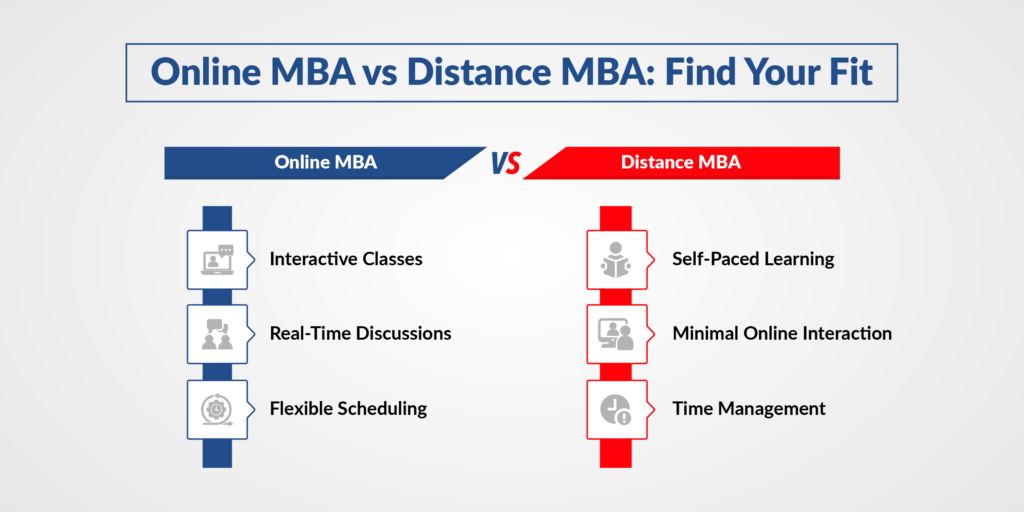
          A distance MBA is best suited for students who require flexibility and convenience. MBA education enables learners to continue education from a distance, sometimes using virtual classes. This program is for anyone, from the start of the career path to professionals who are still in their careers but cannot afford to attend traditional classroom sessions.

          Key Features of a Distance MBA:

          1. Target Audience: Wide range, including early-career professionals
          2. Program Duration: Flexible, often 2 years
          3. Class Schedule: Self-paced, with some live sessions
          4. Networking Opportunities: Lower compared to EMBA, but still valuable through online forums
          5. Cost: Generally lower than EMBA

          Difference Between Executive MBA and Distance MBA

          Understanding the difference between executive MBA and distance MBA involves looking at factors such as the audience, program structure, cost, and career impact. Let’s discuss deeper into each of these aspects:

          Audience and Purpose

          Aspect

          Executive MBA (EMBA)

          Distance MBA

          Target Audience

          Mid- to senior-level managers

          Wide range, including early-career

          Professional Experience

          5+ years (depends upon the different university’s eligibility criteria)

          Varies, can be less

          Purpose

          Leadership and advanced management skills

          Flexible career advancement

          The difference between executive MBA and distance MBA is that EMBAs are designed for experienced professionals looking to step into higher leadership roles. At the same time, Distance MBAs cater to a broader audience with varied career goals.

          Program Structure 

          Aspect

          Executive MBA (EMBA)

          Distance MBA

          Program Duration

          1 to 2 years

          2 years

          Class Schedule

          Weekends or evenings

          Self-paced, online

          Course Delivery

          In-person or hybrid

          Online, with some live sessions

          The difference between executive MBA and distance MBA in terms of structure is significant. EMBAs are more intensive and often require physical presence, while Distance MBAs offer flexibility with online learning.

          Networking Opportunities 

          Aspect

          Executive MBA (EMBA)

          Distance MBA

          Peer Interaction

          High, with in-person classes

          Lower, mainly online

          Alumni Network

          Strong and well-connected

          Varies by institution

          Industry Exposure

          Higher, with industry-focused projects

          Depends on the program

          The difference between executive MBA and distance MBA in terms of networking is that EMBAs provide more direct and robust networking opportunities due to frequent in-person interactions.

          Cost

          Aspect

          Executive MBA (EMBA)

          Distance MBA

          Tuition Fees

          Higher

          Lower

          Additional Costs

          Travel, accommodation for on-campus sessions

          Minimal, mostly online

          The difference between executive MBA and distance MBA in terms of cost is straightforward.

          Distance MBAs cost less due to their online platform, while EMBAs cost more because they offer face-to-face teaching augmented by better-quality faculty.

          Benefits of Executive MBA and Distance MBA

          Executive MBA

          Choosing an EMBA can significantly impact your career, especially if you are aiming for senior leadership roles. Here are some benefits:

          1. Career Advancement: Another factor attributed to the design of EMBAs is to fast-track your professional progression since many result in promotions and higher pay grade opportunities.
          2. Leadership Skills: Leadership and strategic thinking courses are offered at the master of business level and are relevant for directors and managers alike.
          3. Networking: It also offers an opportunity to develop close professional relationships with peers, staff, or faculty that can benefit your future career.
          4. Reputation: An EMBA is tied to some of the most reputable universities, which offers excellent backing to your CV.

          Distance MBA

          A Distance MBA offers a different set of advantages, particularly for those who need flexibility

          1. Flexibility: When studying a subject online, you can learn at a convenient time and pace without giving up essential commitments.
          2. Accessibility: It can be accessed anywhere and at any time of the day, and the tutor and students do not need to be relocated or travel.
          3. Affordability: It is generally comparatively cheaper, so people from different sections of society can afford it.
          4. Technology Integration: This would enable the students to build adequate experience with digital learning tools and e-collaboration, which are prevalent in 21st-century workplaces.

          Challenges of Executive MBA

          While an EMBA has many benefits, it also comes with challenges:

          1. Time Commitment: Considering a solid course schedule and a full-time job, the process can be tricky.
          2. Cost: It indicated that higher tuition and other costs can be an issue.
          3. Intensive Schedule: Closely related to the previous point, the compact schedule provides limited wiggle space, so timing is paramount.

          Challenges of Distance MBA

          Similarly, a Distance MBA has its own set of challenges:

          1. Self-Discipline: High autonomy calls for students to manage their time to catch up with classes independently.
          2. Limited Networking: Less access to peer and faculty interactions in a face-to-face platform.
          3. Technology Dependence: It depends more on technological tools and platforms, it became barrier if you are not comfortable in online platforms. 

          Career Impact: Difference Between executive MBA and distance MBA

          These aspects are also reflected in the effect of the EMBA programme on your career and the Distance MBA programme on your career.

          Executive MBA

          1. Career Growth: It is usually accompanied by a boost in the career track, a change in rank, or even a change in pay scale.
          2. Leadership Roles: It prepares you for responsible senior positions in an organisation, such as CEO, CFO, or even VP.
          3. Industry Recognition: The employers’ recognition means that an EMBA holder can find work with top companies and or industries.

          Distance MBA

          1. Career Flexibility: Enables learners to progress within their chosen fields while still engaged in their existing employment.
          2. Skill Enhancement: Improves your business skills and knowledge, making you more competitive in the job market.
          3. Global Opportunities: It remains possible to gain international perspectives and opportunities for the masses through the comfort of the World Wide Web.

          Choosing Between Executive MBA and Distance MBA

          Anybody facing the option of an EMBA or a Distance MBA needs to consider their own needs. Here are some questions to consider:

          1. Career Goals: You may be keen on training to lead an organisation in the future or rise to the CEO position, or you may be looking for flexibility and just to build on your skills.
          2. Time Availability: Can you attend the standard class times and frequency, or would you prefer a program scheduled around other commitments?
          3. Budget: Regarding other costs, what is your budget for further education, including tuition fees and other expenses?
          4. Networking Needs: Let us now seek your opinion on how important networking is to you. Are you comfortable socialising face to face, or are social interactions through the internet more familiar?
          5. Learning Style: While some people learn better in a rather formal classroom and interact with the instructor and classmates face to face, others prefer flexibility, including self-paced online learning.

          Top Executive MBA Colleges in India 2024:

          College Name

          Rating

          Course Fees (Average)

          Average Salary (PA)

          IIM Ahmedabad – Indian Institute of Management

          4.6

          ₹ 31.50 Lakh

          ₹ 33.05 Lakh

          IIM Calcutta – Indian Institute of Management

          4.6

          ₹ 31.00 Lakh

          ₹ 30.12 Lakh

          Faculty of Management Studies, University of Delhi

          4.4

          ₹ 5.00 Lakh

          ₹ 32 Lakh

          IIM Indore – Indian Institute of Management

          4.4

          ₹ 22.12 Lakh

          ₹ 30 Lakh

          IIM Kozhikode – Indian Institute of Management

          4.5

          ₹ 3.50 Lakh

          ₹ 25 Lakh

          Top Distance MBA Colleges in India 2024:

          College Name

          Full Course Fees 

          (Average)

          Average

           Salary (PA)

          Additional 

          Information

          Indira Gandhi National Open University (IGNOU)

          ₹ 37,800

          ₹ 3.50 Lakh

          Largest open university in India

          Symbiosis Centre for Distance Learning (SCDL)

          ₹ 3,00,00

          ₹ 6.00 Lakh

          Known for flexible learning

          IIMT Centre for Distance Learning, 

          Ghaziabad

              ₹ 1.10 Lakh

          ₹ 7.20 Lakh

          Strong industry connections

          Sikkim Manipal University 

          (SMU-DE)

          ₹ 85,000

          ₹ 4.50 Lakh

          Technology-driven learning

          ICFAI University

          ₹ 65,000

          ₹ 6.50 Lakh

          Comprehensive course material

          Amity University, Noida

          ₹ 2 Lakh

          ₹ 5.00 Lakh

          Globally recognised degrees

          Narsee Monjee Institute of Management Studies (NMIMS)

          ₹ 1.44 Lakh

          ₹ 7.00 Lakh

          Renowned for business studies

          Note – Fees and the average salary are subject to change depending on time and location.

          Conclusion

          One must comprehend the difference between executive MBA and distance MBA before deciding on their research and job prospects. The A and B programs have justified benefits but need to fit the same situations and requirements.

          An EMBA is most suitable for working professionals with (greater) career aspirations of taking top management positions; it is a fully face-to-face program with networking advantages. A Distance MBA, on the other hand, affords flexibility, cost, and easy reach and, therefore, can be convenient for a more extensive client base.

          For more detailed information and to choose the correct course, you can visit the official website of Hike Education. Thor expert counsellors provide comprehensive guidance and support to help you decide about your Distance or Executive MBA options. Visit Hike Education to explore your opportunities today.

          Difference Between Executive MBA and Distance MBA: FAQs

          Q1. What is the primary difference between an Executive and a Distance MBA?

          EMBA is aimed primarily at managers with at least five years of work experience; it is an intensely focused, face-to-face program. Distance MBA is geared toward students of all ages and all levels of expertise who prefer the flexibility of online learning.

          Q2.Which program is more suitable for experienced professionals?

          The differentiated program of the EMBA is more suitable for executive and managerial level candidates with middle-aged or mature managerial professionals in mid- to senior-level positions who seek to augment their leadership and strategic skills.

          Q3. Can I work full-time while pursuing a distance MBA?

          Undoubtedly, you can attend a full-time job while undergoing a distance MBA due to its flexibility, which allows you to conduct studies at your own pace.

          Q4. Are the costs different between Executive MBA and Distance MBA programs?

          Yes, if we compare an Executive MBA with a Distance MBA, the costs are comparatively high because of the packed schedule and experienced faculty involved.

          Q5. Which program offers better networking opportunities?

          The Executive MBA typically offers better networking opportunities due to its in-person format, allowing direct interaction with peers and faculty.

            Enter Your Details To Get Counselling From Our Experts


            Our Programs

            MBA Programs For Working Professionals: Types, Specialisation, Colleges, & More

            MBA Programs for Working Professionals: Types, Specialisation, Colleges, & More

            In the fast-paced digital era, education has evolved to cater to the needs of ambitious working professionals like you. An MBA program could be the perfect fit to boost your qualifications while maintaining your professional commitments. These programs offer many benefits and career opportunities, simplifying the lives of many professionals by providing specialised courses that can significantly shape their careers. 

            In today’s world, MBA programs for working professionals offer many practical benefits, including flexible schedules, leadership development, and the potential for higher salaries. This blog will explore how these programs can empower you to make a significant difference in your career trajectory.

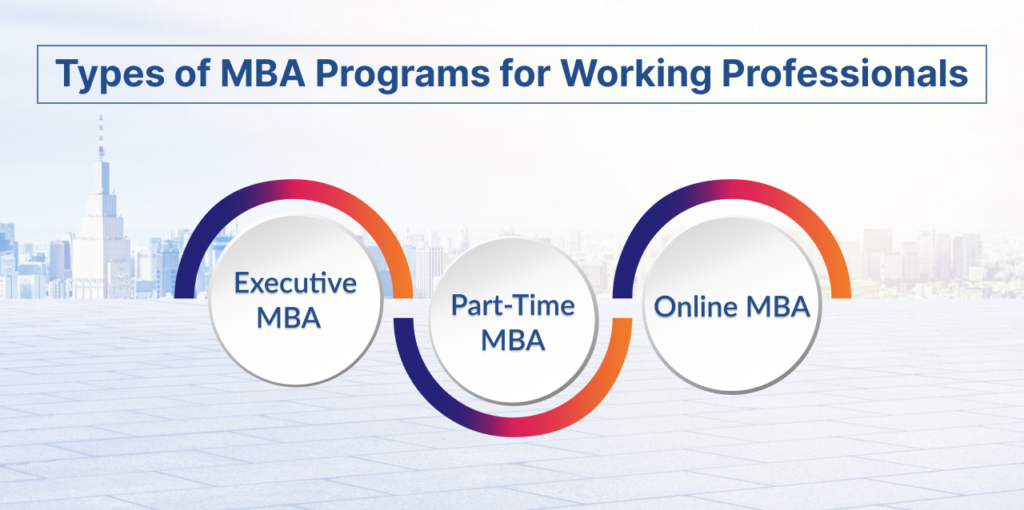
            Types of MBA Programs for Working Professionals

            Types of MBA Programs for Working Professionals
            An MBA is a prestigious degree sought after by many finance, banking, operations, and marketing professionals. Once you enter the program, you’ll learn from industry experts, experienced mentors, and qualified trainers. In this section, we’ll provide a comprehensive understanding of the different types of MBA programs available for working professionals:
            1. Executive MBA– This one-year program is designed for professionals already ahead in their careers who want to upgrade their educational qualifications for better business knowledge, salary potential, and advanced skills.
            2. Part-Time MBA– In an institution, it is generally called an evening or weekend class that provides contemporary learning. It is designed for working professionals who want to advance their careers while doing their jobs. 
            3. Online MBA– This program is conducted entirely online and covers the whole syllabus of a traditional MBA. It offers flexibility and a convenient learning mode, allowing aspirants to study without hindering personal commitments. 
            Now that you’ve learnt the meaning of each type of MBA program, let’s dig into its parameters for better insight:
            Parameters  Executive Year MBA Part-Time MBA Online MBA
            Eligibility Criteria Bachelor’s degree with a minimum of 50% marks in any discipline. Bachelor’s degree in any stream from a reputed institute with at least 50% of the score. Bachelor’s degree in any subject with up to 50% of marks. 
            Duration 12 to 18 months 2 to 3 years 2 years
            Required Entrance GMAT, CAT, GRE, etc. XAT, CAT, MAT, CMAT, GMAT, etc. Depends on the university’s eligibility criteria.
            Work- Experience 2 to 5 years 2 to 4 years 2 to 3 years
            Fees (INR) 4,00,000 to 25,00,000  80,000 to 6,00,000  30,000 to 3,00,000 
            Mode of Learning Regular online classes, evening or weekend classes Evening or weekend classes Online classes
            Please Note: The fees above vary according to the opted stream or colleges.

            Pros and Cons of MBA Programs for Working Professionals

            An MBA program is a sought-after career and is highly demanding in the business world. Earning an MBA degree is like a jackpot for many aspirants who want to enhance their careers and develop much-needed leadership and managerial skills to build professional growth. 

            This degree is highly valued in the job market and can significantly boost your career. Let’s look at some of its key advantages and disadvantages:

            Advantages of the MBA Programs for Working Professionals


            1. Skill Development: The MBA program helps working professionals understand their core subjects and gain in-depth skills to expand their marketing, accounting, and finance knowledge. Additionally, it equips them with leadership, strategic thinking, and management skills, which are highly valued in today’s competitive job market.
            2. Flexible Mode: One of the key advantages of MBA programs for working professionals is their flexibility. You can choose the learning mode that suits your schedule, whether regular online classes, evening or weekend classes, or even entirely online. This flexibility empowers you to learn at your own pace without the stress or difficulty of balancing work and study.
            3. Career Advancement: The MBA program is not just a degree, it’s a stepping stone to a brighter future. It equips you with the knowledge and skills needed to excel in various fields like healthcare, finance, operations, sales, management, and analysis. This diverse skill set opens up a world of potential career opportunities, allowing you to align yourself with the current job market and potentially earn a higher salary. 
            4. Personal Growth: Enrolling in MBA programs for working professionals is not just about gaining a degree; it’s a transformative journey of personal growth. It’s about building your confidence, honing your leadership skills, and gaining a deeper understanding of the business market. With an MBA degree, you open doors to exciting career opportunities that motivate you to reach new heights.

            Disadvantages of MBA Programs for Working Professionals


            1. Time Commitment: As a full-time employee, your biggest concern is time management, which can become challenging if you cannot handle it. Before applying for an MBA program, prepare yourself for its side effects, which come with its advantages. It might look feasible, but juggling your job and studies is the task. 
            2. High Cost: Obtaining an MBA program can be costly, and it might require additional tuition fees that are not affordable for many working professionals. Financial issues can hinder their study and work, making it complicated to advance their careers. However, an online MBA costs much less than a traditional MBA, so plan your budget and choose wisely.
            3. Lack of Classroom Training: MBA Programs for working professionals can cease peer-to-peer interaction and limit interaction with faculty members. Pursuing an MBA degree while working becomes difficult to manage, which is the biggest challenge. It also limits your knowledge of the chosen specialisation. 
            4. Ever-changing Job Market: Digitalisation is evolving in the business market, and the demand for MBAs can vary depending on market and economic conditions. Market trends can fluctuate hugely, impacting an MBA holder’s ability to progress with his degree. To overcome this, aspirants should research and opt for a college that offers an MBA curriculum that aligns with market trends.

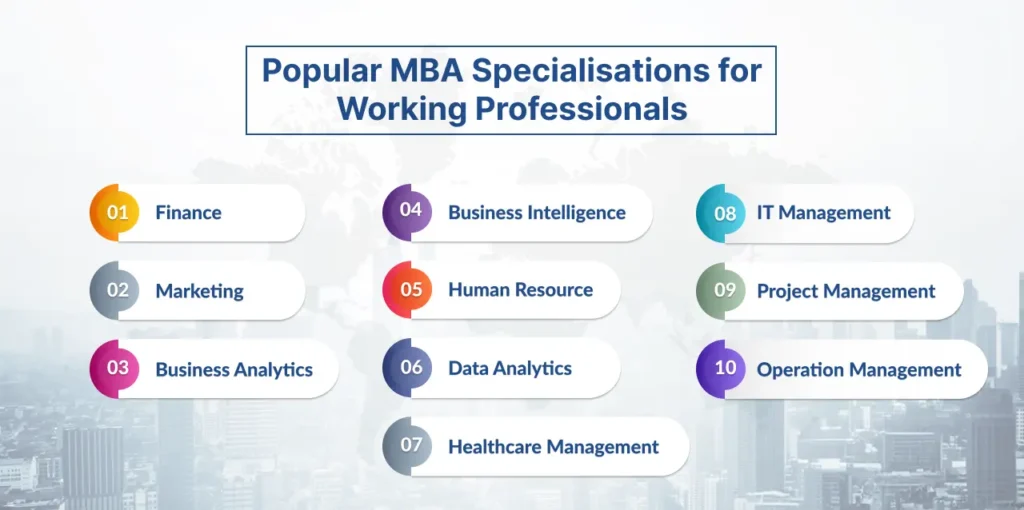
            Popular MBA Specialisation for Working Professionals

            Popular MBA Specialisation for Working Professionals

            MBA provides diverse specialisations which can impact your career for a lifetime. Here are the top MBA specialisations to consider for working professionals:

            1. Marketing: In this specialisation, you will learn to oversee the marketing campaign and manage all social media work. It covers significant topics like consumer behaviour, digital marketing and brand management.
            2. Finance: Learning the financial investment and resources to analyse the company’s profit and loss. The candidates also learn to make strategic decisions to ensure the company’s financial health. 
            3. Business Analytics– Analysing data to make informed decisions for the organisation’s welfare. In this specialisation, the aspirants learn to optimise market trends and data-driven decisions for the business market. 
            4. Business Intelligence– Collecting and analysing data for better insight to make informed decisions.
            5. Human Resources– This specialisation involves managing the workspace, overseeing employee relations, and hiring authentic employees to support the organisation’s growth and success.  
            6. Healthcare Management– Managing the business side of healthcare that deals with patient care, operation systems,  and financial efficiency.
            7. Data Analytics– Using statistical tools, this specialisation extracts data to uncover trends and patterns.
            8. IT Management– This specialisation deals with all the IT functions and supports the operation systems. 
            9. Project Management– The process of project execution and reaching its absolute result is the goal of learning this specialisation that prepares you to complete the target on time before meeting the deadlines.
            10. Operation Management– The process of optimisation and designing to deliver efficient production of goods and services.

            Best Colleges for MBA Programs for Working Professionals

            In India, several MBA programs are available for working professionals who want to hone their skills, apply to industry-based organisations, and improve their careers. Here is the list of top MBA colleges to consider:

            Courses

            Top MBA Colleges for Working Professionals

            Executive MBA

            • OP Jindal Business Education
            • IIM Raipur
            • IIM Rohtak
            • NMIMS Mumbai
            • FMS Delhi
            • Amity University

            Part-Time MBA

            • Symbiosis Centre for Distance Learning
            • IIFT Delhi
            • MIT School of Distance Education
            • IMT Centre of Distance Learning
            • KJ Somaiya Institute Mumbai
            • Chandigarh University

            Online MBA

            MBA Programs For Working Professionals: Potential Job Roles and Salary

            An MBA program opens doors to numerous career opportunities and allows the aspirants to grow in their respective fields. MBA aspirants can choose from a list of job roles with average salaries to build their career trajectory. 
            Job Role  Average Salary (Annual)
            Marketing Manager INR 14,00,000 
            Finance Manager INR 16,00,000
            Human Resource Manager INR 10,00,000
            Business Analyst INR 9,00,000
            Business Intelligence Analyst INR 8,00,000
            Operation Manager INR 11,00,000
            Project Manager INR 10,00,000
            Sales Manager INR 12,00,000
            Management Consultant INR 24,00,000
            Data Analyst INR 9,00,000
            Please Note: The salary mentioned is subject to change depending on education, job location, and work experience. 

            Conclusion

            MBA programs for working professionals have a promising future scope and demand. As digitalisation continues to shape the careers of aspirants, enrolling in an MBA program will help you build your educational pathways and job lives. The skills and knowledge gained during an MBA course prepare you for an industry-based job role and help you establish a better career. 

            To learn more about the program, please visit Hike Education, an ed-tech platform that helps broaden your education horizon.

            MBA Programs For Working Professionals : FAQs

            Q1. What is the difference between a part-time and executive MBA?

            A part-time MBA is designed especially for professionals at various career stages who prefer classes during the evening or weekend. 

            An executive MBA is for those ahead of their careers and want to pursue further education to build leadership or managerial skills.

            Q2. Which MBA Course is best for Working Professionals?

            A working professional should opt for executive management of business administration that allows you to take a break from your career and pursue a full-time executive MBA program. However, someone who wants to pursue their career while doing an MBA can also opt for an Online MBA.

            Q3. Which MBA is most in demand?

            Some of the most in-demand MBA specialisations are-  Finance, Marketing, Information Technology, and Operations.

            Q4. Is MBA programs for working professionals worth it?

            Indeed. Working professionals can pursue an MBA program to advance their careers while learning leadership and management skills to enhance their knowledge.

            Q5. How can I balance work, study, and personal life while pursuing an MBA?

            Traditional MBA programs require a practical time commitment to balance work, study, and personal life. Aspirants must choose the right specialisation that aligns with their daily schedule and responsibilities. However, professionals who want to balance studies and work can also opt for an online MBA program.

              Enter Your Details To Get Counselling From Our Experts


              Strategic Implementation: The Crucial Link Between Vision and Value

              Strategic Implementation: The Crucial Link Between Vision and Value

              An organisation’s future vision is not just a dream but a practical goal that can be achieved through the strategic roadmap. Like a light, this roadmap guides your organisation towards its goals and fuels its passion, translating your vision into tangible results for long-term success. 

              This article will cover all the essential strategic implementation processes to uncover their crucial significance, methods, benefits, and challenges.

              Defining Strategy Implementation: From Vision to Action

              Imagine a puzzle. Your company’s vision is the picture on the box, and strategy implementation is the process of putting all the pieces together to create that picture in reality. Effective implementation, a process that empowers your team, requires the development of plans, resource allocation, and team management to achieve common goals. A strategy must ensure meticulous planning, management, and communication for a correct execution. 

              Here are some vital pillars to follow:

              1. Goal Setting– Maintain clear and time-bound targets that everyone can understand and match individual’s goals.
              2. Action Planning– Take your work slow and break it down into smaller processes to achieve your goals.
              3. Resource Management Determine what you need to get the job done, such as money for expenses, the right skills, confidence, and technology tools. 
              4. Communication– Effective communication is not just a part of strategy implementation; it is the backbone that ensures the smooth flow of strategy plans that match the organisation’s visions. Make sure that everyone understands their role and that their work contributes a positive impact within the organisation.

              Importance and Benefits of Strategic Implementation

              The business world is facing unseen challenges, and to overcome them, we need a defined strategy with clear instructions. Strategy implementation is vital because it involves action, not just ideas, which helps the team understand that the discussed methods are practical. It is also helpful for team members to communicate thoroughly and implement the right tools and strategies to facilitate productive results. These benefits instil confidence and optimism in the team, knowing that their efforts lead to success.

              Lets now delve into its benefits that are in the tabular form:

              Benefits

              Descriptions

              Improved Clarity

              • A defined roadmap limits the problem of uncertainty.

              Enhanced Efficiency

              • Positions the resources into value-generating activities. 

              Increased Accountability

              • Clear and concrete goals lead to better performance.

              Informed Decision-Making

              • The data-driven approach initiates a better decision-making process. 

              Positive Emlopyee Engagagement 

              • Understanding the ‘why’ policies motivate the workers and bring effective change within the work culture.

              Aligning Vision with Strategy Implementation

              A successful strategy implementation is needed to bring an innovative approach towards the company. Here are the points that align with the future vision to achieve a stable perspective:

              1. Articulation of Vision– When communicated effectively, a clear vision sets a tone for the strategy, inspiring the employees and guiding them in a purposeful direction.
              2. Planning Strategically– Strategy development is needed to achieve long-term goals, and it also includes understanding market demands, competitive prospects, and internal and external capabilities. 
              3. Alignment of Culture– The organisation should respect the vision and strategy to foster improved work culture, innovation and constant improvement.

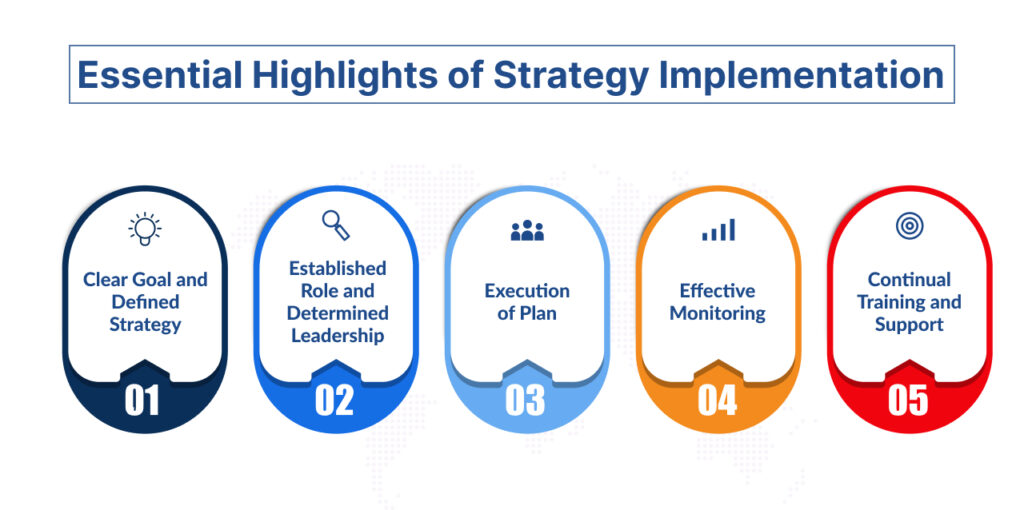
              Essential Highlights of Strategy Implementation

              Essential Highlights of Strategy Implementation​

              A project reaches its goals with the help of well-planned thoughts and applying strategic implementation to reach the final goal. Here are the potential highlights that cover the implementation process completely:

              1. Clear Goal and Defined Strategy– Setting a well-defined and clear goal helps an organisation achieve it quickly. Break down your strategy into a chart or PowerPoint presentation for the team to maintain the workflow. A visual draft of the strategy always prompts a positive response, making the team’s goals achievable. A company with a precise alignment of the strategy always meets the vision’s goal.
              2. Establish Roles and Determined Leadership– Defining the role of the team brings excellent performance and accountability. When working on a project that defines and succeeds in the goal, transparency is needed. Choose a determined leader who can lead the entire project until its deadline. Ensure each team member handles their responsibilities and collectively overcomes the project challenges to meet its end goal.
              3. Execution of Plan– Once the plan and project are assigned to their team, start the execution process. When working on a project, take the initial steps and make a progress report to check its direction. Finally, use your critical thinking and problem-solving skills to reach the end of the goal.
              4. Effective Monitoring– Update the team on the project’s progress to understand where you face challenges and how to overcome them with new ideas. Motivating the team for the project is an excellent way to reach the final point while maintaining productivity. Additionally, each team’s progress must be monitored to identify the challenging areas of the project and improve it after that.
              5. Continual Training and Support– A supportive team extends and addresses a great deal of knowledge and solves problems effectively using innovative ideas. The team must encourage each other’s work performance to reach one common goal. 

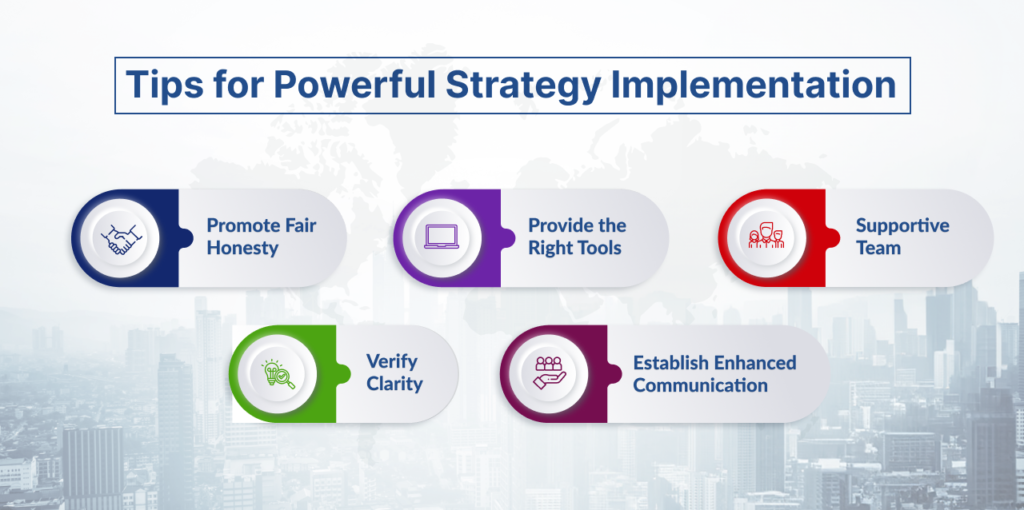
              Tips for Powerful Strategy Implementation

              A project needs step-by-step consideration and strategic implementation of the ideas to reach its goal. Here are the following tips that include:

              1. Promote Fair Honesty– Ensure fair and honest communication between you and your team. This will reflect a team spirit and help you grow within the organisational space. Honest leadership builds trust among team members and fosters an accomplished environment. It will also help the team grow and give unbiased reviews of their work performance.
              2. Verify Clarity– The final goal in the plan requires clarity so that a strategy can be implemented to achieve it. Once all the team members are clear, productivity work will only occur. Hence, a clear vision is necessary to meet structured-oriented goals.
              3. Supportive Team– In an organisation, there should be understanding between teammates who inspire and support each other whenever a problem arises. A supportive team member always overcomes challenging issues with an effective solution.
              4. Provide the Right Tools– Every workspace requires concrete tools to complete the task successfully. Team members should have the right tools to reach the goals in time. 
              5. Establish Enhanced Communication– In every large company, effective communication between the managers and team members is required to run the work smoothly. Every company provides a messaging app and some right tools to measure the proficiency of work and informed-driven outcomes.

              Strategic Implementation: Overcoming Challenges

              While implementing the strategy, the team can face challenges while reaching its goals. Here are some common pitfalls to guide them:

              1. Shortfall of Clarity: Before the project starts, ensure your strategy is clear, concise, and well-communicated to all stakeholders. Clarifying project doubts is useful before they hinder the implementation process.
              2. Resistance to Change: Misunderstandings while working on a project can lead to confusion and work delays. People naturally resist change, and to overcome this situation, Anticipating resistance can impact the whole team’s ability to reach the common goals. 
              3. Miscommunication: Miscommunication can occur in any team, so it’s advised to have open and transparent communication throughout the implementation process to address concerns and celebrate successes.
              4. Absence of Monitoring and Evaluation: Don’t set an autopilot strategy. Be Regular in your work and monitor your progress to adopt a strategic approach.

              Bottom Line

              Strategic implementation is a multifaceted approach that turns vision into value and requires attentive planning, project execution and continuous improvement to reach the final evaluation of the goal. In an organisation, to achieve an objective strategy, the team needs a clear and defined vision before attaining significant growth. 

              Turning the vision into value is challenging, but the proper methods and approach can lead to achievable growth and stability.

              Strategic Implementation: FAQs

              Q1. Define the role of leadership in strategic implementation.

              The role of leadership is emphasised because leaders process the plan strategically and guide the team to reach its goals. They implement clear decisions, motivate the team, and manage conflicts properly. Influential leaders ensure the strategy is executed as planned to achieve the result without facing any challenges.

              Q2. What do you mean by strategic implementation?

              Strategy implementation is about executing a plan to reach the desired goals. In this process, brainstorming ideas can help formulate action by implementing strategic plans.

              Q3. What are the five stages of strategy implementation?

              1. Define your Vision
              2. Collect Analysed Information
              3. Implement Your Strategy 
              4. Formulate a Clear Strategy
              5. Control and Evaluate

              Q4. What are the seven factors of strategic implementation?

              1. Set clear goal
              2. Determine roles and responsibilities of team members
              3. Assign work
              4. Process and Monitor
              5. Conclude the job
              6. Reflect and Review
              7. Revise and Adjust

              Q5. What are the four aspects of strategy implementation?

              Strategic implementation follows four aspects: Quality, Quantity, Time and Information.

                Enter Your Details To Get Counselling From Our Experts


                Best MBA Project Ideas: Complete Guide

                Best MBA Project Ideas: Complete Guide

                Almost there, future business titan! You’ve crushed classes, aced presentations, and perfected the art of the all-nighter (we feel you). Now, it’s crunch time – the MBA project. But don’t let it turn into a stress monster! With the number of MBA project ideas available online in shops increasing daily, an individual can be overwhelmed when searching for the best fit. Fear not, aspiring MBAs!

                This guide will provide the best ideas and motivation to design a project aligned with program objectives. It sets you on the path toward professional and personal fulfilment.

                Why Is Choosing the Right MBA Project Ideas Important?

                Here’s a concise explanation of why choosing the right MBA project is essential:
                Benefit Description
                Skill Development Enhances practical and managerial skills.
                Career Growth Improves job prospects and promotion opportunities.
                Networking Connects with industry professionals and potential employers.
                Industry Insight Provides deep understanding of specific industries.
                Practical Experience Applies theoretical knowledge to real business problems.
                Innovation Encourages creative problem-solving.
                Personal Satisfaction Boosts confidence and sense of achievement.
                Employer Value Demonstrates expertise and initiative to employers.
                Academic Excellence Enhances academic record with impactful projects.
                Future Opportunities Opens doors for future projects and professional development.

                Top MBA Project Ideas Across Specialisation

                Top MBA Project Ideas Across Specialisation​

                MBA projects are distinct in that they can be readily altered to accommodate shifting circumstances, much like snowflakes. Here are some top MBA project ideas that you should know before starting your project : 

                1. Finance:


                The Rise of Fintech: Examine how FinTech has influenced and disrupted the traditional financial service sector. See how players disrupt various spaces, including payments, wealth management, and lending. Think about the lack of qualitative research and the subsequent implications for expanded access to financial services. This is a timely MBA project idea that explores a rapidly evolving field.

                Cryptocurrency Integration: Evaluate the two papers and the possibility of using cryptocurrency in investment decisions. Sensitise the risks and opportunities inherent in the asset class and recommend solutions for adequately integrating it into the portfolio.

                Risk Management in Volatile Markets: Utilize the risk management principles to manage this new sphere for interacting with market conditions. It could involve assessing the appropriateness of stress testing approaches, portfolio diversification methods and hedge programmes.

                Refrain from settling for generic MBA project ideas. Find a project that excites you and showcases your unique skills.

                2. Marketing:


                The Influencer Effect: Explore the effects of social media influence on the purchase process. This refers to engaging different categories of influencers, their reach to different audiences, and various ethical implications of the partnerships.

                Data-Driven Marketing: The topic is the use of Artificial Intelligence in the localisation of marketing campaigns. Insight into how the technology of AI can be used in delivering messages, product recommendations and preferences of each customer.

                Evolving SEO Landscape: Review the dynamic character of SEO activities since it is an essential and ever-evolving field.

                Because Google’s algorithms are a major factor in deciding how visible websites are, it is important to discuss the implications of these changes and the most effective strategies to deal with them.

                3. Operations Management:


                Supply Chain Resilience: Develop strategies for building resilience into supply chains in an era of global disruption. This could include diversification of suppliers, near-shoring initiatives, and investment in logistics technology.

                Digital Transformation in Manufacturing: Describe the various strategic manufacturing issues that may be affected by digital technologies such as robotics and automation in manufacturing. Explain to what extent new approaches to management, organisation, and work will directly impact the overall efficiency, workers’ productivity, and the quality of products.

                Sustainable Operations: Introducing the concept of a Sustainable Business Operations System to guide practice within an organisation. This might refer to reduced waste management practices, using energy conservation methods, and procuring materials in the best way possible.

                4. Human Resource Management:


                Remote Work & Employee Engagement: Examine how remote work affects personnel engagement and performance. Establish appropriate approaches for the organisation to adopt when creating a conducive environment for employees working remotely, communicating with them, and encouraging teamwork.

                Diversity & Inclusion in the Workplace: Analyze best practices for creating a diverse and inclusive workplace environment. Explore strategies for attracting and retaining talent from diverse backgrounds and promoting an atmosphere of respect and inclusion.

                The Future of Work: Future developments in the labour market, including trends such as automation processes and the gig economy, should also be investigated.

                As part of the analysis, job roles that may be affected by the implementation of emerging technology applications should be discussed critically, as should the relevant skill sets required for workforce development strategies.

                5. Information Technology:


                Cybersecurity in the Cloud: Develop a framework for secure cloud computing practices. This could include data encryption strategies, access control mechanisms, and disaster recovery plans.

                The Rise of Blockchain Technology: Analyze the potential applications of blockchain technology in various industries. Explore its use cases in areas like supply chain management, secure financial transactions, and data provenance.

                Big Data Analytics for Business Growth: The important next step is to establish the guidelines for using big data analytics for this purpose. This could include methods of data collection, methods of data presentation or visualisation, as well as usage of data in decision processes.

                6. International Business:


                Business Risks of Emerging Markets: Analyze the opportunities and challenges associated with doing business in emerging markets. Consider factors like political instability, currency fluctuations, and infrastructure development.

                Global Supply Chain Management: Formulate practical approaches to address logistical global supply chain requirements. This could include economic interconnecting policies such as trade, commerce, movement of people, products, services, and social factors.

                The Future of International Trade: Examine the potential impact of technological advancements and geopolitical shifts on international trade.  Examine how these  factors shape the global market . 

                Best Innovative Product Ideas for MBA Students

                Although the concept of conventional projects is decent, it’s high time you uncork the emerging entrepreneur within you, so here it comes.

                Product Idea Focus Tools/Technologies
                Smart Home Energy Systems Optimising Home Energy Usage IoT, Smart Sensors
                AI-driven Personal Finance Apps Financial Management AI, Mobile Apps
                Eco-friendly Packaging Sustainable Packaging Biodegradable Materials

                Let’s explore some innovative product ideas that leverage current trends and have the potential to disrupt the market:

                1. The Sustainable Shopping Assistant: Organise an app for consumers to make them informed and sensitive to environmental impacts. It is proposed that valuable features such as product life cycle assessments, carbon footprint comparison, and product origin be implemented to assist in proper purchasing.

                  Remember, a well-chosen and executed MBA project idea can be a launchpad for your career. So, get ready to dive in and showcase your business prowess!

                2. The AI-Powered Mental Wellness Coach: Design an intelligent conversational agent app that will kindly offer a helping hand to those in need of mental healthcare services. This will require integrating features such as mood tracking, guided meditation features, links to mental health resources, and increased focus on solutions for well-being.

                3. The Hyper-Personalized Learning Platform: Propose an application that horizontally integrates technology solutions, allowing educators and learners to choose content and delivery modalities that align with their learning style and objectives.

                  Introduce an artificial intelligence engine for improved review and analysis of student performance, and suggest an appropriate learning journey map suited to the dynamic market needs in the education sector.

                4. The Immersive Travel Experience App: Create an application that is not just an application to use variants of a travel guide. One should include aspects like the possibility of overlaying historical sightseeing sites with AR, virtual tours, and real-time translation services as a break from the traditional travel activity experience.

                5. The Smart Home Security System (Elderly Care Focus): Design a smart home security system specifically designed for elderly care. Integrate features like fall detection, medication reminders, and emergency contact buttons, providing peace of mind for families and promoting independent living for seniors.

                Tips to Choose the Right MBA Project Idea

                Picking a great MBA project idea is easy! Here’s how:

                1. Pick something you like & want to learn more about. This will keep you motivated.
                2. Make sure you can find info on it. No point in picking a topic with no research available.
                3. Focus on solving real business problems. Show you can use MBA skills in the real world.
                4. Try a new twist on an old idea. Can you look at it from a different angle?
                5. Talk to your teachers! They can help you pick a good topic and avoid issues.
                6. Keep it manageable. Don’t pick a giant project you can’t finish on time.

                Conclusion

                MBA project ideas selection is as much an investment in oneself as choosing the right program. Connecting your project with your interests and finding a place in the existing business environment creates favourable conditions for success.

                Bear in mind that while a solid academic grounding is essential for designing a good project, it is equally vital that the chosen idea stimulates your passion and demonstrates your ability to reason independently and creatively to the assessors. Thus, feel free to start from the ground and work on your chosen topic; make your project a starting point for your career.

                Best MBA Project Ideas : FAQs

                Q1. How long should my MBA project be?

                This depends on the kind of program you are pursuing. On average, students’ projects are 2000-4000 words or about 20-40 pages.

                Q2. Can I work on a project with a team?

                It is common practice to form groups for the assignment, but it is advisable to consult your program guidelines for special instructions.

                Q3. Is there external data available for my project?

                Several government and industry institutions offer open access to data, often free to download. Libraries may also be important in the given context.

                Q4. How can I showcase my project beyond the classroom?

                It is also advised to participate in various competitions or contribute to publishing articles in relevant publications online.

                Q5. What happens after I complete my project?

                Launching a project successfully is a ladder to the top of your career. Include it in interviews or simply use it to pave the way to getting freelance consulting jobs.

                  Enter Your Details To Get Counselling From Our Experts


                  Our Programs

                  Equity Principle of Management: Importance, Advantages and More

                  Equity Principle of Management: Importance, Advantages and More

                  Employees, valuable assets of any organisation, are the driving force behind the Equity Principle of Management (EPM). This principle, pioneered by the father of management, Henry Fayol, advocates for a work environment free from inequity and biases, placing the utmost importance on every individual’s unique contribution. 

                  In this article, we will learn about the scope, advantages, and more about EPM to understand its core aspects.

                  What is the Equity Principle of Management?

                  In Management, the principle of equity states that all employees should be treated equally and fairly. Henry Fayol believed that within the organisation, all employees should be given equal emphasis in terms of gender, caste, colour, position, religion, etc.

                  The fundamental principles of equity include the following:

                  1. Fairness- Ensures that no one should fall behind or be favoured in one group of circles.
                  2. Transparency- Information should be accessible to all the stakeholders.
                  3. Inclusiveness- Presenting the decision-making process to diverse groups.
                  4. Accountability- Holding the responsibility of the group and individuals for their actions.

                  Before discussing Equity further, let’s discuss the other equally important principles. 

                  Henry Fayol's 14 Principles of Management

                  In an organisation, the management principle helps the managers to get the best from employees and run a smooth culture within the industry. Here are the detailed principles to follow:

                  Principle of Management 

                  Descriptions

                  Division of Work 

                  • Splitting the work among teammates to maintain work efficiency and assign each person to a task they are good at.

                  Authority

                  • Managers have the right to give commands to their employees and expect to follow them, but they should maintain responsibility for their actions.

                  Discipline

                  • An organisation should run on discipline, which keeps the company reputed. 
                  • Employees should follow the company’s rules and regulations to foster leadership and growth.

                  Unity of Command

                  • In an organisation, there should be only one person whose command you need to follow, whether it be the Team lead, Manager, CEO, etc. 

                  Unity of Direction

                  • A team with the same objective should be managed under one person using similar pain.

                  Subordination of Individual Interests to the General Interest

                  • The team’s interest should come before the interests of the single employee.

                  Remuneration

                  • Employees should be paid fairly for their distinctive job roles and responsibilities.

                  Centralisation

                  • It states that the power of decision-making is centralised at the top and is considered necessary.  

                  Scalar Chain

                  • It reflects a communication chain between employers and their superiors, defining their position in the organisational hierarchy. 

                  Order

                  • It states that everything in the organisation should be in the right place at the right time.

                  Equity

                  • There should be fairness between employers and managers to maintain loyalty and team-building.

                  Stability of Tenure of Personnel

                  • Working longer benefits in gaining work experience, which develops efficient skills and knowledge.

                  Initiative

                  • It states that employees should develop different ideas to implement progress in their work. 
                  • This emphasises innovation and enthusiasm in their work responsibilities 

                  Esprit de Corps

                  • Teamwork is welcomed within the organisation to build a healthy and friendly workplace.

                  What is the Importance of the Equity Principle of Management?

                  In the work culture, everyone craves fairness and equality, and the principle of equity champions these values. It fosters a positive organisational environment, promoting transparency and employee well-being. A healthy work environment enhances productivity and employee satisfaction, ensuring a harmonious work atmosphere where all decisions are driven by equality. 

                  Let’s learn the features of the principle of equity:

                  1. Strong Trust– To have a healthy workplace, one must be transparent with stakeholders and promote fairness and equity.
                  2. Enhanced Decision-Making– A diverse perspective is needed to make profound and insightful decisions that benefit the company.
                  3. Risk Reduction– Limiting the risk of legal issues will adhere to equitable practices.
                  4. High Productivity– Ensures all employees are highly motivated to provide their best work, emphasising increased productivity.

                  Advantages of Fayol’s Principle of Equity

                  Advantages of Fayol’s Principle of Equity​

                  The principle of equity in management promotes fairness and justice within the company, significantly changing the work environment. Here are the compelling advantages of the principle of equity to consider:

                  1. Builds Team Spirit– If the company is friendly, healthy, nonjudgmental, and empowers you to grow, team spirit usually builds up with its positive surroundings. It becomes easy for the teammates to achieve the organisational goals that bring stability and successful growth.
                  2. Enhanced Collaboration and Diversity– The equity principle of management brings various perspectives from different employees where ideas are valued and voices are heard. When an organisation understands your point of view, it leads to innovation, collaboration, and problem-solving
                  3. Increased Employee Retention– Employees who feel appreciated and are treated fairly are less likely to seek employment elsewhere. When an organisation builds equity, it increases their desire to stay loyal to the company.
                  4. Morale and Motivation– A defined equity principle of management creates a fair workplace, boosts employees’ morale, enhances work motivation, and creates a healthy and friendly environment. 
                  5. Conflict Mitigation and Disputes– Justice in the decision-making process limits organisational conflicts and disputes. Employees are mature enough to avoid negative behaviours like favouritism, discrimination, or resentment to create a team spirit organisation.

                  Conclusion

                  The equity principle of management fosters a healthy environment within the organisation through a strategic approach which implements a productive and thriving work culture. The organisation’s goal is to maintain an equal standard of team building, which leads to outstanding achievement by building a solid foundation and guaranteeing fairness, justice, and respect to all employees.

                  Equity Principle of Management: FAQs

                  Q1. What is the Principle of Equity?

                  Equity is defined as fairness to all employees regarding respect, work opportunities, etc., to establish teamwork within the company.

                  Q2. Why is the Principle of Equity important?

                  A workplace requires EPM to ensure equal opportunities for all employees. This principle provides the same chance of applying for a position, participating in team projects, and accessing professional development within the company’s surroundings.

                  Q3. How is the Equity Principle of Management implemented in an organisation?

                  In an organisation, EPM is implemented by defining objectives, enhancing stakeholder engagement, developing policies, and allocating resources to monitor effectiveness.

                  Q4. Can equity impact an employer's performance?

                  Indeed, when an employee is treated fairly and respectfully, the performance is impacted hugely.

                  Q5. How can managers exercise equity?

                  Managers had to be fair to all employees, reflecting teamwork and enhanced organisational productivity.

                    Enter Your Details To Get Counselling From Our Experts


                    Our Programs

                    Online MBA vs Distance MBA: Advantages, Salary, and More

                    Online MBA VS Distance MBA: Advantages, Salary, and More

                    Getting an MBA is a big step towards moving up in your job and becoming a better professional. However, because business management education is changing, people who want an MBA now have to decide which learning style is best for them: the standard regular MBA, the more modern online MBA, or the open distance MBA.

                    In this blog, we will explore and discuss the difference between an online MBA vs distance MBA.  It will also help you make a well-informed decision that aligns with your career goals.

                    What is an Online MBA Course?

                    The online MBA is a two-year graduate degree programme that can be done entirely online without having to go to a university or institute. With an online MBA, you can study at your own pace and on your own time, which can be very helpful for people who are already working. Online MBA programmes are easier to get into and cost less than traditional MBA programmes because you don’t have to move or pay for transportation.

                    Even though the classes are online, many MBA programmes give students chances to interact with their teachers and peers. It also allows them to enhance their knowledge through virtual group discussions, workshops and other online activities. Students who want to get an MBA can choose from several specialisations, such as finance, marketing, human resources, and more.

                    What is a Distance MBA Course?

                    Distance MBA is abbreviated to DMB or D.MBA, which means learning via a distance mode without the requirement of physically attending classes. Students will receive study materials either by post or online platforms, and while doing assignments and the expedition, they will be required to work by themselves.  

                    For a long time, it was called as correspondence course but now it is known as distance MBA. Students receive their study materials and learning tools, including video lessons, PDFs, and other files, in the mail or via email.

                    Also, distance MBA programs have hybrid flexibility, which may intrude on the interactive elements common in traditional classroom settings. 

                    Difference between Online MBA VS Distance MBA

                        Aspect Online MBA Distance MBA
                    Delivery Method Primarily conducted over the internet. Relies on physical study materials and correspondence.
                    Interaction Virtual classrooms, forums, and chats for discussions. Limited interaction, often asynchronous.
                    Flexibility High flexibility with 24/7 access to course materials. Flexible, but may require more self-discipline.
                    Accreditation Accredited by recognised institutions. Accredited by recognised institutions.
                    Exams and Assessment Often conducted online with remote proctoring. Exams may be taken at designated centres or via mail.

                    What are the Benefits of doing an Online MBA?

                    Benefits of Online MBA
                    1. Flexibility: Such online and distance MBA degrees ultimately offer an alternative to the traditional on-campus MBA program that allows students to study at the pace and timing chosen. 
                    2. Accessibility: Online and distance education MBA pathways remove physical restrictions. Thus, those with various backgrounds can accomplish higher learning without changing their places of origin.Through this openness, the students are empowered to learn from each other, encouraging and building diversity within the institution.
                    3. Cost-effectiveness: While conventional on-campus MBA programs may have higher tuition fees compared to online and distance learning programs, the elimination of extra expenses such as commute or accommodation makes them much less costly. 
                    4. Career Advancement: Besides online delivery and distance education, students acquire all the much-needed skills and knowledge they need to steer their careers forward. This opportunity to remain employable and gain the necessary experience makes for a combination that can’t be found in plain education.

                    Online MBA Best Colleges and their Fee Structure

                    Several colleges stand out for their quality education and reputation when considering Online MBA programs. Here are a few top colleges offering Online MBA programs, along with a brief overview of their fee structures:

                                 College

                       Fee (INR)

                    Amity Online

                    1,95,000

                    Manipal Online

                    1,75,000

                    LPU Online

                    1,63,000

                    DPU Online

                    1,70,000

                    Symbiosis

                    1,50,000

                    Amrita Vishwa Vidyapeetham

                    1,70,000

                    Note: These approximate fee structures can vary depending on residency status, scholarships, and additional fees. It’s essential to check the official websites of these universities for the most accurate and up-to-date information on tuition and fees.

                    Online MBA Eligibility Criteria

                    The online MBA Eligibility differs throughout Educational Institutions. The requirement for an online MBA program is a bachelor’s degree. To be admitted to the best online MBA programs in India, applicants must fulfil the following qualifying requirements:

                    Educational Qualifications:

                    •  
                    1. A bachelor’s degree from an accredited university in a related field.
                    2. A minimum of 50% overall (45% for SC/ST students)
                    3. Students in their last year may also apply to take online MBA courses.

                    Aptitude Test:

                    1. Certain universities use the results of the XAT, CAT, MAT, CMAT, and SNAP tests to consider admission. Therefore, candidates must take management entrance exams.
                    2. Applicants had to meet the minimum online MBA cut-off in order to be eligible for the exam.

                    Work Experience:

                    1. Although not required, a certain amount of job experience in a related subject would be beneficial.
                    2. The minimum required work experience is three years following graduation, though the requirements may differ amongst institutions.

                    Age:

                    1. In India, there is no upper age limit for applying to online MBA programs.

                    Online MBA and Distance MBA Salary in India as per the Roles

                    Exploring the salaries individuals with Online MBA or Distance MBA degrees can expect to earn in India, categorised by different job roles or positions. However, earning potential may vary due to conditions like the program’s reputation and networking.

                    There will mostly be positions such as Marketing Manager, Financial Analyst, and Operations Manager, offering lucrative salaries to fresh MBA graduates in India. Here’s a comparative overview of the salary ranges for these roles based on Online and Distance MBA qualifications: 

                    Role

                    Average Annual Salary (Online MBA)

                    Average Annual Salary (Distance MBA)

                    Marketing Manager

                    INR 8-15 lakhs

                    INR 7-13 lakhs

                    Financial Analyst

                    INR 6-12 lakhs

                    INR 5-10 lakhs

                    Operations Manager

                    INR 9-16 lakhs

                    INR 8-14 lakhs

                    These remuneration ranges are exemplary and change depending on the situation, e.g. company size, geographic location, industry demand, and individual negotiation skills, among other factors. 

                    Meanwhile, online and distance MBA graduates can anticipate competitive compensation packages based on their certifications and expertise.

                    Online MBA vs Distance MBA: Which one is better?

                    Online MBA vs Distance MBA: Find Your Fit

                    It would be answered to a varying degree depending on an individual’s taste, learning styles, and career goals. However, both vary as teachers will either switch to the audial mode of teaching or the online part, which suits their day-to-day schedule as it is flexible, affordable, and accessible.

                    Students attending an online MBA program likely want interactive learning experiences, virtual teamwork, and real-time feedback. These initiatives utilise technology to form immersive learning spaces in their true sense that imitate the usual classroom architectures.

                    On the one hand, those who are self-motivated to study but would rather not be location-bound are drawn to distance MBA or online MBA programs because they introduce them to online learning and flexibility. Online programs’ nonlinearity is clearly advantageous, but this is only sometimes the case for distance-learning courses that provide study guides and other tools. 

                    Also, prospective students deliberating between an online MBA and vs distance MBA should consider their preferences for flexibility and convenience, as both programs cater to working professionals seeking to balance career commitments with academic pursuits.

                    Choosing between an online MBA vs distance MBA necessitates a thorough assessment of factors such as lifestyle, learning preferences, and desired levels of interaction and support throughout the academic journey.

                    Conclusion

                    When comparing the benefits of an online MBA vs distance MBA, it’s essential to consider factors such as flexibility, interaction, and course variety. Considering educational opportunities is not just about choosing a program.

                    Also, students should take the time to compare and contrast programs offered, the accreditation, the faculty’s expertise, and the success of their alumni before making a decision.
                    Hike Education offers comprehensive guidance for individuals seeking to elevate their careers through quality education. For more information, visit the official website.

                    Online MBA vs Distance MBA : FAQs

                    Q1. Are online MBA programs recognised by employers?

                    The online MBA degree from accredited institutions’ online programs is welcome everywhere. Employers look at the qualifications, knowledge, and experience acquired as submerged irrespective of the teaching model applied.

                    Q2. May I simultaneously enrol in MBA programs while working full time?

                    Working individuals benefit from remote and virtual MBA programs. You gain from the simplicity of obtaining the course materials and the flexibility of scheduling, which enable you to balance your job and study obligations. 

                    Q3. What is the salary package after an online MBA?

                    Depending on the specialisation they selected throughout the course, working individuals with an online MBA degree might anticipate a significant pay increase. A recent graduate of an online MBA program may make between INR 5 – 6 LPA.

                    Q4. Is an online MBA applicable?

                     People who have completed an online MBA program are frequently paid more than those who have not. Additionally, you may have an advantage over other candidates when applying for jobs if you have an online MBA. After you get hired, it can also help you progress in your career more swiftly.

                    Q5. Can I get a job after an online MBA?

                    Enrolling in an online MBA program will give you the same employment chances as a traditional MBA program. Given the extensive curriculum that online MBA students follow, many multinational corporations are eager to hire recent graduates.

                      Enter Your Details To Get Counselling From Our Experts